
Quick outline
- What horsepower really means on an ice bath chiller
- Why 1/3HP and 1HP feel very different in real use
- The four things that actually decide which size you need
- Who should buy 1/3HP
- Who should buy 1HP
- Common buying mistakes
- FAQs
- Final call to action for CHILLMEND
Ice Bath Chiller Power Guide: 1/3HP vs 1HP
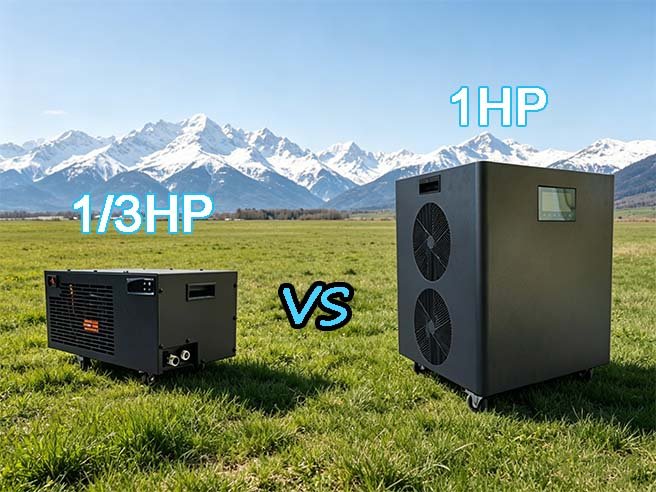
Shopping for an ice bath chiller sounds simple at first. Then you see specs like 1/3HP, 1/2HP, 1HP, cooling rate, ambient temperature, gallons, flow rate—and suddenly it feels like you’re reading the side of an industrial machine instead of buying recovery gear.
Here’s the thing: horsepower matters, but not in the way many buyers think.
A bigger HP number does not mean you automatically need the larger machine. And a smaller HP model is not always “too weak.” What matters is how the chiller performs in your setup: your tub size, your climate, your target water temperature, and how often people use it. That’s the real story.
Simply put, for a refrigeration system, horsepower refers to the input power of the compressor, which indicates its cooling capacity. The input power of 1 horsepower is approximately between 735 and 746 watts. However, the actual power consumption and cooling performance of a chiller do not depend solely on input power, but on the entire refrigeration system. Take the Chillmend ice bath chiller as an example. Some 1/3 HP chillers are rated at approximately 850 BTU/h with a power consumption of around 250 watts, while 1 HP units are rated at about 3,820 BTU/h with a power consumption of roughly 735 watts. Therefore, even if you use an ice bath tub of the same water capacity, different models of ice bath chillers will perform differently.
So, if you’re comparing 1/3HP vs 1HP, this guide will help you make the call without guesswork, without marketing fluff, and without buying a machine that leaves you annoyed three weeks later.
What does “HP” actually mean on an ice bath chiller?
Let me explain.
HP, input power, output power, EER, cooling capacity, and the relationships between them.
HP: Short for horsepower, a unit describing the mechanical power of the ice bath chiller’s compressor, measuring its work capacity. Input power: The electrical power supplied to the compressor by the power source. Output power: The actual mechanical power output from the compressor shaft, equal to input power minus losses (efficiency η), usually lower than input power. EER: Energy Efficiency Ratio under normal temperature conditions (commonly used for ice bath chillers). Cooling capacity: The total heat removed from the water per unit time, the core indicator measuring the cooling performance of the ice bath chiller.
The compressor is the core component of the chiller. It compresses the refrigerant to achieve heat exchange with water. Smart buyers never choose a chiller based solely on HP. A 1/3 HP model does not mean its cooling capacity is only one-third of a 1 HP unit.
Avoiding pitfalls: Higher HP ≠ higher cooling capacity — always consider the Energy Efficiency Ratio. Prioritize models labeled with cooling capacity (W/kW), as it is more direct and reliable.
Selection formula: First use cooling capacity to determine performance, then HP to assess power consumption, and finally EER to evaluate energy efficiency.
Still, horsepower gives you a useful starting point:
- 1/3HP usually fits lighter-duty home use
- 1.0HP usually fits faster cooling, stronger recovery, hotter environments, and heavier usage
That’s the broad outline. The details are where the real buying decision happens.
Why 1/3HP and 1HP feel so different in real life
In theory, both chillers can cool water. But in practical use, they feel like completely different types of machines.
A 1/3 HP chiller typically meets personal household needs, such as occasional use or daily use by one person. It is a stable and economical choice, much like a practical Japanese car that works well for daily commuting.
A 1 HP chiller feels more like a public bus — built to carry more users and handle heavy-duty operation. It usually cools faster and offers smarter functions. 1HP models are mostly chosen by commercial facilities such as fitness centers, high-end rehabilitation clinics, and hotels, as well as professionals with dedicated space who want fast, consistent cold therapy.
They are often promoted for stronger cooling capacity and greater durability, which is why many buyers select this model.
That’s why the wrong-size purchase usually hurts in one of two ways:
A buyer picks too small, saves money upfront, then spends months frustrated because the water takes too long to cool or won’t hold low temperatures during summer.
Or the buyer picks too large, pays more than necessary, uses more space, and ends up with a setup that is overbuilt for a simple personal routine.
Neither feels great. The goal is balance.
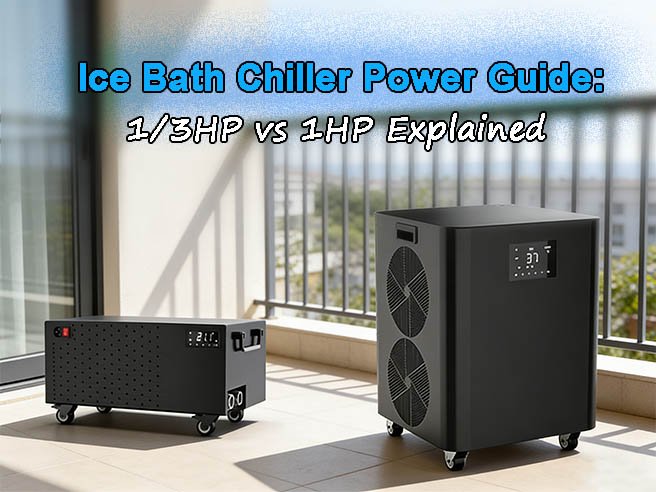
The four things that really decide whether you need 1/3HP or 1HP
A lot of people ask, “Which is better?” Honestly, that’s the wrong question.
The better question is, “Which one fits my use case?”
1. Tub volume matters more than most buyers expect
The more water there is, the more heat the chiller needs to remove. While this may sound obvious, many people wonder how to choose the right chiller based on water volume — this is a common question.
According to tests by CHILLMEND engineers, a 1/3 HP unit is suitable for personal cold therapy if your tub holds between 150L and 300L. For larger ice baths ranging from 250L to 500L, or for two-person use, a 1 HP or higher model is recommended.
But does this mean you have to follow this standard strictly? Not necessarily. Even if you have a small tub for single use, you can still choose a 1 HP model if you want faster cooling — especially if you value efficiency and time-saving, right?
As tested by our engineers, the CHILLMEND 1 HP smart model can cool 300L of water from 25°C down to 3°C in just 4–5 hours under 25°C ambient conditions. It fully meets the needs of efficiency-focused users.
2. Climate changes everything
This is the one people underestimate the most.
A 1/3HP unit in a cool garage in a mild climate may perform beautifully. That same unit on a patio in a hot, humid region can struggle. Ambient temperature is not background noise. It is an active load on the system.
And the heat source isn’t only the air. It’s also warm plumbing lines, warm tub walls, warm fill water, and direct sun. Every one of those adds resistance. So when someone says, “My friend’s 1/3HP chiller works fine,” the missing question is: where is that tub located?
The IOC consensus statement on cooling strategies notes that ice bath temperatures for effective cooling commonly fall in the 5°C to 15°C range. Reaching and holding that kind of cold becomes much more demanding when outdoor conditions are hot. That is exactly where stronger chillers separate themselves from lighter-duty models.
So yes, climate matters—a lot. A hot environment can turn a “good enough” chiller into a daily compromise.
3. Your target temperature changes the recommendation
Everyone has vastly different needs and tolerance levels for cold water baths. Some find 10–15°C comfortable enough, while others pursue an extreme cold therapy experience and insist on temperatures as low as 0°C, demanding consistent performance every single day with no compromises.
These two sets of requirements place completely different demands on a cooling system. The lower the water temperature you want, the harder the chiller must work continuously at a higher load — energy consumption and operating pressure do not increase linearly.
It is easy to cool water from room temperature to a refreshing coolness, but pushing it further from low temperatures to near-freezing, while maintaining a stable set temperature all day long, will push ordinary machines to their limits. They may struggle with temperature fluctuations, slow cooling, accelerated wear from prolonged high-load operation, and other issues.
It has long been clear in the industry that the actual minimum water temperature a unit can achieve is affected by multiple factors, including water volume, initial water temperature, and ambient temperature. In other words, the rated temperature on the specification sheet does not equal stable, real-world performance in your actual usage scenario.
When choosing an ice bath chiller, the key factor is not how cold it can get in theory, but whether it can reach and maintain your target low temperature stably, continuously, and reliably in your specific environment.
So if your goal is simply “refreshingly cold,” 1/3HP may be enough in the right setup. If your goal is “consistently very cold, even when conditions are not ideal,” 1HP is usually the safer call.
4. Usage frequency is the silent deal-breaker
Many consumers tend to overlook a crucial factor when purchasing: the actual operating load of an ice bath chiller varies significantly depending on usage scenarios. The stress placed on the cooling system for personal use alone is completely different from that of multi-person household use, team rehabilitation, or high-frequency use in therapy clinics and gyms.
When a person enters the bath, heat is continuously transferred into the water. Opening the lid for ventilation also introduces ambient heat. For consecutive users, the cooling system must quickly restore and stabilize the water temperature in a shorter period.
Under such conditions of frequent heat input and rapid cooling demands, a 1 HP cooling system is no longer a premium option — it becomes a basic requirement to ensure consistent performance.
For multi-person rotating use or performance close to commercial standards, a 1/3 HP model is often insufficient to sustain continuous operation. This is not a product defect; it is simply designed for light residential use and cannot meet the continuous operation standards of small commercial applications.
Higher-power chillers provide greater performance redundancy, which is especially critical in real-world complex environments. This redundancy ensures the unit maintains precise and stable temperature control even under varying loads.
When 1/3HP is the right choice
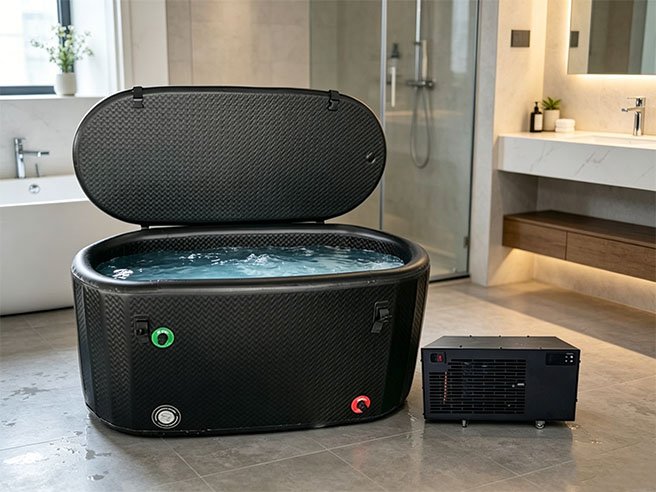
One fact rarely mentioned in most marketing materials is that small-capacity chillers can actually be more practical when used in the right scenarios. A 1/3 HP chiller is more than sufficient if your ice bath unit is mainly for personal daily use, with consistent usage frequency and a mild, controlled environment.
This is especially true for compact tub setups, where there is no need to handle extreme high temperatures, rapid continuous cooling, or frequent multi-person rotation. Additionally, it is ideal for users looking to manage upfront investment and daily energy expenses, without paying for excess performance that will likely never be utilized.
For these lightweight, low-load applications, the 1/3 HP model represents an optimal balance between efficiency and cost-effectiveness. With a typical input power rating of 250–400 watts, it delivers reliable cooling performance while keeping operating costs manageable, making it a popular choice among household users who prioritize value for money.
A good 1/3HP buyer often sounds like this:
“I want reliable cold water at home. I’m patient. I’m not trying to run a recovery business. I just want it to work.”
That is a perfectly fair goal.
And honestly, there’s something nice about buying the equipment that matches your actual needs instead of chasing the biggest spec sheet in the room. Bigger is not always smarter.
When 1HP is the better investment
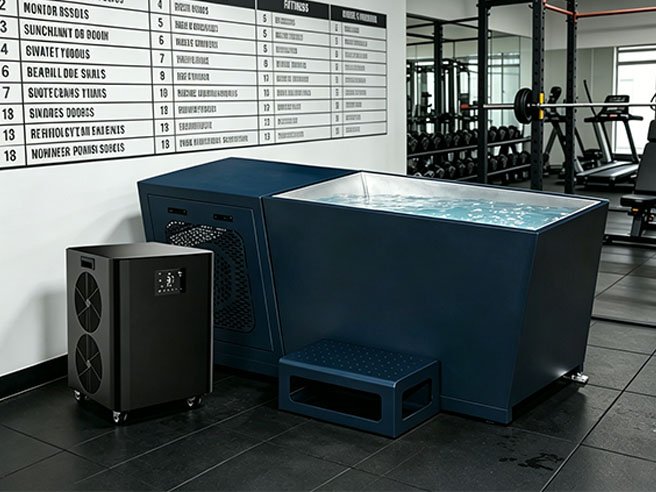
If you prioritize consistent, stable performance of your ice bath system in demanding environments, a 1 HP chiller is the more reliable choice.
Whether paired with a larger tub, used in hot climates, installed outdoors, for multi-person rotation, to achieve lower target temperatures, or to quickly re-cool water after it has risen and reduce waiting time — higher-power equipment delivers a far more dependable experience.
In terms of actual cooling performance:
- 1 HP models typically offer 7,500–9,000 BTU/h cooling capacity, with input power of 900W–1,100W.
- By comparison, some 1/3 HP models only provide around 2,500–3,000 BTU/h, at 250W–400W.
This gap means more than just “stronger power.” It directly translates to faster water temperature recovery, more stable low-temperature retention, and superior adaptability in harsh conditions such as high ambient temperatures and heavy-duty use.
This is also the category many serious users prefer because it leaves less to chance. And you know what? That peace of mind matters. Nobody buys a cold plunge chiller because they want a machine that is “almost fine” during the hottest week of the year.
A 1HP unit is often the better call if you want your system to feel calm, not strained.
Electricity cost: is 1HP always much more expensive to run?
Not always in the way people assume.
Yes, larger chillers usually have higher power draw. But operating cost is not just about the peak number on the spec sheet. It’s also about run time, cooling efficiency, ambient load, insulation quality, and how hard the system has to work to stay on target.
A smaller chiller can save energy if it is correctly matched to the setup. But if it is undersized and must run constantly while still struggling to hit temperature, the savings may not look so impressive anymore. Meanwhile, a stronger unit may cool faster and cycle more effectively because it has enough headroom for the job.
So the real question is not, “Which one has the lower number?” It’s, “Which one is properly sized?”
That’s a bit like air conditioning in a house. A unit that is too small might look cheaper on paper, yet become the more annoying and sometimes less efficient choice in daily use.
The most common mistake buyers make
The biggest mistake is buying based on headline horsepower alone.
The second biggest mistake is buying based on price alone.
People see 1/3HP and think, “That’s probably enough.” Sometimes it is. Sometimes it isn’t even close. The trouble is that most buyers decide before they’ve thought through tub volume, local weather, installation location, usage frequency, and target temperature.
Another mistake? Planning for your “average” day instead of your “stress” day.
Your chiller doesn’t prove itself on a mild spring morning. It proves itself when the weather is hot, the water started warm, two people used the tub already, and you still expect a cold plunge right now. That’s the test that tells you whether you sized correctly.
So, which should you choose?
Here’s the practical answer.
Choose 1/3HP if you want a home setup for light-to-moderate use, your tub is relatively compact, your environment is mild or controlled, and you don’t need ultra-fast cooling or hard low-temperature performance.
Choose 1HP if you want more cooling muscle, faster recovery, better performance in hot weather, support for heavier use, or a stronger chance of holding lower temperatures with less compromise.
If you are right on the line between the two, many buyers are happier sizing slightly up rather than slightly down. Not always—but often. Why? Because a bit of extra capacity usually feels like confidence, while too little capacity feels like regret.
And regret is expensive.
For more context on setup and safe temperature planning, you can connect this topic with 《What Is an Ice Bath Chiller?》, 《Ice Bath Temperature Guide: What’s Safe and Effective?》, and 《How to Set Up an Ice Bath at Home》.
FAQ: Is 1/3HP enough for a home ice bath?
For many home users, yes. A 1/3HP ice bath chiller can be enough when the tub is small to medium, usage is limited, and the setup is indoors or in a moderate climate. If you only plunge once or twice a day and don’t need very aggressive cooling speed, a 1/3HP home ice bath chiller may be a practical fit.
FAQ: Is a 1HP ice bath chiller better for hot climates?
A 1 HP ice bath chiller usually performs much better in hot environments, thanks to its higher cooling efficiency and greater performance redundancy, which effectively offset the impact of external heat.If your tub is placed outdoors, constantly exposed to high summer temperatures, or used frequently, choosing a 1 HP chiller will generally provide a more stable and reliable experience.
FAQ: Does higher horsepower mean colder water?
That’s not absolutely the case. Higher horsepower does allow the chiller to reach the target low temperature faster and maintain it more steadily under heavy use. However, the minimum achievable water temperature of an ice bath is jointly affected by multiple factors, including the tub’s insulation performance, total water volume, ventilation, ambient temperature, and overall system design. So while horsepower is an important factor in improving performance, it is not the only condition that determines the lowest temperature an ice bath can reach.
FAQ: What is the difference between 1/3HP and 1HP cooling performance?
The core difference between the two lies in cooling efficiency and water temperature recovery speed. Based on common industry specifications, 1/3 HP models have a cooling capacity of 2,500–3,000 BTU/h, while 1 HP models can reach 7,500–9,000 BTU/h. Accordingly, higher-power units also consume more electricity. Put simply, a 1 HP ice bath chiller performs more smoothly and stably when handling large‑volume tubs, high-temperature environments, and high-frequency usage scenarios.
FAQ: Should I buy a larger ice bath chiller than I need?
Not always, but slightly oversizing can be safer than undersizing if your climate is hot or your usage may grow. The right answer depends on your tub size, target temperature, and daily routine. If you expect heavier use later, choosing a slightly larger cold plunge chiller can help you avoid performance frustration and replacement costs down the road.
If you’re still unsure whether a 1/3HP or 1HP ice bath chiller is right for your setup, contact CHILLMEND. We can help you match the chiller to your tub size, climate, and usage plan, so you get a system that feels right in real life—not just on a spec sheet.