
Choosing an ice bath chiller sounds simple until you actually try to do it. Then the questions pile up fast. Is 1/3HP enough? Do you need 1HP? What happens if your tub is outdoors in summer? And why does one setup cool beautifully while another feels like it’s always catching up?
Here’s the thing: the right size is not just about tub volume. It’s about water volume, ambient temperature, insulation, target temperature, refill habits, and how often you use it. A small chiller can work great in one setup and feel painfully slow in another.
So this guide will help you figure it out in a practical way. No fluff, no spec-sheet theater. Just a clear sizing method, a simple calculator logic, and real-world advice that makes sense for home users, athletes, gyms, and recovery studios.
A quick outline before we get into the cold stuff
We’ll cover:
- what “size” really means for an ice bath chiller
- the simple calculator formula you can use
- how tub size changes the answer
- why climate and insulation matter more than many people expect
- common sizing mistakes
- a practical size chart you can actually use
- FAQs at the end
And yes, we’ll also talk about the annoying truth: sometimes the “technically correct” size on paper is still the wrong choice in real life.
First off, what does chiller size actually mean?
When people ask about the specifications of a cold plunge chiller, they usually refer to its cooling capacity, commonly expressed in horsepower (HP). Typical models include 1/3 HP, 1/2 HP, 1 HP, 1.5 HP, and 2 HP.
However, horsepower alone does not tell the whole story. A chiller essentially works against heat gain. Water absorbs heat from the surrounding air, the walls of the tub, sunlight, and the human body. Moreover, water has significant mass — a great deal of it. One US gallon of water weighs about 8.34 pounds, or roughly 3.785 liters. This is why even a moderately sized cold plunge tub holds a very large thermal mass.
Therefore, when choosing a chiller size, what you are actually evaluating is: how much heat does the unit need to remove, and how quickly does it need to cool the water down?
The second point is critical. Some people are willing to wait several hours for the tub to reach the desired temperature, while others prefer the water to stay consistently at the set temperature with minimal fluctuation throughout the day. For the same tub, different requirements will call for vastly different chiller specifications.
The simple ice bath chiller calculator
Let me give you the practical version first.
Step 1: Start with your actual water volume
Do not size by the outside tub dimensions alone. Size by the actual filled water volume.
Use either:
Water volume in gallons or Water volume in liters
If you only know the rough tub size, estimate the filled amount, not the full shell capacity. Most people don’t fill a plunge tub to the rim.
Step 2: Look at your temperature drop
Use this:
Temperature drop = ambient water or starting water temperature – target water temperature
For example:
- Starting water: 75°F
- Target water: 50°F
- Temperature drop: 25°F
If you use Celsius:
- Starting water: 24°C
- Target water: 10°C
- Temperature drop: 14°C
For many users, a beginner-friendly cold plunge range is around 50 to 59°F (10 to 15°C), while more experienced users sometimes go colder. Cleveland Clinic describes that same general range as a common starting point for beginners.
Step 3: Add your real-world usage factors
Now ask:
- Is the tub indoors or outdoors?
- Is it in direct sun?
- Does it have a good insulated cover?
- Is the climate mild, warm, or very hot?
- Will multiple users use it back-to-back?
- Do you need fast pull-down time, or is overnight cooling fine?
This is where a lot of buying mistakes happen. People treat chillers like the water just sits in a lab somewhere at perfect room temperature. It doesn’t. Real setups leak heat constantly.
Step 4: Use this simple sizing rule
Here’s a practical guide for most plunge setups:
- Up to 80 gallons (300L): 1/3HP may work well in mild conditions
- 80–120 gallons (300–450L): 1/2HP to 1.0HP is usually safer
- 120–160 gallons (450–600L): 1.0HP to 1.5HP is often the sweet spot
- 160–250 gallons (600–950L): 1.0HP or more is usually the better call
- 250+ gallons (950L+): 1.5HP and above may be needed, especially for commercial or hot-climate use
That’s the quick version. But don’t stop there, because climate can shift your answer by a full size category.
Why water volume matters so much
Water is stubborn. That’s the polite way to put it.
Because water has high thermal mass, larger volumes simply take more energy to cool. Even when the water is already cold, the chiller still has to keep removing heat that creeps back in from the environment. And since water is dense — roughly 1 gram per milliliter, or about 1 kilogram per liter in practical terms — the numbers add up fast.
A small personal plunge might hold 80 gallons. A larger commercial tub might hold 200 gallons or more. That’s not just “a bit more water.” That’s a whole different workload.
You know what? This is why some buyers feel disappointed with a small chiller. The machine is not broken. It’s just been asked to do a big job in a harsh setting.
The real calculator logic, without making your head hurt
If you want a more thoughtful estimate, use this framework:
Chiller size depends on five things:
- Tub water volume
- Target temperature
- Ambient temperature
- Insulation quality
- Usage frequency
A rough way to think about it:
- Bigger tub = bigger chiller
- Hotter room or hotter outdoor weather = bigger chiller
- Worse insulation = bigger chiller
- More frequent use = bigger chiller
- Faster cooldown expectations = bigger chiller
So yes, there’s a pattern here. When conditions get harder, the safe answer usually shifts upward.
A practical size chart by tub type
Small personal tub: 60–90 gallons
This is common for single-user home setups.
If the tub is indoors, covered, and used once a day, a 1/3HP chiller can often be enough. It’s the budget-friendly choice and works best when the environment is not fighting you.
But if that same tub sits in a garage in summer or outdoors on a patio, 1/2HP or higher is usually the smarter move. Otherwise, cooldown may feel slow and temperature stability may be frustrating.
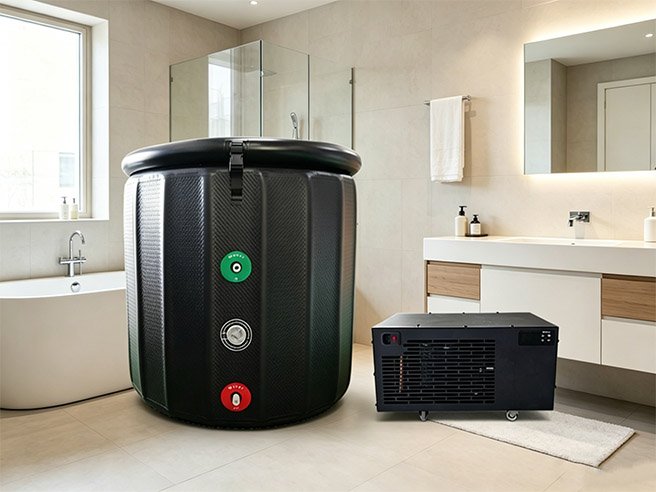
Medium plunge tub: 90–150 gallons
This is where many home cold plunge buyers land.
A 1/2HP to 1.0HP chiller is often a solid fit, especially if you want good daily consistency. If the climate is warm, the tub is outside, or you want colder water without long waiting times, moving to 1.5HP is often worth it.
Honestly, this is the range where undersizing becomes very common. People see the lower price of a smaller unit and think, “That should probably do it.” Sometimes it does. Sometimes it becomes an everyday annoyance.
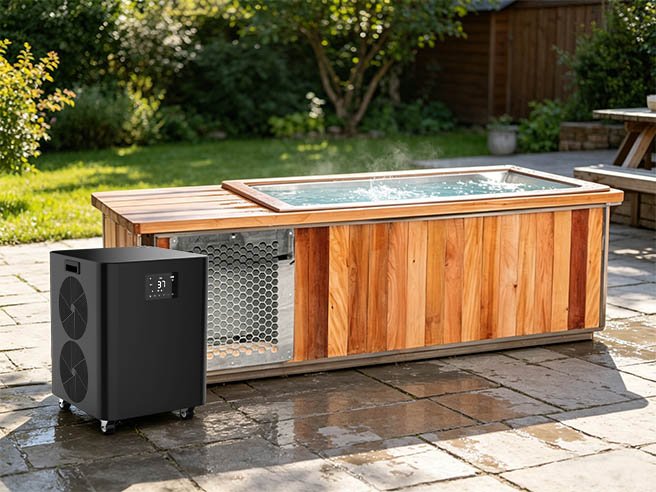
Larger tub: 150–250 gallons
Now you’re in territory where 1HP usually makes more sense. For hot climates, heavy daily use, or shared use, 1.5HP may be the better long-term fit.
This is especially true for:
- sports teams
- physical therapy or recovery spaces
- homes with multiple users
- setups where the tub needs to stay ready all day
Commercial and high-turnover setups
If users rotate through all day, the chiller is not just cooling standing water. It is also recovering from repeated body-heat input and lid openings. That means sizing needs to be more conservative — or rather, more realistic.
For those situations, 1HP, 1.5HP, or beyond is often the right lane, depending on total volume and climate.
But wait — what target temperature should you size for?
Good question, because the colder you want to go, the harder the chiller has to work.
A lot of users aim for 50–59°F (10–15°C), especially when starting out. More experienced users sometimes go down to the 37.4–50°F (3–10°C) range, which Cleveland Clinic notes is often used by people with more cold exposure experience.
So if your goal is:
- 55°F / 13°C, your cooling load is moderate
- 50°F / 10°C, the load gets heavier
- 39–45°F / 4–7°C, now your system needs to be more capable and more stable
That doesn’t mean everyone needs a huge chiller. It means lower target temperatures reduce your room for error.
The climate factor people tend to underestimate
This one matters a lot.
Indoor, climate-controlled room
This is the easiest environment. The chiller is not battling direct sun, hot air, or major day-to-night swings. A smaller unit can often perform well here.
Garage or semi-conditioned space
Now things get less predictable. A garage can swing hot in summer and cool in winter. If the summer highs climb, your chiller will feel that.
Outdoor setup
Outdoor tubs are tougher. Sunlight, hot ambient air, warm surfaces, wind, and frequent lid opening all add heat. In a warm region, outdoor setups often need one size larger than a similar indoor setup.
That’s not sales talk. That’s just heat load.
Insulation and covers — boring topic, huge effect
Not glamorous, but incredibly important.
A good insulated cover can make a noticeable difference in how hard the chiller has to work. It helps reduce heat gain, limits evaporation, and keeps the temperature more stable between sessions.
A poorly insulated tub, or a tub left uncovered, makes the machine do extra work every day. That can mean:
- slower cooldown
- more compressor run time
- higher power use
- more temperature drift
So yes, chiller size matters. But the tub and cover matter too. A lot.
How fast do you want it to cool?
This is where two buyers with the same tub can need different answers.
Scenario A: Slow and steady is fine
You fill the tub, leave it overnight, and use it the next morning. No rush.
A smaller chiller may work.
Scenario B: You want quick pull-down
You refill the tub or warm water sneaks in, and you want the system back at target temperature quickly.
That usually points toward a larger chiller.
And this is the contradiction I mentioned earlier: a smaller chiller may be “enough” on paper, yet still feel like the wrong choice in everyday use because your patience runs out before the machine catches up.
Simple calculator examples
Let’s make this real.
Example 1: Home user, small indoor tub
- Tub volume: 80 gallons
- Indoor use
- Good cover
- Target temp: 52°F
- Light daily use
Likely fit: 1/3HP
Better comfort pick: 1/2HP if you want quicker cooling or colder temperatures
Example 2: Home user, medium outdoor tub
- Tub volume: 120 gallons
- Outdoor patio
- Warm climate
- Target temp: 50°F
- Daily use
Likely fit: 1.0HP
A 1/3HP or even 1/2HP unit may struggle here, especially in hotter months.
Example 3: Recovery studio
- Tub volume: 180 gallons
- Indoor but frequent lid opening
- Multiple users
- Target temp: 48°F
- High turnover
Likely fit: 1HP minimum, often 1.5HP is more comfortable
Example 4: Athlete using a garage setup
- Tub volume: 100 gallons
- Garage use
- Summer gets hot
- Target temp: 50°F
- Wants reliable daily use
Likely fit: 1/2HP to 1.0HP
Safer long-term pick: 1.0HP
Common sizing mistakes that cause regret
Buying only by price
Cheap upfront can become expensive in frustration. A too-small unit may run longer, recover slower, and still fail to hold your preferred temperature in warm conditions.
Ignoring actual climate
A chiller that works beautifully in a cool indoor room might feel underpowered outdoors in July. Same machine, same tub, totally different result.
Using tub shell size instead of filled water volume
This one happens all the time. The listed tub capacity may not match real operating volume.
Not thinking about future use
Maybe it’s just you today. But what about later?
- a partner starts using it
- your training frequency increases
- you move the tub outdoors
- you want colder water than you do now
A little extra capacity can save you from upgrading too soon.
Is oversizing bad?
Not usually — within reason.
A slightly larger chiller can be a smart move when:
- your climate is hot
- your tub is outdoors
- you want colder water
- you may expand usage later
- you care about quicker cooldown
The only caution is that going way beyond what you need can mean spending more than necessary. So the goal is not “buy the biggest.” The goal is buy the right buffer.
In plain English: being slightly above your minimum is often safer than being right on the edge.
What about energy use?
People often assume the smallest chiller always saves the most power. Not necessarily.
A smaller unit may run longer and work harder in a demanding setup. A more appropriately sized unit may reach target temperature faster and maintain it more efficiently. Actual power use depends on run time, insulation, ambient heat, target temperature, and system design — not just HP alone.
So don’t look at horsepower in isolation. Look at the whole setup.
Safety matters too, not just performance
Cold plunge discussions sometimes get carried away with “colder is better.” That’s not the whole story.
Cleveland Clinic notes that 50–59°F (10–15°C) is a common starting range for beginners, and more experienced users sometimes use colder water. The same source also notes starting with shorter sessions and building tolerance gradually.
There are also real risks with sudden cold exposure. The American Heart Association explains that plunging into cold water can trigger a cold shock response with a rapid increase in breathing, heart rate, and blood pressure. Mayo Clinic makes a similar point and notes that this can be risky for people susceptible to cardiac events.
So while sizing your chiller, it’s worth sizing your expectations too. You do not need an ultra-cold setup just because social media made it look hardcore.
The easiest way to choose your chiller size
Here’s the practical shortcut.
Choose 1/3HP if:
- your tub is small
- your setup is indoors
- your room stays fairly cool
- you use a good cover
- you’re fine with slower cooldown
Choose 1/2HP to 1.0HP if:
- your tub is medium-sized
- you want steadier daily performance
- your setup is in a garage or mildly warm environment
- you want less waiting and less guesswork
Choose 1HP if:
- your tub is larger
- your target temperature is colder
- your climate is warm
- your tub is outdoors
- more than one person uses it regularly
Choose 1.5HP or higher if:
- your tub is large
- usage is frequent or commercial
- your climate is hot
- fast recovery and strong temperature stability matter
The no-nonsense rule of thumb
If your setup is right on the edge between two chiller sizes, the safer answer is often the larger one.
Not always. But often.
Especially if you live somewhere warm, keep the tub outdoors, or expect your usage to grow.
That’s the part people learn after the purchase, when the machine technically works but never quite feels effortless.
Final thought
Picking the right ice bath chiller size is really about matching the machine to real life — not just a neat number on a product page. Start with actual water volume, be honest about your climate and insulation, then factor in how cold you want the water and how quickly you want it ready. Do that, and the answer gets much clearer.
If you’re still unsure what size fits your setup, contact CHILLMEND. We can help you match the right chiller to your tub size, target temperature, climate, and usage plan, so you get a system that works smoothly in real conditions — not just in theory.
FAQ: What Size Ice Bath Chiller Do You Need?
How do I calculate the right ice bath chiller size for my tub?
Start with your actual filled water volume, not just the tub’s advertised shell capacity. Then look at your starting water temperature, target temperature, climate, insulation, and usage frequency. Small indoor tubs may work with 1/3HP, while medium or outdoor tubs often need 1/2HP or 1HP for more reliable cooling.
Is a 1/3HP ice bath chiller enough for home use?
A 1/3HP ice bath chiller for home use can be enough if your tub is small, your setup is indoors, and you use a cover with decent insulation. It may feel underpowered, though, if the tub is outdoors, the climate is hot, or you want faster cooldown to lower cold plunge temperatures.
Should I size up my cold plunge chiller if the tub is outdoors?
Yes, in many cases you should. An outdoor cold plunge chiller size guide usually points buyers one step higher than an indoor setup because sunlight, hot air, and lid opening all add heat. Outdoor tubs in warm climates often need more capacity to hold temperature consistently.
What size chiller is best for a 100 to 150 gallon ice bath?
For a 100 to 150 gallon ice bath chiller, the practical sweet spot is often 1/2HP to 1HP, depending on your climate and target temperature. If the tub is indoors in a controlled room, the lower end may work. If it’s outside or used often, moving up is usually the safer choice.
Is it better to oversize or undersize an ice bath chiller?
For most buyers, slightly oversizing an ice bath chiller is safer than undersizing. A unit with a little extra capacity usually gives better cooldown speed and steadier temperature control, especially in hot weather or higher-use setups. Going massively oversized is unnecessary, but buying too small is the mistake that tends to sting later.