
Quick Outline (So You Know What You’re Getting)
- What “cooling speed” really means (and why marketing numbers confuse people)
- Real-world test data (°C per hour, time to target temp)
- Small tub vs large tub timelines
- What actually affects speed (more than you think)
- Ways to make your chiller feel twice as fast
- Common myths (and a couple of uncomfortable truths)
- FAQs for buyers & athletes
- Final takeaway + what to do next
So… How Fast Is “Fast,” Really?
Let’s be honest—when people ask “how fast can an ice bath chiller cool water?”, what they really mean is:
“How long until I can actually get in without suffering through lukewarm disappointment?”
Fair question.
But here’s the thing: cooling speed isn’t a single number. It’s a moving target shaped by water volume, starting temperature, and your chiller’s horsepower.
Still, we can pin down real-world benchmarks—and they’re surprisingly consistent across tests.
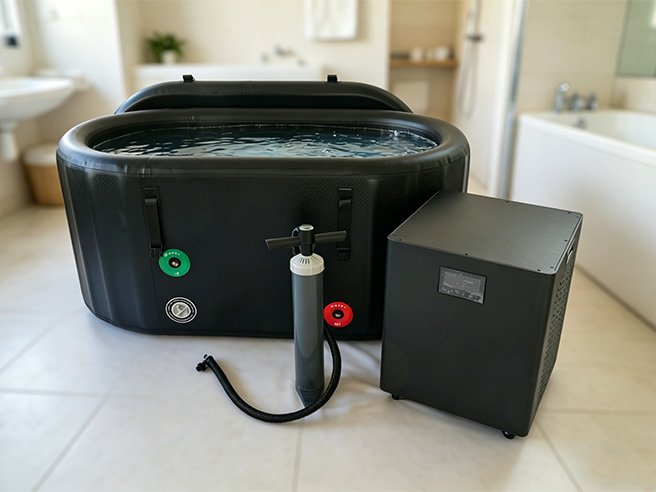
CHILLMEND Chiller (Model: IB-Pro C10) Real Test Results (What Actually Happens)
Let’s start with measured performance, not theory.
A real-world test of a CHILLMEND modern cold plunge chiller showed:
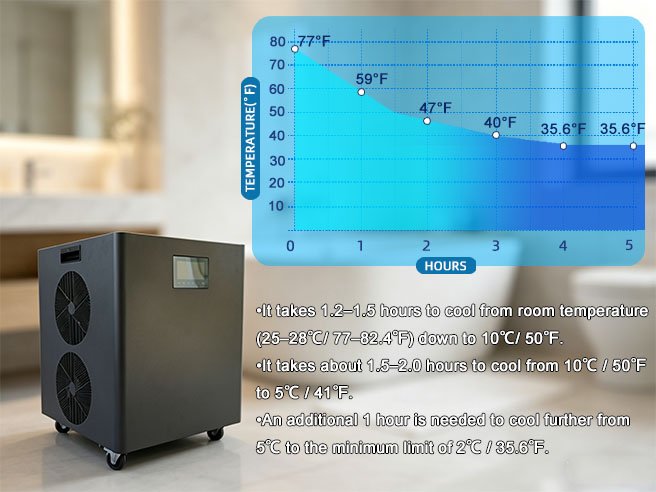
The cooling rate presents an S-shaped curve.
Taking a standard plunge tub filled with 300L (79 gal) of water as an example:
- It takes 1.2–1.5 hours to cool from room temperature (25–28℃/ 77–82.4℉) down to 10℃/ 50℉.
- It takes about 1.5–2.0 hours to cool from 10℃ / 50℉ to 5℃ / 41℉.
- An additional 1 hour is needed to cool further from 5℃ to the minimum limit of 2℃ / 35.6℉.
Power consumption: Only 1 kWh per hour.
That’s not lab fantasy—that’s practical, repeatable data.
What does that mean in plain English?
If you fill your tub with tap water at ~25°C (77°F), you’re looking at:
- 1.5 hours to reach “cold plunge ready”
- 3–4 hours to get near ice-level temps (depending on your setup)
And yes… that’s with a decent chiller (around 1HP class).
Small Tub vs Big Tub — The Cooling Gap
Now let’s zoom out a bit.
Small tubs (50–100 gallons / 189.27 ~ 378.54 L)
- 15–30 minutes to noticeably chill
- Around 1–2 hours to reach usable cold temps
Large tubs (200+ gallons / 757.08+ L)
- 45 minutes to 1.5 hours just to drop significantly
- Full cooling can take longer depending on power
he reality check
More water = more heat energy = slower cooling.
It’s not linear either. Double the water doesn’t just double time—it often feels slower because your chiller works harder to maintain efficiency.
The “Overnight Cooling” Myth (Let Me Explain)
You’ll sometimes hear:
“It takes 6–12 hours to cool a tub.”
That’s not wrong—but it’s misleading.
That number usually refers to:
- Starting from warm water (~25°C)
- Cooling all the way to near-freezing (~2°C)
- With average insulation
For example:
- A 1HP chiller might take 3–4 hours for full-range cooling (Based on actual measured data from the CHILLMEND laboratory)
- In extreme cases, even 6–12 hours depending on conditions
But here’s the nuance:
You don’t need freezing temps for effective recovery.
Most people use 10–15°C (50–59°F) anyway.
So in practice, your usable wait time is much shorter.
What Actually Controls Cooling Speed (It’s Not Just HP)
Let’s break it down like a coach would explain it in the gym.
1. Starting Water Temperature
Warm tap water = longer cooling.
Drop your starting temp by just 5°C, and you can shave off 30–60 minutes easily.
2. Chiller Power (HP)
This one’s obvious—but often misunderstood.
- 0.3–0.5 HP → slow, often hours
- 1 HP → solid balance
- Commercial units → fast but expensive
More power = faster heat removal. Simple physics.
3. Water Volume
This is the silent killer of performance.
A chiller that feels “fast” in a 60-gallon tub can feel sluggish in a 150-gallon setup.
4. Insulation (Underrated but Critical)
Honestly? This might matter more than horsepower.
Poor insulation = constant heat leaking back in.
Good insulation = faster cooling and better temp stability.
5. Ambient Temperature
Cooling in a hot garage vs a cool basement?
Big difference.
Heat is always trying to creep back into your tub.
Want Faster Cooling? Do This (Seriously)
Here’s where things get practical.
1. Pre-chill your water
Even dropping from 25°C → 20°C before turning on the chiller saves time.
2. Add ice strategically
Not cheating—just smart.
- 20–40 lbs for small tubs
- Boosts early cooling dramatically
3. Upgrade insulation
Tub cover, insulated walls, even shaded placement.
This alone can cut cooling time and energy use.
4. Keep water circulating properly
Flow rate matters.
Too slow = inefficient heat exchange
Too fast = water doesn’t cool enough per pass
Balance is key.
A Slight Contradiction (And Why It Matters)
Here’s something that surprises people:
Faster isn’t always better.
Yeah, really.
Ultra-fast cooling:
- Uses more energy
- Puts more strain on the compressor
- Can reduce lifespan if poorly designed
A well-balanced system that cools steadily is often better long-term.
So… What Should You Expect?
Let’s simplify everything into a realistic expectation:
Typical Home Setup (1HP, ~100–250L tub)
- Noticeable cooling: 15–30 minutes
- Cold plunge ready (~10–15°C): 1–1.5 hours
- Near freezing: 4–10+ hours
That’s the honest, no-marketing version.
Final Thoughts — Speed vs Experience
You know what?
Most people obsess over cooling speed at the beginning. Makes sense.
But after a few weeks, what they actually care about is:
- Consistency
- Convenience
- Reliability
Because the real win isn’t how fast your water cools once…
It’s whether it’s ready every time you need it.
FAQs (Real Questions People Ask)
1. How long does an ice bath chiller take to cool water from room temperature?
For most setups, expect 1–3 hours to reach cold plunge temperature (10–15°C) and longer for near-freezing levels, depending on chiller power and water volume.
2. What is the cooling rate of a 1HP ice bath chiller?
Real-world tests show around 6–7°C per hour, though this varies with insulation, ambient temperature, and water volume.
3. Can an ice bath chiller cool water instantly?
No. Even high-end systems require time because they remove heat gradually. However, adding ice can create a faster initial drop.
4. Why is my ice bath chiller cooling so slowly?
Common reasons include:
- Undersized chiller
- Poor insulation
- High ambient temperature
- Too much water volume
5. What’s the fastest way to cool an ice bath at home?
Use a combination of:
- Pre-chilled water
- Proper insulation
- Adequate chiller size
- Optional ice for initial boost
Ready to Upgrade Your Recovery Game?
If you’re tired of waiting around for your water to cool—or worse, dealing with inconsistent temperatures—it might be time to rethink your setup.
At CHILLMEND, we design ice bath chillers that balance cooling speed, efficiency, and long-term reliability—not just flashy specs.
Want a system that’s ready when you are?
Reach out to CHILLMEND today and build a cold plunge setup that actually keeps up with your routine.