
Article Summary
The best cold plunge setup for sports teams is not simply a large tub filled with cold water. It is a complete recovery system built around athlete volume, training schedules, water temperature, cooling speed, sanitation, safety, and daily operating demands.
For most organized sports teams, a practical setup includes an insulated commercial cold plunge tub, a 1 HP to 2 HP ice bath chiller, continuous water circulation, reliable filtration, sanitation equipment, easy-access plumbing, and a clear athlete-use protocol.
Smaller teams may operate well with one 1 HP system. College programs, professional clubs, and busy training centers often need a 1.5 HP or 2 HP commercial chiller—or several separate plunge stations—to prevent queues and maintain stable water temperature.
This guide explains how coaches, athletic trainers, facility managers, and sports equipment buyers can build a cold plunge recovery station that works during real training conditions, not just during a showroom demonstration.
Article Outline
- Why do sports teams need a different cold plunge setup
- What a complete team recovery system should include
- How to calculate athlete capacity
- Choosing between 1 HP, 1.5 HP, and 2 HP chillers
- Selecting the right cold plunge tub
- Managing temperature during repeated use
- Filtration, sanitation, and water circulation
- Indoor, outdoor, and mobile setup options
- Electrical, drainage, and ventilation requirements
- Athlete safety and operating procedures
- Common purchasing mistakes
- Recommended setups for different team sizes
- How to evaluate a commercial cold plunge supplier
- Frequently asked questions
Why Sports Teams Need More Than a Standard Cold Plunge
A home user may enter a cold plunge once each morning, stay for a few minutes, and leave the equipment unused for the rest of the day.
A sports team doesn’t work that way.
After practice, ten, twenty, or even forty athletes may arrive at the recovery area within the same hour. Each athlete transfers body heat into the water. The cover stays open. Water is displaced. Grass, sweat, tape residue, fabric fibers, and dirt may enter the tub.
Suddenly, what looked like a simple cooling job becomes a demanding commercial application.
This is why the best cold plunge setup for sports teams must be designed around workload rather than appearance. A beautiful tub means very little when the water temperature rises after the third athlete or the filter blocks halfway through the week.
The system needs to recover temperature quickly, circulate water continuously, and remain easy for staff to clean. More importantly, it should fit naturally into the team’s recovery schedule.
Cold-water immersion is commonly used by athletes after training and competition. Research suggests that it may support perceived recovery, muscle soreness management, and certain short-term performance outcomes after strenuous exercise. However, protocols should be adapted to the athlete, sport, training phase, and coaching goal rather than applied blindly to everyone.
That last point matters. Cold plunging is a recovery tool, not a contest to see who can tolerate the lowest temperature.
What Does a Complete Sports Team Cold Plunge Setup Include?
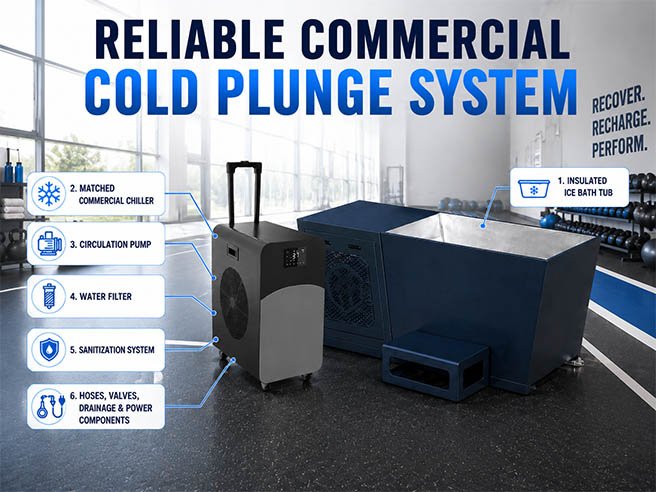
A reliable setup normally contains six connected parts:
- An insulated cold plunge tub
- A correctly sized commercial chiller
- A circulation pump
- A water filter
- A sanitation system
- Hoses, valves, drainage, and electrical connections
Some commercial ice bath chillers combine the pump, filtration, sanitation, and temperature controls inside one housing. This integrated structure can simplify installation and reduce the number of loose components around the recovery room.
That’s useful when several athletes are moving through a wet area. Fewer exposed fittings usually mean fewer accidental knocks, leaks, and confused staff members wondering which switch controls which piece of equipment.
Still, an integrated machine is only as good as its internal engineering. Buyers should check the pump flow, heat exchanger material, compressor, filtration access, replacement-part availability, and actual cooling performance.
The cold plunge tub
The tub holds the water and the athlete, but it also affects cooling efficiency.
A poorly insulated tub absorbs heat from the room or outdoor air. The chiller then has to work harder just to maintain the target temperature. During a busy recovery session, that extra heat load becomes even more noticeable.
The ice bath chiller
The chiller removes heat from the water. Its capacity affects how quickly the system reaches the target temperature and how well it handles repeated athlete use.
Horsepower is helpful for comparison, but it should not be the only specification considered. Ambient temperature, water volume, insulation, pump flow, heat-exchange efficiency, and starting water temperature all affect real performance.
The circulation system
Cold water should move through the tub rather than sit in separate temperature layers.
Consistent circulation helps stabilize temperature, moves debris toward the filter, and improves sanitation. It also prevents one side of the tub from feeling much colder than the other—a surprisingly common problem in weakly designed systems.
Filtration and sanitation
A filter captures visible particles. A sanitation system helps control microorganisms and organic contamination.
These are related jobs, but they are not the same job.
A fine filter won’t replace proper sanitation, and an ozone or UV system won’t magically remove mud, hair, or athletic tape. A team facility needs both physical filtration and a sensible water-care routine.
Plumbing and drainage
The hoses, connectors, valves, and drain points determine whether routine maintenance takes five minutes or becomes a minor engineering project.
Commercial facilities should have accessible shutoff valves, secure hose connections, a practical drain route, and enough clearance to inspect the machine.
Controls and monitoring
Digital temperature control is standard. App control, scheduling, fault alerts, and remote diagnostics can add real value for larger facilities.
For example, staff may schedule the system to begin cooling before morning training, reduce unnecessary operation overnight, or check the temperature before athletes enter the recovery room.
Start With Athlete Throughput, Not Tub Size
Here’s the thing: the number of athletes on the roster is not the same as the number using the cold plunge at once.
A football team may have more than fifty players, but recovery sessions may be divided by position group. A basketball roster is smaller, yet the whole squad might finish training together. A track program may have several groups following different schedules throughout the day.
Before choosing equipment, ask four practical questions:
- How many athletes will use the system each day?
- How many will use it during the busiest hour?
- How long will each session last?
- How quickly must the water return to its target temperature?
Imagine twenty athletes using a single-person tub. If each athlete spends five minutes in the water and staff need another minute for entry, exit, and basic cleaning, the queue could last around two hours.
That’s not a recovery station. That’s an airport security line with colder water.
Teams can solve this in several ways:
- Install a larger multi-person plunge
- Use two or more single-person tubs
- Divide recovery by training group
- Use shorter, supervised sessions
- Add a second chiller or a higher-capacity cooling system
Multiple independent stations often provide better control than one oversized pool. Staff can assign different temperatures, isolate a tub for cleaning, and keep part of the recovery area open if one unit needs service.
A single large tub may cost less to install, but one maintenance problem can stop the entire cold recovery program.
Choosing the Right Chiller Power for a Sports Team
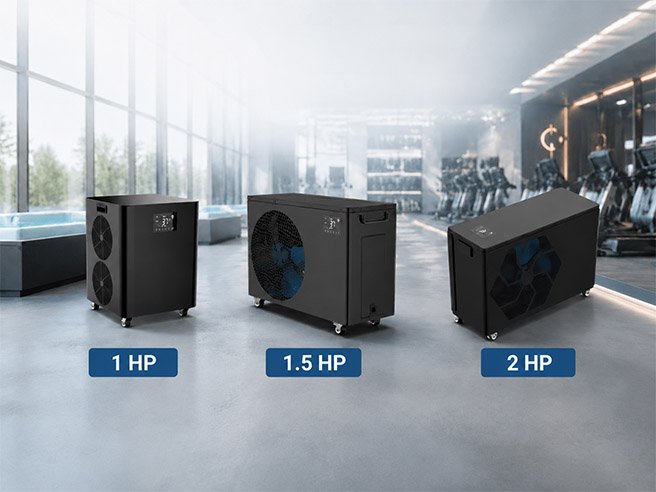
There is no universal horsepower that fits every team. Still, several practical ranges can guide the buying process.
When Is a 1 HP Cold Plunge Chiller Enough?
A 1 HP system can suit:
- Small sports clubs
- Personal training facilities
- School teams with scheduled recovery groups
- Mobile recovery units
- One-person insulated tubs
- Lower-frequency training programs
A well-designed 1 HP chiller can provide strong performance when paired with a moderate water volume and good insulation. It may also be suitable for teams that operate several individual stations instead of one large tub.
For example, two 1 HP systems can create separate recovery lanes. That gives the team more flexibility, although it also requires additional floor space, electrical outlets, plumbing, and maintenance.
For mobile teams, a portable 1 HP unit may offer a useful balance between cooling strength and transport convenience. CHILLMEND’s 1 HP ice bath chiller range includes configurations designed for gyms, commercial recovery spaces, and mobile sports applications.
However, buyers shouldn’t assume that every machine labeled “1 HP” produces identical cooling results. Compressor efficiency, refrigerant design, condenser size, heat exchanger construction, water flow, and ambient conditions can create a noticeable difference between two machines with the same advertised horsepower.
When Should a Team Choose a 1.5 HP Chiller?
A 1.5 HP commercial cold plunge chiller is often a sensible middle ground for:
- University sports departments
- Busy training academies
- Professional team facilities
- Medium-sized multi-user tubs
- Recovery rooms operate for several hours per day
- Warm indoor or outdoor environments
The extra cooling capacity can help the system pull the water temperature back down after repeated entries. This is especially valuable when athletes use the tub one after another with little recovery time between sessions.
A 1.5 HP machine may also reach the target temperature faster before training ends. Staff doesn’t want to discover at 4:30 p.m. that the water is still several degrees too warm for a 5:00 p.m. recovery block.
The CHILLMEND 1.5 HP commercial ice bath chiller range is designed for applications that require stronger cooling, steady temperature control, and longer daily operation.
When Does a Sports Team Need a 2 HP Chiller?
A 2 HP system is more appropriate when the setup involves:
- Large water volumes
- High athlete turnover
- Hot outdoor conditions
- Commercial operation throughout the day
- Multi-person plunge pools
- Fast temperature recovery requirements
- Professional or national-level training facilities
Stronger is not always automatically better. A 2 HP chiller may require more electrical capacity, larger water flow, better ventilation, and a greater initial investment.
Yet undersizing the machine can be far more frustrating.
An undersized chiller may run almost constantly, struggle during hot weather, recover slowly after athlete use, and experience more operational stress. The team saves money at purchase, then pays for it through poor performance and potential service issues.
It is a little like assigning a lightweight utility vehicle to pull a fully loaded team trailer. It may move—but it won’t enjoy the job.
Why Water Volume Alone Cannot Determine Chiller Size
Suppliers often ask only one question: “How many liters is the tub?”
That’s a start, but not enough.
The cooling load also changes according to:
- Starting water temperature
- Target water temperature
- Room or outdoor temperature
- Tub insulation
- Number of athletes
- Athlete body size
- Entry frequency
- Pump flow rate
- Hose length
- Sun exposure
- Whether the cover is used
- Required cooling time
Consider two identical 400-liter tubs.
One sits in an air-conditioned recovery room at 22°C. The other sits beside a training field in 38°C summer heat. Technically, the water volume is the same. Operationally, these are two very different cooling jobs.
A reliable manufacturer should ask about the whole application before recommending a model.
Choose a Tub That Can Survive Team Use
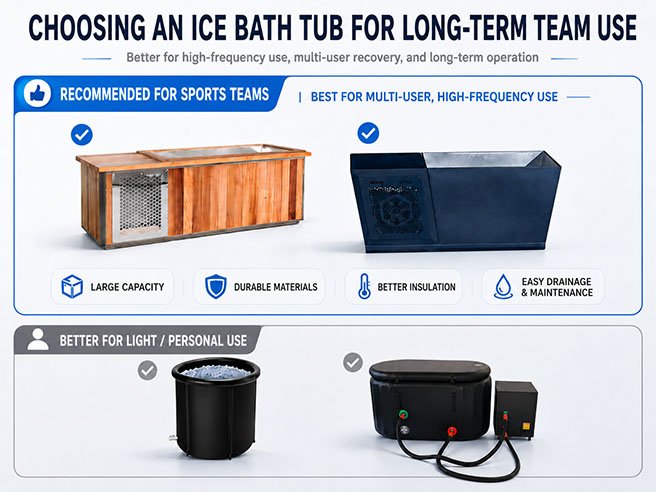
The best tub for a sports team is not necessarily the most luxurious one. It is the one that remains stable, clean, accessible, and efficient after hundreds or thousands of entries.
Insulation matters more than people think
Good insulation slows heat gain and reduces the workload on the chiller. It also helps the water stay cold between sessions.
Look for insulated walls, a fitted cover, and a structure that limits thermal transfer from the floor. A cover should be used whenever the tub is idle, especially outdoors.
The entry height must suit the athletes
A very deep tub may provide good immersion, but it can be awkward for tired athletes, injured players, or users with limited mobility.
Steps, handrails, stable edges, and non-slip flooring should be considered during the facility design. Para-athlete access may require modified seating, transfer support, wider access, or purpose-built bath geometry. The Australian Institute of Sport has highlighted the importance of stable, accessible equipment that allows athletes to enter and leave recovery baths safely and independently.
Material selection affects maintenance
Common choices include:
- Stainless steel
- Insulated acrylic
- Reinforced plastic
- Fiberglass
- Drop-stitch inflatable material
- Wood-clad tubs with waterproof inner tanks
Stainless steel and quality molded shells are often easier to clean in commercial environments. Inflatable tubs can be useful for travel and temporary recovery camps, though they need protection from sharp equipment, rough flooring, and careless transport.
Wood-clad tubs create a premium look for clubs and high-end training centers, but the internal water-contact surface should still be durable and easy to sanitize.
Single-person or multi-person?
Single-person tubs offer better hygiene control and simpler athlete supervision. They also allow several temperature settings when multiple stations are installed.
Multi-person tubs can process more athletes per session, but they require greater cooling power, stronger water treatment, and disciplined operating procedures.
Neither design wins every time. The right choice depends on the team’s traffic pattern.
Temperature Control: Colder Isn’t Always Smarter
A sports team does not need to run every session at 0°C or 2°C.
Many cold-water immersion studies use temperatures around 10°C to 15°C for limited periods, although protocols vary by sport, training load, timing, and desired outcome. Reviews have reported that immersion around 10°C to 15°C for approximately 5 to 15 minutes may support certain recovery outcomes, but individualization remains important.
Professional staff may adjust protocols according to:
- Athlete experience
- Training intensity
- Competition schedule
- Environmental heat
- Injury status
- Strength-development phase
- Athlete preference and tolerance
Routine cold-water immersion immediately after every strength session may not be suitable when the primary goal is maximizing long-term muscle growth and adaptation. ACSM notes that during strength- and hypertrophy-focused periods, delaying cold exposure for several hours may be considered.
So yes, the chiller may be capable of reaching near-freezing temperatures. That does not mean the team should always use the lowest setting.
The value of a powerful chiller is control. It gives coaches and medical staff the ability to reach and maintain the selected temperature even under heavy load.
Temperature Stability During Repeated Athlete Use
When an athlete enters the tub, body heat moves into the water. Larger athletes, warmer skin, longer immersion, and frequent entry all increase the load.
In a weak setup, the display may show the target temperature near the chiller while the actual tub temperature rises elsewhere. This is why sensor position and water circulation matter.
A stable commercial system should provide:
- Continuous water movement
- Adequate pump flow
- Proper inlet and outlet positioning
- Accurate temperature sensing
- Enough cooling reserve for repeated use
- Insulated hoses were necessary
The water inlet and outlet should not sit directly beside each other. Otherwise, recently cooled water may return to the chiller before circulating through the whole tub.
For a rectangular plunge, placing the inlet and outlet at separate points can improve full-tub movement. The exact layout will depend on the tub structure and plumbing design.
Filtration and Sanitation Can’t Be an Afterthought
Team cold plunges face more contamination than most residential systems.
Athletes may enter after running on grass, training on rubber flooring, wearing taped ankles, or using body lotions and topical products. Even with a pre-rinse rule, the water will collect debris.
A commercial setup should include multiple layers of water management.
Physical filtration
A cartridge or sediment filter captures hair, fibers, dirt, and other particles.
The filter should be easy to reach. If staff need to remove half the machine housing to inspect it, maintenance will eventually be delayed. That’s just human nature.
The cleaning frequency depends on athlete volume and water quality. During busy periods, staff may need to inspect the filter daily and clean it several times per week.
Ozone or UV sanitation
Ozone and UV systems can support water sanitation, but they should be treated as part of a broader water-care process.
They do not replace:
- Regular water testing
- Tub surface cleaning
- Filter maintenance
- Scheduled water replacement
- Pre-entry athlete hygiene
- Facility-specific chemical treatment
Local health rules may apply, particularly when a plunge is used commercially or shared by the public. Facility managers should consult local regulations and qualified water-treatment professionals.
Pre-rinse procedures
A simple shower or rinse station can dramatically reduce the amount of sweat, dirt, and organic matter entering the tub.
Teams sometimes resist this because it adds another step. Yet that extra minute can save far more time in cleaning and water replacement later.
Post a clear rule. Make it part of the recovery routine. Athletes follow systems better when staff applies them consistently.
Indoor, Outdoor, or Mobile: Which Setup Is Best?
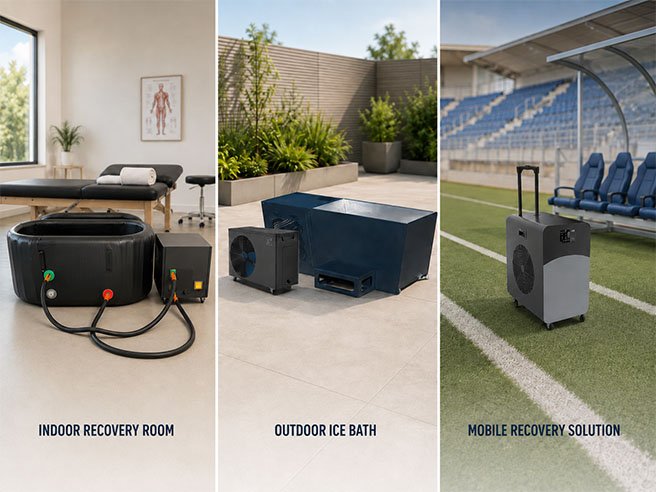
The same machine can behave differently depending on where it is installed.
Indoor Recovery Room
An indoor cold plunge setup gives the team better control over weather, cleanliness, security, and access.
A well-planned room should include:
- Floor drainage
- Water-resistant surfaces
- Non-slip flooring
- Ventilation
- Adequate electrical supply
- Hose and cable management
- Cleaning-product storage
- Space around the chiller for airflow
- Privacy where required
The room should not feel cramped. Athletes need enough space to enter, exit, towel off, and move safely around teammates.
Ventilation is especially important because the chiller releases heat into the room. Place several high-capacity machines in a tiny, unventilated room, and they will gradually heat the same space they are trying to cool.
That’s a rather expensive tug-of-war.
Outdoor Cold Plunge Station
Outdoor setups work well beside fields, training grounds, pools, and team facilities. They can also simplify drainage.
However, the equipment must handle:
- High ambient temperature
- Rain and moisture
- Direct sunlight
- Dust and leaves
- Freezing winter conditions
- Uneven ground
- Unauthorized access
Use a shaded, ventilated area rather than placing the chiller in a sealed box. A protective enclosure should keep rain away without trapping the heat discharged by the condenser.
Electrical outlets must be suitable for the environment and installed by a qualified electrician. Equipment water-resistance ratings should also match the placement.
Mobile Team Recovery Setup
Traveling teams may need cold-water recovery at tournaments, training camps, away games, and temporary performance centers.
A mobile setup may include:
- Portable insulated or inflatable tubs
- A trolley-style chiller
- Quick-connect hoses
- A compact filter system
- Extension-ready electrical planning
- Protective transport cases
- Drain hoses
- Spare connectors and seals
- A basic water-testing kit
Portability involves more than adding wheels. Staff needs to consider lifting weight, vehicle space, hose storage, setup time, electrical compatibility, and protection during transport.
A mobile unit that takes ninety minutes to assemble will probably stay in the truck more often than anyone admits.
Electrical Planning for a Commercial Cold Plunge
Before ordering, confirm:
- Local voltage
- Frequency
- Plug type
- Rated current
- Startup current
- Circuit capacity
- Grounding requirements
- Indoor or outdoor outlet type
High-power compressors may require a dedicated circuit. Using unrelated gym equipment on the same line can cause tripping or unstable operation.
The supplier should configure the machine for the destination market. A professional B2B manufacturer should also provide clear electrical specifications before production—not after the equipment reaches the training facility.
For international clubs, universities, distributors, or franchise recovery centers, certification may also affect purchasing approval. CHILLMEND supplies systems for different markets and provides information about ice bath chiller certifications and compliance, including configurations associated with major regional requirements.
Drainage, Hose Routing, and Service Access
These details look boring on a quotation sheet. In daily operation, they matter enormously.
A sports facility should plan where the water goes during:
- Partial draining
- Full water replacement
- Filter cleaning
- Hose disconnection
- Accidental overflow
- Equipment servicing
Do not run loose hoses across athlete walkways. Use secure routing, wall clips, protective channels, or a designed service area.
Keep enough clearance around the chiller for air intake, heat exhaust, filter access, and panel removal. Pushing the unit tightly against a wall may create a cleaner visual line, but it can restrict cooling and make repairs harder.
The ice bath chiller setup guide explains the basic relationship between the tub inlet, tub outlet, water flow, and machine placement.
Build a Clear Athlete-Use Protocol
Equipment alone cannot create a professional recovery program.
The team should have a written procedure covering:
- Who may use the plunge
- Who supervises sessions
- Pre-entry health screening
- Shower or rinse requirements
- Temperature and time limits
- Entry and exit procedures
- Cleaning responsibilities
- Emergency response
- Daily temperature records
- Water-quality checks
- Maintenance reporting
Athletes with certain medical conditions or cold sensitivity may need professional clearance or modified protocols. The team’s physician, physiotherapist, or qualified sports medicine staff should guide individual use.
The plunge should not be used casually by an unsupervised athlete who thinks “more pain means more recovery.” That mindset belongs in motivational movie scenes, not risk management.
A visible wall chart can make the procedure easy to follow. Keep it simple enough that athletes actually read it.
Common Mistakes Sports Teams Make
Buying a residential chiller for commercial traffic
Residential equipment may work well for one person but struggle when used by a whole squad.
The issue is not only initial cooling. Teams need temperature recovery, long operating hours, stronger pumps, accessible filters, and durable components.
Choosing equipment only by horsepower
Horsepower offers a rough reference. It does not describe the entire refrigeration system.
Ask for cooling capacity, test conditions, recommended water volume, ambient-temperature limits, pump flow, noise level, and expected pull-down time.
Ignoring the local climate
A setup that performs well in a cool indoor showroom may behave differently beside a football field in Texas, Florida, Dubai, or Queensland.
Tell the supplier the highest expected ambient temperature.
Using a poorly insulated tub
A cheap uninsulated tub can force the chiller to run longer and recover more slowly.
The team may blame the machine when the tub is quietly absorbing heat all day.
Forgetting about maintenance access
Filters, pumps, drain points, and electrical panels must remain reachable.
A visually neat installation that traps the chiller behind fixed cabinetry can become a service headache.
Installing only one station for a large roster
One large chiller does not solve an athlete-queue problem if the tub still holds only one person.
Calculate actual throughput before purchase.
Treating sanitation as an optional accessory
Shared cold water must be managed carefully. A clear hygiene and maintenance plan should be created before the first athlete enters the tub.
Choosing the cheapest quotation
Commercial recovery equipment is a long-term operating asset.
A low purchase price loses its charm when the machine cannot maintain temperature, replacement parts are unavailable, or technical support disappears after shipment.
Honestly, the cheapest machine can become the most expensive one surprisingly fast.
Recommended Cold Plunge Setups by Team Size
Small Team: Up to 10 Regular Users
A practical setup may include:
- One insulated single-person tub
- One reliable 1 HP chiller
- Integrated circulation and filtration
- Basic sanitation
- Insulated cover
- Floor drain or drain hose
- Scheduled recovery periods
This can work for smaller school teams, martial arts clubs, private training groups, and local sports academies.
If several athletes finish at once, create time slots rather than allowing an unmanaged queue.
Medium Team: 10 to 25 Regular Users
Consider:
- Two single-person tubs or one larger tub
- One 1.5 HP commercial system, or two independent 1 HP systems
- Stronger water circulation
- Higher-capacity filtration
- Daily water-quality checks
- App scheduling or remote monitoring
- A dedicated wet recovery zone
Two independent systems provide useful redundancy. One tub can remain operational while the other is cleaned.
Large Team: 25 to 50 Regular Users
A suitable setup may require:
- Two to four plunge stations
- Multiple 1 HP or 1.5 HP chillers
- One or more 2 HP systems for larger tubs
- Commercial plumbing
- Dedicated electrical circuits
- Staff-controlled recovery schedules
- A documented sanitation program
- Spare filters, seals, pumps, and connectors
At this level, the recovery area should be treated like a small performance department rather than a collection of tubs.
Professional or Multi-Sport Facility
Professional clubs, universities, national teams, and sports institutes may benefit from:
- Several independently controlled plunge stations
- Different temperature zones
- Hot and cold contrast therapy areas
- High-capacity commercial chillers
- Remote monitoring
- Maintenance logs
- Backup components
- Accessible designs for injured and Para athletes
- Supplier service agreements
- Custom branding and facility integration
Elite recovery centers often combine cold-water immersion with nutrition, hydration, sleep support, compression, mobility work, and medical supervision. Cold plunging is one part of the recovery system, not the whole recovery system.
Should Teams Choose One Large System or Several Small Systems?
One large system may offer:
- Lower initial equipment count
- Simpler central plumbing
- Higher simultaneous capacity
- A strong visual centerpiece
Several independent systems may offer:
- Better hygiene separation
- Different temperature settings
- Easier athlete scheduling
- Partial operation during maintenance
- Simpler replacement or relocation
- Better support for different sports groups
For many facilities, two or three medium-sized stations provide a better operational balance than one enormous tub.
There is no glamorous answer here. Facility flow should make the decision.
Watch how athletes move after training. Where do they enter? Where do they leave wet towels? How many staff members supervise them? Which teams overlap? Those ordinary details reveal the right equipment layout.
How to Evaluate a Cold Plunge Manufacturer for Team Projects
Sports team buyers should look beyond product photos.
A capable manufacturer should be able to discuss:
- Water volume and athlete frequency
- Ambient temperature
- Required pull-down time
- Compressor and refrigerant configuration
- Heat exchanger material
- Pump performance
- Noise control
- Electrical configuration
- Filtration and sanitation
- Replacement parts
- Commercial warranty support
- Certifications
- OEM or custom requirements
Ask whether the supplier has an internal engineering team. Also ask what happens after the warranty claim is submitted.
Can the pump be replaced? Can the control board be shipped separately? Are wiring diagrams available? Does the manufacturer keep spare parts? Can technicians diagnose a fault through videos, error codes, or remote data?
These questions reveal far more than a polished brochure.
CHILLMEND is a technology-driven manufacturer specializing in sports recovery, wellness, and rehabilitation systems. With more than 17 years of industry experience, an 8,000 m² manufacturing facility, OEM and ODM capability, and international after-sales support, CHILLMEND develops cold plunge systems for sports teams, gyms, recovery centers, distributors, and equipment brands.
Buyers planning a full system can also review the ice bath tub with chiller package guide to compare the components required for residential and heavy-duty commercial use.
The Best Setup Is the One Athletes Can Use Every Day
A successful sports team cold plunge station should feel almost uneventful.
The water is ready when training ends. The temperature stays stable. Athletes move through without long queues. Staff can inspect the filter without reaching for a toolbox. Cleaning follows a routine. Replacement parts are available.
Nothing dramatic happens—and that is exactly the point.
Commercial recovery equipment should disappear into the daily workflow. When the setup is designed correctly, coaches can focus on athletes rather than chasing bags of ice, resetting electrical breakers, or explaining why the plunge is warm again.
Choose the tub, chiller, circulation system, and layout as one connected system. Plan for the busiest day, not the quietest demonstration. And leave some capacity for growth, because a recovery station that works well tends to become popular rather quickly.
FAQs
What Is the Best Cold Plunge Temperature for a Sports Team?
Many sports recovery programs use cold plunge temperatures between 10°C and 15°C, or approximately 50°F to 59°F, for controlled sessions. The ideal cold plunge temperature for athletes depends on the sport, training load, recovery objective, medical condition, and professional guidance. Lower temperatures are not automatically more effective.
How Many Cold Plunge Tubs Does a Football Team Need?
The number of cold plunge tubs for a football team depends on roster size, session length, and the available recovery window. A team with 40 to 60 athletes may require two to four stations, scheduled position-group sessions, or a larger multi-person system to avoid long queues.
Is a 1 HP Chiller Powerful Enough for Team Recovery?
A 1 HP ice bath chiller can be powerful enough for a small sports team, one insulated tub, or scheduled athlete groups. Larger teams, warm outdoor environments, and repeated back-to-back use may require a 1.5 HP or 2 HP commercial cold plunge chiller.
How Often Should a Team Cold Plunge Filter Be Cleaned?
A sports team cold plunge filter should be inspected frequently and may need cleaning several times per week during heavy use. The exact schedule depends on water quality, athlete volume, pre-rinse compliance, filter size, and the amount of debris entering the tub.
Can a Cold Plunge System Be Used Outdoors at a Training Field?
A commercial cold plunge system can be installed outdoors when the chiller has suitable weather protection, ventilation, safe electrical connections, level ground, drainage, and enough cooling capacity for the local climate. The machine should be shaded without being sealed inside an enclosure that traps exhaust heat.
Build a Team Recovery System With CHILLMEND
A sports team needs more than a cold tub—it needs a dependable recovery system that can handle real athlete traffic. CHILLMEND provides commercial ice bath chillers, cold plunge tubs, mobile recovery units, and customized OEM/ODM solutions for sports clubs, universities, training academies, professional teams, and recovery facilities. Contact CHILLMEND to share your tub volume, team size, local climate, electrical requirements, and daily usage plan. Our engineering team will recommend a suitable chiller capacity and complete cold plunge configuration for your facility.