
Article Summary
An ice bath chiller normally produces some compressor, fan, pump and water-flow sound. A sudden increase in volume—or new rattling, buzzing, grinding, clicking or bubbling—can indicate restricted airflow, poor water flow, trapped air, loose exterior parts, vibration transfer or a component fault. This guide helps users identify the type of sound, complete safe external checks and decide when to stop the chiller and contact technical support.
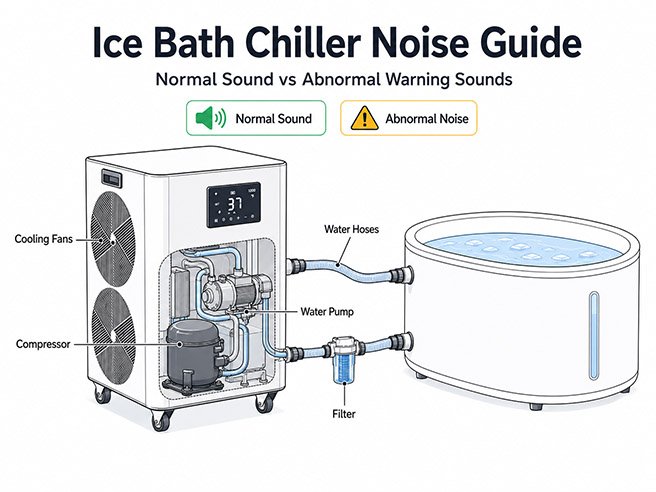
Quick Outline
- Normal operating sounds versus warning signs
- Diagnose the sound before changing anything
- Compressor hum, buzzing and repeated clicking
- Fan noise and restricted airflow
- Pump noise, trapped air and possible cavitation
- Dirty filters and restricted water flow
- Vibration from floors, walls, tubs and hoses
- Heavy cooling loads and outdoor conditions
- Safe steps that may reduce noise
- When to stop using the chiller
Is Some Ice Bath Chiller Noise Normal?
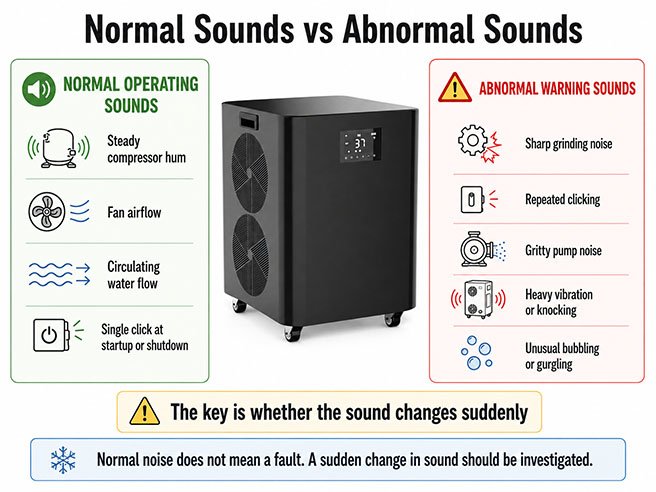
Yes. Compressor-based ice bath chillers contain moving parts and flowing fluids. During normal operation, users may hear:
- A steady compressor hum
- Air moving through the condenser
- Water circulating through hoses
- Mild pump vibration
- A click when the compressor starts or stops
- Changes in sound as the system enters or leaves a cooling cycle
The important question is not whether the chiller makes any sound. It is whether the sound is consistent with its normal operation.
A machine that has always produced a stable hum and still cools normally may not have a fault. A sound that suddenly becomes louder, changes character or appears together with poor cooling, low water flow, leakage, burning odor or repeated electrical trips deserves attention.
For guidance on comparing stated noise data and measurement conditions before purchase, read Ice Bath Chiller Noise Levels: What Buyers Should Know. This article focuses on abnormal noise and troubleshooting.
Start by Identifying the Sound
Before moving the chiller or removing any accessible part, record what is happening.
Note:
- When the sound started
- Whether it is constant or intermittent
- Whether it occurs during startup, cooling, circulation or shutdown
- Whether cooling performance has changed
- Whether water flow appears weaker
- Whether the system displays an error code
- Whether the chiller was recently moved, shipped, drained or reinstalled
- Whether the filter, hoses or tub were recently changed
- Ambient temperature and starting water temperature
Record a short video that includes the display, water flow, hose layout and abnormal sound. A useful recording often helps technical support distinguish fan contact, panel vibration, water-circuit noise and compressor startup problems.
Quick Sound Guide
| Sound | Common areas to check | Action level |
|---|---|---|
| Steady low hum | Normal compressor operation, floor vibration | Compare with previous operation |
| Bubbling or gurgling | Air in the water circuit, priming | Check water level and priming procedure |
| Gravel-like pump noise | Restricted inlet, trapped air, possible cavitation | Stop and correct water-flow conditions |
| Rattling or tapping | Loose exterior panel, hose or contact point | Switch off and inspect accessible external parts |
| Repeated clicking | Startup problem, protection cycling, unstable power | Stop repeated restarts and contact support |
| Harsh grinding or metallic knocking | Fan contact or mechanical fault | Stop the unit and obtain technical inspection |
| Electrical buzzing with no startup | Power or electrical component issue | Disconnect power and contact qualified support |
This table identifies possible areas, not a remote diagnosis. Similar sounds can have different causes.
1. Compressor Hum and Vibration
The compressor is often the most noticeable sound source. A stable low-frequency hum during active cooling can be normal, especially when the water is warm and the system is working toward the target temperature.
When Compressor Sound May Be Normal
- The sound is similar to previous cooling cycles
- Cooling performance remains normal
- The unit is stable and does not move
- The sound becomes less noticeable after reaching the target temperature
- There are no errors, burning smells or electrical trips
When It Needs Attention
- Strong vibration appears suddenly
- The cabinet shakes or moves
- The compressor repeatedly tries and fails to start
- Loud humming is combined with poor cooling
- Metallic knocking or grinding appears
- The breaker repeatedly trips
Do not open the sealed refrigeration circuit or electrical compartment. Compressor diagnosis and refrigerant work require appropriately qualified service personnel.
If abnormal noise occurs together with weak cooling, use the separate guide to an ice bath chiller not cooling and provide both symptoms to technical support.
2. Cooling-Fan Noise and Restricted Airflow
The condenser fan removes heat from the refrigeration system. Fan or airflow noise may increase when the chiller operates under a higher heat load, but new scraping, rattling or pulsing should be investigated.
Possible causes include:
- Dust or debris on an external grille
- Leaves or outdoor debris near the intake
- Insufficient clearance around the unit
- A cover or enclosure restricting exhaust air
- A loose fan guard or exterior panel
- Visible fan obstruction
- Fan contact or an internal mounting problem
Switch off and disconnect power before inspecting accessible exterior areas. Do not insert fingers or tools through a grille.
Keep the inlet and outlet clear according to the model’s installation manual. Do not place the chiller inside a tightly enclosed cabinet unless that installation is specifically engineered to provide adequate airflow and service access.
Restricted airflow can make the compressor and fan operate longer, so the system may be perceived as louder even when the original problem is the installation rather than a failed component.
3. Pump Noise, Trapped Air and Cavitation
Water-circuit problems often sound like a refrigeration fault. A pump that is not receiving a stable water supply may produce bubbling, rattling, whining or gravel-like noise.
Possible causes include:
- Low tub water level
- Incomplete priming
- Air trapped in the hoses
- A partially closed valve
- A clogged filter
- A kinked or collapsed hose
- Incorrect pump direction
- A loose fitting allowing air into the line
- Excessively long or restrictive plumbing
- Pump placement outside the manufacturer’s requirements
What Is Cavitation?
Cavitation can occur when pressure at the pump inlet becomes too low and vapor bubbles form and collapse. It can reduce flow, create rough noise and damage a pump if allowed to continue.
Users should not assume every bubbling sound is cavitation, but a noisy pump combined with weak or irregular flow needs prompt attention.
Follow the manufacturer’s filling and priming instructions. Never allow a water pump to run dry.
4. Dirty Filters and Restricted Water Flow
A blocked filter increases resistance in the circulation loop. The result may include:
- Louder pump operation
- Reduced visible flow
- Air or irregular water sounds
- Slower cooling
- Flow-related error codes on equipped models
- Longer compressor operation
Inspect, clean or replace the filter according to the product manual. Turn off the system and isolate the water circuit before opening a filter housing if required by the instructions.
Commercial cold plunge installations can load filters faster than light residential use. Maintenance frequency should be based on water condition, use frequency and the manufacturer’s guidance—not a universal schedule copied from another system.
If cleaning the filter restores water flow and reduces noise, record the maintenance interval and train staff to recognize the symptom before the restriction becomes severe.
5. Hose Layout and Plumbing Restrictions
Hose routing affects both water flow and vibration.
Check for:
- Sharp bends or kinks
- Crushed hose sections
- Incorrect inlet and outlet connections
- Partially seated quick connectors
- Closed or restricted valves
- Hose diameter different from the approved setup
- Loose fittings drawing air
- Excessive plumbing length
- Hoses tapping against the tub, wall or cabinet
A fitting that is not fully seated may allow air into the water loop without producing an obvious external leak. A hose touching a hard surface can also transmit pump vibration and create repetitive tapping.
Use the plumbing layout and connection sizes specified for the model. Adding smaller fittings, longer hoses or extra filtration can change resistance and pump behavior.
6. Vibration Transfer From the Floor or Nearby Objects
Sometimes the chiller is producing normal mechanical vibration, but the installation surface amplifies it.
A hollow wooden deck, lightweight shelf or uneven platform can behave like a soundboard. Contact with the tub, wall, plumbing or another appliance can transmit sound through the surrounding structure.
After switching off the unit, check whether it is:
- Level and stable
- Rocking on its feet or wheels
- Touching the cold plunge tub
- Pressed against a wall or cabinet
- In contact with rigid plumbing
- Resting on a hollow or resonant platform
- Supported in a way that blocks a lower ventilation opening
Reposition the unit only according to the manufacturer’s clearance and installation requirements. A suitable anti-vibration solution may help in some installations, but it must not make the chiller unstable or obstruct ventilation and drainage.
Do not place soft household materials, towels or improvised foam around the machine. They can block airflow, retain water or create an unsafe installation.
7. Loose Exterior Panels and Transport-Related Vibration
If noise begins after delivery or relocation, inspect accessible external parts after disconnecting power.
Look for:
- Loose exterior covers
- Fan guards
- Handles
- Wheels or feet
- External brackets
- Accessory parts left against the housing
- Hose connectors tapping against panels
Do not remove internal panels, adjust compressor mounts or touch electrical and refrigeration components unless the manufacturer authorizes the work and a qualified person performs it.
For distributors, record transport damage and recurring loose-part issues by model and batch. Packaging, fastener control or pre-shipment inspection may need improvement if the same symptom appears repeatedly.
8. Heavy Cooling Loads and Long Operating Cycles
A chiller may sound more noticeable while pulling warm water down to the target temperature than while maintaining already-cold water.
Cooling load increases with factors such as:
- Larger water volume
- Higher starting temperature
- Hot ambient conditions
- Direct sunlight
- Poor tub insulation
- An uncovered tub
- Frequent users adding body heat
- Restricted condenser airflow
- A model that is undersized for the application
Longer runtime is not automatically a fault. Compare sound under equivalent conditions and wait until the machine enters its normal temperature-maintenance pattern before deciding whether its volume has changed.
However, continuous hard operation combined with failure to approach the target temperature can indicate incorrect sizing, poor installation or a technical problem. Do not mask the noise without finding the reason the system is working so hard.
9. Outdoor Location and Room Acoustics
The same chiller can sound different in different environments.
- Hard walls can reflect sound
- Corners can reinforce low-frequency hum
- Wooden decks can transmit vibration
- Decorative covers can restrict airflow
- Dust, leaves and debris can affect ventilation
- Rain or weather protection may change clearances
Follow the model’s weather-exposure, ventilation, drainage and electrical-safety requirements. A product that is not approved for a particular outdoor condition should not be made suitable with an improvised cover.
For commercial projects, evaluate the actual installation location before purchase. Noise perceived by users depends on distance, room acoustics, cooling load and mounting—not only a number on a specification sheet.
A Safe Troubleshooting Sequence
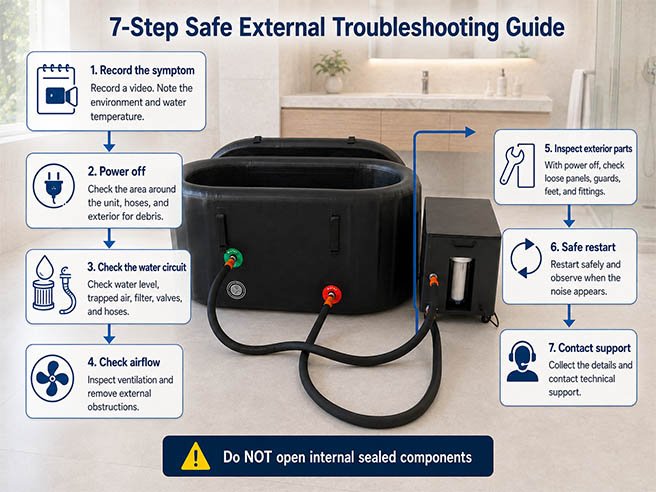
Use this order to avoid unnecessary disassembly:
Step 1: Record the Symptom
Capture the sound, display, water flow, error code and operating conditions.
Step 2: Switch Off and Inspect the Area
Check the floor, nearby contact points, hose layout, exterior grille and visible debris.
Step 3: Check the Water Circuit
Confirm water level, priming, filter condition, open valves, hose direction and stable flow.
Step 4: Check Airflow and Clearance
Remove external obstructions and follow the required clearance in the manual.
Step 5: Inspect Accessible Exterior Parts
With power disconnected, look for loose covers, guards, wheels, feet and external fittings.
Step 6: Restart Only If It Is Safe
Observe whether the sound occurs during pump startup, compressor startup or fan operation. Stop again if severe vibration, grinding, leakage, electrical smell or repeated clicking appears.
Step 7: Send Evidence to Technical Support
Provide:
- Model and serial number
- Purchase date
- Video and photographs
- Error codes
- Water and ambient temperatures
- Tub volume
- Hose, pump and filter configuration
- Maintenance already completed
Avoid repeatedly power-cycling a chiller that cannot start normally.
When Should You Stop Using the Chiller?
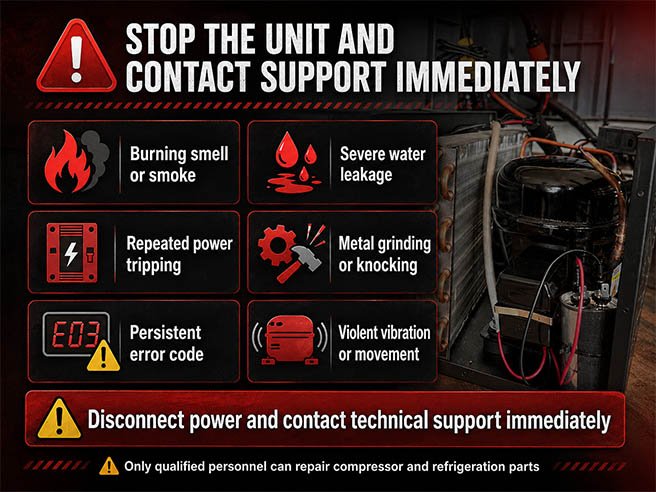
Disconnect power when safe to do so and contact technical support if unusual noise appears with:
- Burning odor, smoke or sparking
- Damaged cable or plug
- Repeated breaker or protection trips
- Severe or uncontrolled water leakage
- Strong metallic grinding or knocking
- Sudden major vibration or movement
- Fan contact that is externally apparent
- Compressor repeatedly failing to start
- Persistent error codes
- Loss of water flow that cannot be safely restored
Keep people away from water and electrical equipment if an electrical fault or serious leak is suspected. Electrical, compressor and sealed-refrigeration repairs should be performed only by appropriately qualified personnel.
What Not to Do
- Do not open the sealed refrigerant circuit
- Do not bypass electrical protections or flow sensors
- Do not insert tools through fan grilles
- Do not keep restarting a unit that trips protection
- Do not run a pump dry
- Do not block ventilation to reduce perceived sound
- Do not add household soundproofing around the condenser
- Do not replace internal parts without confirming the diagnosis and compatibility
These actions can create safety risks, worsen the fault or affect warranty coverage.
Why Noise Diagnosis Matters to B2B Buyers
For gyms, recovery studios, hotels and wellness facilities, noise is part of the customer experience. For distributors, it also becomes an after-sales cost.
Recurring noise complaints can reveal issues with:
- Product sizing
- Installation instructions
- Pump and filter selection
- Packaging and transport
- Panel or piping vibration
- Maintenance training
- Supplier diagnosis and spare-parts support
Before approving a commercial product, test it in a representative room and record the operating conditions. Do not evaluate only a showroom sample or an unloaded demonstration.
During sample approval, assess startup, active pull-down, temperature maintenance, pump operation and vibration on the intended type of floor. The ice bath chiller sample order checklist provides a complete B2B validation process.
How Manufacturers Can Reduce Avoidable Noise
Noise is influenced by product design and production consistency as well as installation.
Manufacturing controls can address:
- Compressor and pump mounting
- Fan selection and clearance
- Pipe and hose support
- Cabinet stiffness
- Fastener control
- Wiring and component contact
- Water-flow design
- Final noise and vibration inspection
- Packaging that prevents transport movement
Buyers should ask how abnormal noise is identified, what test conditions are used and how a failed unit is corrected and retested. CHILLMEND’s manufacturing and quality-control page provides its factory information, while the article on how ice bath chillers are manufactured explains the wider production process.
CHILLMEND Technical and B2B Support
CHILLMEND supports distributors, cold plunge brands and commercial operators with model selection, sample evaluation, installation information, troubleshooting coordination, OEM production and spare-parts planning.
The correct response to a noisy unit depends on its model, installation and symptoms. Buyers and users should follow the product manual and supply the model, serial number and operating evidence when requesting support.
CHILLMEND provides a one-year warranty and after-sales support through its California warehouse and service point in the United States. Project-specific coverage and service responsibilities should be confirmed before the distributor publishes customer-facing warranty terms.
Review the available ice bath chiller models or contact CHILLMEND for model-specific guidance.
Frequently Asked Questions
Why does my ice bath chiller make a loud humming noise?
A steady hum can be normal compressor operation. If it suddenly becomes stronger, check whether the unit is touching another surface, sitting unevenly or working under a much heavier cooling load. Loud humming with poor cooling, repeated clicking or electrical trips needs technical assessment.
Why is my cold plunge chiller rattling?
Rattling can come from an exterior panel, guard, wheel, foot, hose or nearby contact point. Switch off and disconnect the unit before inspecting accessible exterior parts. Persistent internal rattling should be checked by qualified support.
Why does the water pump sound like gravel?
Rough bubbling or gravel-like pump noise may result from trapped air, restricted inlet flow or cavitation. Check water level, filter, hose restrictions, valves and priming according to the manual. Stop the pump if stable water flow cannot be restored.
Can a dirty filter make the chiller louder?
Yes. A clogged filter can restrict flow, increase pump noise and make cooling take longer. Clean or replace it according to the model’s maintenance instructions.
Can I put soundproofing around an ice bath chiller?
Do not surround the chiller with material that blocks airflow, holds moisture or limits service access. Any acoustic enclosure must be engineered around the model’s ventilation, drainage and electrical requirements.
Is a louder chiller always defective?
No. Active pull-down from warm water can require longer compressor and fan operation. Compare equivalent conditions and look for changes in sound character, cooling, flow, errors or vibration.
When should I call a technician?
Seek qualified help for grinding or knocking, repeated startup failure, electrical odor, breaker trips, major leakage, severe vibration or a problem that remains after safe external checks.
Get Help With an Ice Bath Chiller Noise Problem
When contacting CHILLMEND, provide the model, serial number, video, error code, tub volume, water temperature, ambient conditions and water-circuit configuration.
Contact CHILLMEND for model-specific troubleshooting or B2B product-selection support.