
Article Summary
Ice bath chiller ROI depends on what the system changes financially. At home, that may be fewer ice purchases. In a gym or recovery studio, it may be paid sessions or membership upgrades. In both cases, the calculation must include installation, electricity, maintenance and the time required to operate the system. This guide explains how to estimate payback, compare demand scenarios and decide whether the numbers support the purchase.
Article Outline
- What counts as a return on an ice bath chiller?
- Build the complete investment budget
- Calculate operating costs
- Compare a home chiller with buying ice
- Estimate commercial payback and ROI
- Test demand before committing
- Evaluate equipment and supplier support
- Frequently asked questions
Is an Ice Bath Chiller Worth the Investment?
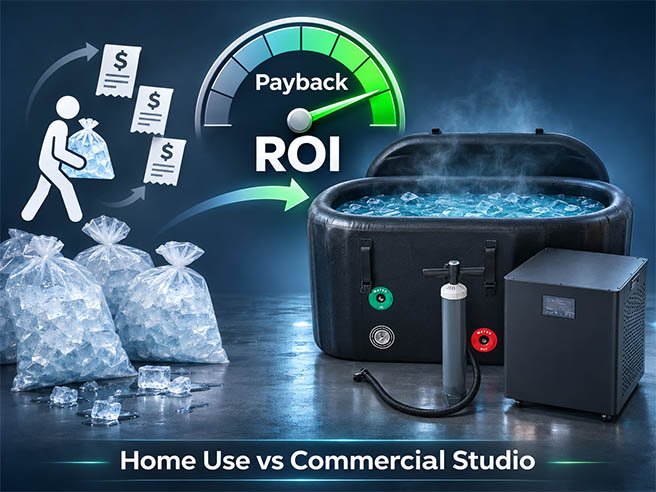
The equipment quotation arrives, and the monthly revenue forecast looks promising. But there is still a gap between buying a chiller and recovering what you spent.
Who will use the system? What will they actually pay? How much work will it take to keep the service available?
Those questions matter as much as the machine’s purchase price. A cold plunge can be useful and convenient without generating a financial return. It can also cover its monthly running costs while still taking years to recover the initial investment.
Start with the decision you are making. Replacing regular ice purchases is one calculation. Adding a paid service to an existing gym is another. Opening an entirely new recovery business requires a budget for the whole operation.
All dollar amounts below are hypothetical USD examples, not CHILLMEND quotations, market averages or promised results.
What Does Ice Bath Chiller ROI Measure?
For this guide, use a simple project cash-return calculation over a stated period.
Net cash benefit for the period = additional cash revenue + cash costs avoided − additional operating cash costs
Simple project ROI = (net cash benefit for the period − initial investment) ÷ initial investment × 100%
For a steady positive monthly benefit:
Simple payback in months = initial investment ÷ monthly net cash benefit
These measures answer different questions. Payback estimates when the initial outlay is recovered. ROI reports the return over the period you choose. A three-year ROI is not an annual return.
This simplified model excludes taxes, financing, depreciation, resale value and the time value of money. Include expected repairs and replacement spending in the cash forecast when relevant. For a larger project, extend the model to monthly cash flows and an appropriate discounted analysis.
If monthly net benefit is zero or negative, there is no positive simple payback under those assumptions.
Keep Convenience Separate From Cash Savings
Time saved can be valuable without reducing a bill. A homeowner who spends less time collecting ice has gained convenience, but not necessarily cash income.
Likewise, freeing a gym employee for another task is an operational benefit. Count it as a cash saving only if staffing expenditure actually falls, or separately model the measurable contribution from the employee’s new work. Do not count both benefits for the same time.
Build the Complete Initial Investment Budget
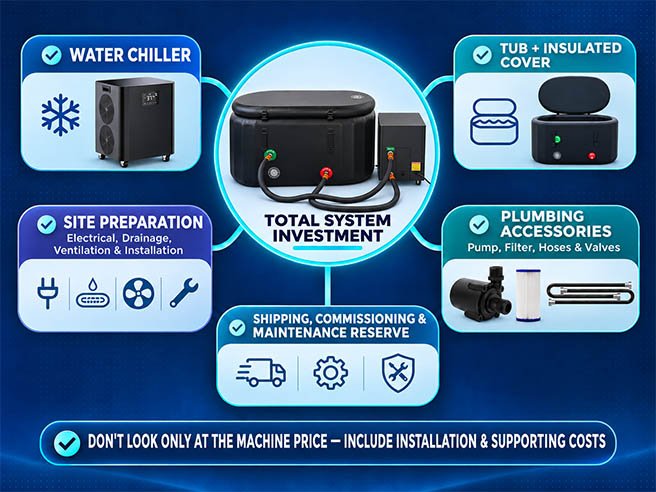
Price the installation that will actually operate, including everything needed to put it into service.
| Budget item | What to confirm |
|---|---|
| Chiller | Exact model, configuration and included components |
| Tub and cover | Usable water volume, insulation and compatibility |
| Water circuit | Pump, filter, hoses, valves and fittings not already included |
| Site work | Electrical supply, drainage, ventilation and installation |
| Delivery | Freight, handling and applicable import costs |
| Commissioning | Setup, checks and staff instruction |
| Opening supplies | Required consumables and initial service stock |
Avoid counting an integrated pump or filter twice. Separate optional upgrades from required items so you can see which costs change the business case.
If you already own a suitable tub, compare the incremental cost of adding the chiller. If the project needs a new tub, include it. Use the same scope on both sides of any comparison.
For a new recovery studio, the equipment budget is only part of the funding required. Premises, fit-out, launch costs and working capital also need a place in the forecast.
Our guide to ice bath chiller total cost of ownership helps structure the costs beyond the first invoice.
Estimate the Operating Costs You Will Actually Pay
Electricity
Use measured consumption for the complete system where possible.
Electricity cost = metered kWh × applicable electricity rate
For illustration, 144 kWh in a month at $0.15 per kWh costs $21.60. Neither figure represents a particular CHILLMEND model.
A calculation based only on compressor wattage may miss circulation, controls and water-treatment equipment. Include those loads if they are not already measured. Where the tariff includes additional demand or time-based charges, include the costs attributable to the installation.
Before purchase, request energy data with the water volume, ambient temperature, setpoint and operating schedule stated. After commissioning, replace estimates with measured figures.
Water, Consumables and Maintenance
Budget for water and drainage charges, treatment supplies, filter elements, cleaning and servicing. Use the exact configuration and intended usage to estimate quantities.
Do not assume refrigeration removes the need for water management. Do not reduce required cleaning or water changes to make the forecast look better.
Our ice bath operating-cost guide covers practical areas to review once the installation is running.
Labor and Service Overhead
Commercial operation may require preparation, cleaning, monitoring, booking administration and customer support. Include additional paid labor, payment fees and any additional premises or insurance costs.
An existing gym may incur little extra rent, but a room used for cold plunges could displace another paid service. Show that opportunity cost separately when comparing alternative uses of the space.
Home Example: Chiller Savings Versus Buying Ice
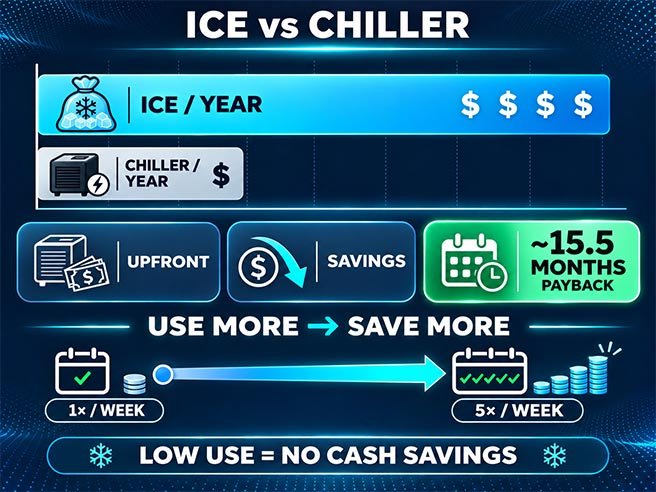
Consider a household that already owns a compatible tub and spends $8 on ice for each session. Assume four sessions a week for 52 weeks.
The annual ice bill would be:
$8 × 4 × 52 = $1,664
Now assume adding the chiller and required installation costs $1,500. The estimated additional annual operating cost is $500, including electricity, consumables and a maintenance allowance. Costs that are genuinely identical under both options are excluded from both.
| Measure | Illustrative result |
|---|---|
| Annual ice purchases avoided | $1,664 |
| Additional annual chiller operating costs | $500 |
| Annual net savings | $1,164 |
| Initial investment | $1,500 |
| Simple payback | Approximately 15.5 months |
| Three-year net savings after initial investment | $1,992 |
The three-year result is $1,164 × 3 − $1,500. It assumes unchanged usage and operating costs, with no additional major repair or replacement outlay beyond the allowance.
Frequency changes the result quickly. At one $8 session per week, annual ice spending is $416. With the same assumed $500 operating budget, the chiller would not produce cash savings. In practice, re-estimate operating costs for the lower usage rather than assuming they remain fixed.
The right comparison uses your own ice receipts and intended operating schedule. Convenience may still justify a purchase, but it should be shown separately from financial payback.
Commercial Example: Start With Net Contribution
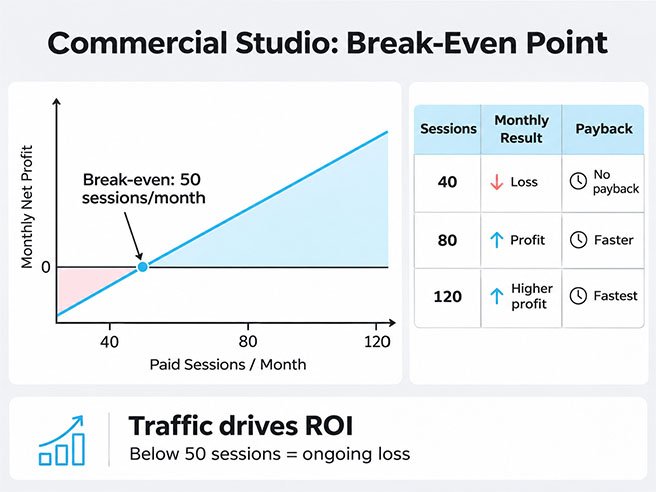
A gym considering paid cold plunge sessions needs a forecast of additional paid demand, not the total number of members who might try the service.
For an illustrative project, assume:
- Initial installed investment: $6,000
- Collected revenue per paid session: $15
- Variable operating cost per session: $3
- Additional fixed operating cash costs: $600 per month
The $3 represents session-related costs such as supplies, transaction fees and variable labor. The $600 represents the assumed recurring fixed costs. These are placeholders: build a complete cost list for your facility and count each cost once.
Each paid session contributes $12 before fixed costs. Monthly net contribution is therefore:
Paid sessions × $12 − $600
How Demand Changes Payback
| Paid sessions per month | Monthly revenue | Total operating costs | Monthly net contribution | Simple payback |
|---|---|---|---|---|
| 40 | $600 | $720 | −$120 | No positive payback |
| 80 | $1,200 | $840 | $360 | 16.7 months |
| 120 | $1,800 | $960 | $840 | 7.1 months |
These rows use the same installation and pricing assumptions. They show sensitivity to demand, not typical returns for different types of facility.
The operating break-even volume is 50 sessions per month: $600 ÷ ($15 − $3). At that volume the service covers the modeled operating costs but contributes nothing toward the $6,000 investment.
This follows the standard fixed-cost and per-unit contribution approach described by the U.S. Small Business Administration.
Operating Contribution Is Not Full Investment Recovery
At 80 paid sessions every month, annual operating contribution would be $4,320.
First-year simple project ROI would be:
($4,320 − $6,000) ÷ $6,000 × 100% = −28%
At the same contribution for 36 months:
($360 × 36 − $6,000) ÷ $6,000 × 100% = 116%
The project can generate positive monthly contribution before it has recovered its initial outlay. The 36-month result is cumulative and assumes no ramp-up, closures or additional major capital spending.
Allow for Launch Time, Downtime and Refunds
New demand rarely appears at its steady-state level on opening day.
Suppose the same project sells 40 sessions per month for the first three months, then 80 per month. It would lose $360 during the first three months before generating $360 per month thereafter.
Recovering the initial investment and those early losses takes approximately 20.7 months from launch. That is longer than the 16.7-month constant-demand estimate.
Use a month-by-month forecast if demand is seasonal or still developing. Include refunds, discounts, cancelled bookings, scheduled closures and servicing. During downtime, fixed expenses may continue even when session-related costs fall.
Record lost contribution rather than automatically treating every lost dollar of revenue as lost profit. Avoid subtracting cancelled sales twice if they are already removed from your revenue forecast.
Membership Upgrades Need Their Own Calculation
If 30 members pay an additional $20 per month specifically for cold plunge access, gross incremental revenue is $600 per month before service costs.
Do not also charge those included visits as separate session revenue in the forecast. If the upgrade includes several services, estimate the costs of the whole package and be clear about what revenue can reasonably be attributed to this addition.
Retention can matter, but it needs evidence. Keep unmeasured claims about lower churn out of the base case. Start with actual upgrades or paid bookings, then update the forecast as data becomes available.
What Can Improve Long-Term Return?
Match Equipment to the Operating Plan
Specify water volume, ambient conditions, target temperature and the time available between sessions. An installation that cannot meet the schedule can constrain bookable capacity.
More horsepower alone does not prove that a project will earn more. Compare performance under relevant conditions and choose a configuration suitable for the planned workload.
Control Heat Gain and Maintain the System
Review tub insulation, an appropriate cover, ventilation and routine maintenance. These factors can affect running costs and availability, but assign savings only after measuring or testing them.
Keep the water-management requirements and the manufacturer’s operating instructions in place. Cost control should come from a suitable installation and consistent care.
Confirm the Service Plan Before Ordering
Ask about diagnostic support, compatible parts, lead times and the division of responsibility for repairs. A warranty period alone does not identify labor, freight or downtime costs.
The CHILLMEND warranty and spare-parts guide provides questions for distributors and commercial buyers to resolve before purchase.
A Different ROI Model for Distributors
A distributor earns its return by selling and supporting equipment. Gym session revenue is not the right model for that business.
Start with net selling price and deduct landed product cost, selling expenses and expected after-sales costs. Then account for overhead, inventory investment and the time between paying the supplier and collecting customer payments.
A healthy margin per unit can still create cash pressure if stock sells slowly. Model trial-order quantities, inventory turnover, returns and warranty support alongside unit economics.
For private-label projects, include any development, packaging or testing costs that apply to the agreed configuration. Confirm these in the quotation instead of treating the factory unit price as the complete investment.
What to Prepare Before Requesting a CHILLMEND Quotation
A useful quotation starts with a clear project brief. Share:
- Intended use: home, gym, recovery studio or distribution
- Tub volume, target temperature and installation environment
- Expected daily usage and required cooling schedule
- Destination market and electrical requirements
- Equipment already available and components still needed
- Quantity, branding requirements and service expectations
Review the CHILLMEND ice bath chiller range and request a configuration-specific quotation. Use that quotation to replace the equipment assumptions in your model. Keep your own demand forecast separate from the supplier’s technical specification.
Frequently Asked Questions
How Long Does an Ice Bath Chiller Take to Pay for Itself?
Divide the complete initial investment by a realistic positive monthly net benefit. Use monthly cash flows if demand or expenses change. There is no universal payback period; an installation with no positive net benefit will not recover its cost under those assumptions.
Is a Chiller Cheaper Than Buying Ice?
It can be for frequent users with substantial ice expenses. Compare purchases actually avoided with the chiller’s installation and operating costs over the same period. Include repairs and any differences in water-management costs.
Can a Gym Make Money From Cold Plunge Sessions?
Paid sessions can generate a positive contribution when collected revenue exceeds the related operating costs. Recovering the initial investment requires additional time and sufficient demand. Membership counts alone do not demonstrate paid usage.
Does a Larger Chiller Produce a Better ROI?
Only if its capabilities are useful to the project and justify the additional cost. Match equipment to water volume, environmental conditions and service schedule. Confirm performance rather than using horsepower as a proxy for profitability.
What Should I Track After Installation?
Track paid visits or upgrades, collected revenue, electricity consumption, labor, consumables, service spending and downtime. For home use, track avoided ice purchases and additional operating expenses. Replace forecast inputs with these actual results.
Discuss Your Cold Plunge Project With CHILLMEND
A sound purchase decision brings together the installation requirements and a realistic operating budget.
Contact CHILLMEND with your application, water volume, destination market and expected quantity. Request the equipment specification, included components and service information needed to build a project-specific cost comparison.