
Article Summary
Ice bath chiller MOQ depends on whether a buyer needs a standard sample, a market trial order or a customized OEM production run. Buyers should evaluate cooling performance, electrical configuration, certification, branding, packaging and after-sales requirements before comparing minimum order quantities. This guide explains how brands, distributors and commercial cold plunge operators can move from product validation to repeat production with lower purchasing risk.
Quick Outline
- Why ice bath chiller MOQ matters
- What MOQ means for standard and customized chillers
- Sample orders for product and supplier validation
- Trial orders for market validation
- Mass production and supply consistency
- Factors that change MOQ
- How OEM and ODM projects are evaluated
- A practical purchasing framework
- Questions to send a manufacturer before requesting a quote
- Frequently asked questions
Why Ice Bath Chiller MOQ Matters for B2B Buyers
When a brand, distributor or commercial recovery operator contacts an ice bath chiller manufacturer, one of the first questions is usually:
What is your MOQ?
MOQ means minimum order quantity, but the number alone does not tell a buyer whether a project is commercially sensible.
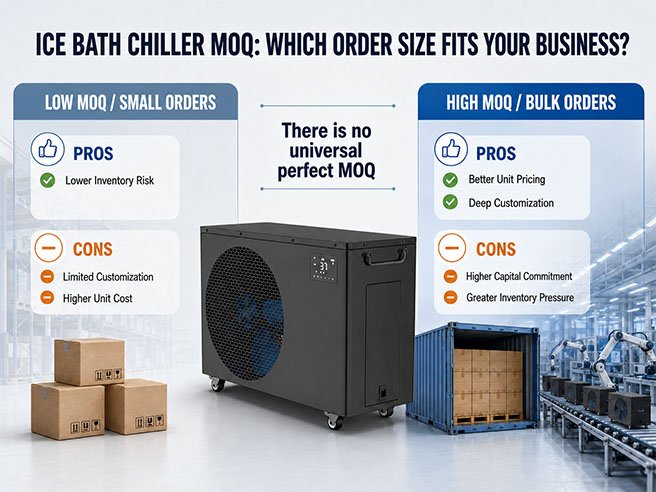
A low starting quantity can reduce inventory exposure, but it may also limit customization, packaging choices or unit-price efficiency. A larger order may support better production planning and deeper customization, but it requires more working capital, storage space and confidence in market demand.
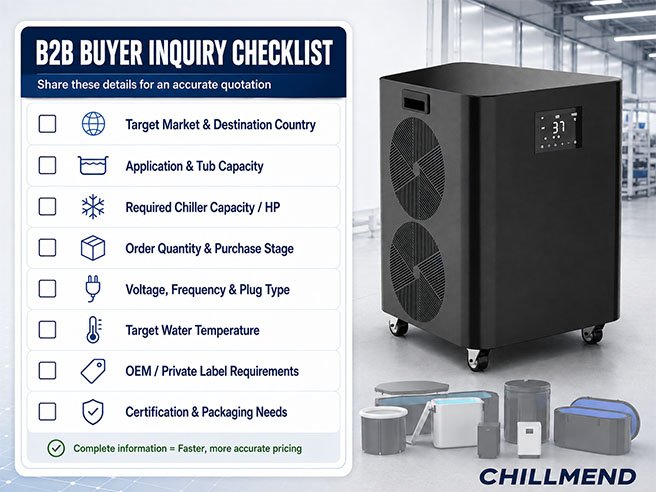
For this reason, professional ice bath chiller sourcing normally develops through three stages:
- Sample order: verify the product and evaluate the supplier.
- Trial order: validate market demand and operating requirements.
- Mass production: establish repeatable supply, quality control and delivery planning.
The right MOQ is therefore not simply the smallest number a supplier will accept. It is the quantity that matches the buyer’s current validation stage, customization scope and sales plan.
What Is MOQ for Ice Bath Chillers?
MOQ is the smallest quantity a manufacturer is prepared to supply under a defined product and commercial configuration.
Ice bath chillers are more complex than basic consumer accessories. Production may involve:
- Compressors and refrigeration circuits
- Pumps, filters and water circulation components
- Control boards and temperature sensors
- Model-specific housings and internal layouts
- Voltage, frequency and plug configurations
- Functional, leakage and electrical inspections
- Product packaging, manuals and accessories
These elements affect material purchasing, assembly scheduling, testing and packaging. As a result, one MOQ should not be assumed to apply to every model or project.
Standard Model MOQ
A standard model with an existing housing, established components and regular packaging can usually support a more flexible starting quantity than a newly developed product.
The buyer may still need to confirm:
- Model availability
- Voltage and plug type
- Destination market
- Shipping method
- Required accessories
- Certification compatibility
OEM Ice Bath Chiller MOQ
OEM projects use an existing product platform but add brand-specific elements such as:
- Logo application
- Color selection
- Customized packaging
- Branded manuals
- Label and rating-plate changes
- Accessory combinations
MOQ may increase when the customization requires dedicated materials or a separate production setup.
ODM and New Product Development MOQ
ODM or co-development projects can involve a new enclosure, control logic, refrigeration configuration, tooling or structural design. These projects require engineering work and production validation, so the commercial commitment is normally different from ordering a standard model.
Buyers should separate three questions:
- What is the MOQ for an existing standard model?
- What is the MOQ for private-label customization?
- What volume or development commitment is required for a new design?
This prevents a standard-product quotation from being incorrectly compared with a full ODM proposal.
Sample Orders: Validate the Product and the Supplier
A sample order is usually the first practical step before a buyer commits to inventory or customization.
Product photographs and specification sheets cannot fully demonstrate:
- Real cooling speed under local ambient conditions
- Temperature stability over repeated use
- Pump flow and water circulation
- Operating noise
- Condensation and drainage behavior
- Filter access and routine maintenance
- Installation experience
- Packaging protection during transport
A sample should be treated as both a product test and a supplier evaluation.
What to Test on an Ice Bath Chiller Sample
Cooling Performance
Record the starting water temperature, target temperature, water volume, ambient temperature and total cooling time. A cooling claim without test conditions is difficult to compare.
Temperature Stability
Check whether the chiller can maintain the selected temperature during normal operating cycles rather than only reaching it once.
Noise and Installation
Evaluate the product in the intended environment. A gym, hotel, recovery studio and private home can have different expectations for noise, ventilation and appearance.
Water Circulation and Filtration
Confirm pump performance, hose connections, filter accessibility and the maintenance routine required for the planned tub.
Electrical and Market Compatibility
Verify voltage, frequency, plug type, rating labels and the certification documentation relevant to the destination market.
Packaging and Documentation
Inspect the carton, protective materials, accessories, manual and installation guidance. These details influence damage rates and customer support after launch.
How Many Sample Units Should a Buyer Order?
There is no universal sample quantity. One unit may be sufficient for basic engineering validation. Multiple units may be justified when a buyer needs to:
- Test more than one power level
- Compare home and commercial applications
- Evaluate different climates or regions
- Send units to technical, sales and compliance teams
- Run parallel tests in a gym, spa or recovery center
The quotation should state whether the sample is a standard production unit, a branded sample or an engineering prototype because the cost and lead time can differ.
Trial Orders: Validate Market Demand Before Scaling
After a sample passes technical review, a buyer may move to a trial order.
A sample answers: Does the product perform as expected?
A trial order answers: Can the product be sold, installed and supported successfully in this market?
Trial orders are particularly useful for:
- New cold plunge brands
- Fitness equipment distributors
- Regional dealers
- Online retailers
- Gym and wellness groups
- Commercial recovery projects with phased installation
What a Trial Order Should Validate
- Customer response to the product concept
- Acceptable retail or project pricing
- Preferred power and feature configuration
- Installation questions from real users
- Packaging durability in normal distribution
- Common after-sales requests
- Spare-parts and maintenance requirements
- Actual reorder speed
Rather than choosing a trial quantity from a generic online recommendation, buyers should estimate:
- Number of sales or project locations
- Expected sales during the test period
- Demonstration and replacement units
- Shipping lead time
- Reorder lead time
- Available warehouse space
- Cash-flow tolerance
For example, a regional distributor testing one market requires a different quantity from a gym group installing equipment across several locations. The correct trial order is the smallest quantity that can generate reliable commercial feedback without creating unnecessary inventory.
Mass Production: Move From Testing to Repeatable Supply
Mass production begins when the product, market positioning and commercial configuration have been validated.
At this stage, purchasing decisions should focus on consistency rather than only unit price.
A repeat production program requires:
- Stable component specifications
- Approved samples and configuration records
- Defined inspection standards
- Production and delivery schedules
- Packaging and labeling control
- Spare-parts planning
- Clear after-sales responsibilities
- Change-management procedures
Typical Ice Bath Chiller Production Stages
1. Order and Specification Confirmation
The manufacturer and buyer confirm the model, voltage, plug, accessories, branding, packaging, labeling, manuals and destination requirements.
2. Component and Material Preparation
Compressors, pumps, filters, controllers, heat exchangers, housings and electrical components are prepared according to the approved configuration.
3. Assembly and Functional Testing
Production should include checks appropriate to the model, such as refrigeration performance, water circulation, leakage, controls, electrical operation and appearance.
4. Final Inspection and Packaging
The finished units are checked against the approved order specification before accessories and documentation are packed.
5. Shipment and After-Sales Preparation
Commercial buyers should receive the documents, maintenance guidance, spare-parts information and support contacts needed for their market.
Factors That Affect Ice Bath Chiller MOQ
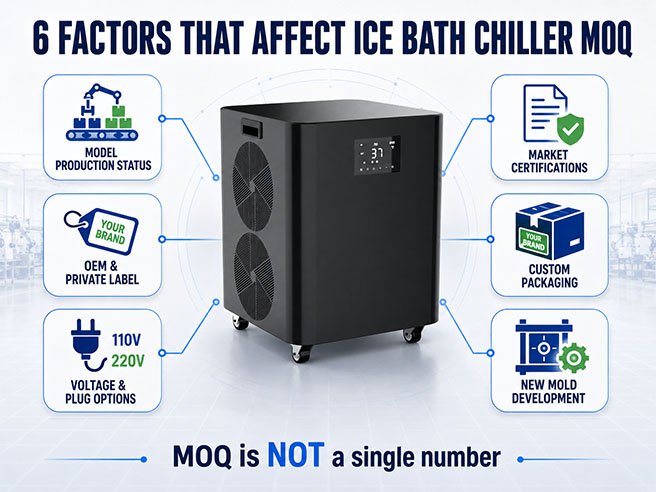
Product Model and Production Status
An actively produced standard model may support a different MOQ from a low-volume model or a newly developed configuration.
Branding and Customization
Logo application may require less commitment than a custom color, exclusive housing or newly developed control system. Buyers should request separate MOQ levels for each customization item.
Voltage, Frequency and Plug Type
Electrical configurations such as 110V/60Hz and 220–240V/50Hz affect component selection, labels, testing and production grouping.
Certification and Destination Market
Certification requirements vary by model, configuration and market. Buyers should not assume that one certificate covers every product version or country. Required documentation should be confirmed before the order is finalized.
Packaging and Printed Materials
Custom cartons, molded inserts, manuals, barcodes, labels and marketing materials often have their own supplier minimums. Packaging MOQ can therefore be different from equipment MOQ.
Tooling and New Product Development
New molds, structural parts or electronic development can require tooling charges, engineering validation and a larger production commitment.
Lead Time and Component Planning
Smaller or urgent orders are not always faster if they require a special production setup. Component availability and production scheduling should be discussed together with MOQ.
How Manufacturers Evaluate OEM and ODM Orders
A professional manufacturer normally considers the complete project rather than responding with one number before requirements are known.
Important evaluation questions include:
- Is the requested model already in regular production?
- Which parts of the product need customization?
- Is new tooling or engineering work required?
- Which voltage and market standards apply?
- Does the buyer need custom packaging or documentation?
- What is the forecast after the sample and trial stages?
- Will future orders use the same approved configuration?
A useful inquiry therefore gives the manufacturer enough information to propose a staged plan.
Instead of asking only for the lowest MOQ, a buyer can explain:
We plan to validate one or more samples, launch a controlled trial order and increase volume after sales and installation feedback are confirmed. Please quote the standard, private-label and customized options separately.
This creates a clearer basis for comparing suppliers.
A Practical Three-Stage Purchasing Framework
| Stage | Main objective | Buyer should confirm | Decision before moving forward |
|---|---|---|---|
| Sample | Product and supplier validation | Performance, installation, electrical configuration, documentation and support | Does the product meet the technical and market requirements? |
| Trial order | Market and operational validation | Sales response, preferred model, packaging, support workload and reorder timing | Is there enough evidence to scale responsibly? |
| Mass production | Repeatable supply and growth | Approved specification, QC process, lead time, packaging, spare parts and forecast | Can both parties maintain consistent quality and delivery? |
This framework reduces the risk of making a mass-production decision before the product and market have been properly tested.
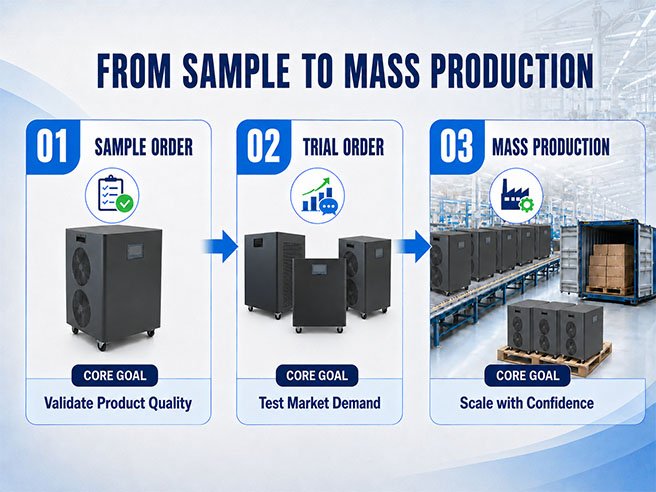
Questions to Send an Ice Bath Chiller Manufacturer
To receive a useful MOQ and quotation, include:
- Buyer type: brand, distributor, gym, hotel, clinic or project contractor
- Destination country and market
- Intended application
- Required water volume and target temperature
- Indoor or outdoor installation
- Expected ambient conditions
- Preferred chiller power or model
- Voltage, frequency and plug type
- Estimated sample, trial and annual quantities
- Logo, color, packaging and manual requirements
- Certification or compliance requirements
- Desired delivery schedule
Buyers should also ask:
- Is the sample identical to the future production version?
- Which customization options are available at each MOQ level?
- What is included in the quoted price?
- How is the production configuration documented and approved?
- Which quality-control checks are performed?
- What spare parts and after-sales support are available?
- What changes between sample, trial and mass-production lead times?
CHILLMEND Support From Sample to Mass Production
CHILLMEND works with cold plunge brands, distributors and commercial recovery buyers at different purchasing stages.
Depending on the selected model and project requirements, cooperation can include:
- Standard product evaluation
- Sample and trial-order planning
- OEM and private-label support
- Packaging and documentation coordination
- Electrical configuration review
- Production and quality-control planning
- Commercial project configuration
- After-sales and spare-parts coordination
MOQ, pricing, customization availability and lead time should be confirmed against the specific model, destination market and order requirements. This avoids presenting a general quantity as a promise for every project.
Buyers can review CHILLMEND’s OEM and private-label capabilities, manufacturing and quality-control process, certification support and ice bath chiller models before requesting a quotation.
Frequently Asked Questions About Ice Bath Chiller MOQ
1. What is the MOQ for an ice bath chiller?
MOQ depends on the model, production status, electrical configuration, branding, packaging and development requirements. Standard products may support a more flexible starting quantity than customized OEM or ODM projects. Buyers should request a model-specific quotation.
2. Can I order one sample before placing a larger order?
Sample availability depends on the selected model and current production arrangement. When available, a sample can help buyers evaluate cooling performance, noise, installation, filtration, documentation and supplier support before committing to a trial or production order.
3. What is the difference between a sample and a trial order?
A sample is primarily used for product and supplier verification. A trial order is used to test real sales, installation, customer feedback and after-sales requirements in the target market.
4. Does private-label branding increase MOQ?
It can. Simple logo application may have a different MOQ from custom colors, cartons, manuals, control interfaces, housings or structural changes. Each customization item should be quoted separately.
5. Does custom packaging have a separate MOQ?
Often it does. Carton, insert, label and manual suppliers may have production minimums that differ from the equipment quantity. Buyers should ask whether packaging materials can be stored for repeat orders.
6. Should I choose the supplier offering the lowest MOQ?
Not automatically. MOQ should be evaluated together with technical capability, product consistency, certification support, quality control, lead time, spare parts and after-sales service. A low starting quantity does not compensate for an unsuitable product or unreliable supply.
7. When should a buyer move to mass production?
Mass production is appropriate after the product configuration has been approved, sample performance has been verified, trial-order feedback is positive and the buyer has a realistic sales or project forecast.
Discuss Your Ice Bath Chiller Order Plan
Whether you are evaluating a first sample, preparing a regional trial order or planning repeat OEM production, provide CHILLMEND with your market, application, model requirements, electrical configuration, customization scope and estimated quantity.
Contact CHILLMEND to request a model-specific MOQ, technical proposal and B2B quotation.
For Brands, Distributors & Commercial Buyers
If you are evaluating equipment for resale, private label or a commercial cold plunge project, compare more than cooling specifications. Review manufacturing capability, customization scope, compliance support, quality control, warranty and spare-parts availability.