
Article Summary
Launching a private label ice bath chiller involves more than adding a logo to an existing machine. Wellness brands need to define their target users, select the right product platform, verify cooling and water-system performance, confirm market-specific electrical and compliance requirements, test samples, and establish a repeatable quality-control process. This guide explains the journey from product planning to trial orders and mass production so that brands can reduce sourcing risk and build a more reliable cold plunge product line.
Quick Outline
- What a private label ice bath chiller is
- When private labeling is the right business model
- Define the target market and product position
- Evaluate a manufacturing partner
- Select the appropriate customization level
- Confirm technical specifications
- Validate samples, MOQ and production plans
- Review quality control and market requirements
- Prepare for launch and after-sales support
- Questions to ask before starting a project
What Is a Private Label Ice Bath Chiller?
A private label ice bath chiller is manufactured on an established product platform and sold under another company’s brand. Depending on the project, the product can include a customized logo, labels, manuals, packaging, colors, accessories or selected functions.
Private labeling is different from developing a completely new machine. It normally starts with a manufacturer’s existing refrigeration and water-circulation platform, then adapts selected elements to match the buyer’s market and brand identity.
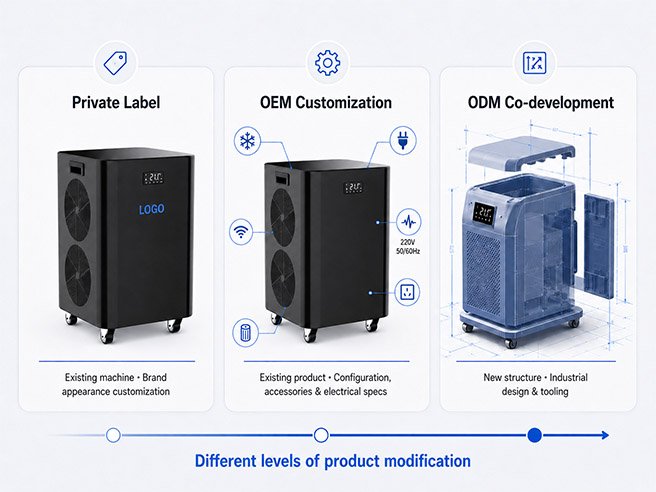
The terms private label, OEM and ODM are sometimes used interchangeably, but they can describe different levels of work:
- Private label: an established product with brand-specific presentation.
- OEM customization: an existing platform adapted to defined branding, configuration or feature requirements.
- ODM or co-development: deeper engineering work involving structure, tooling, control logic or a substantially different product design.
Clarifying the required level at the beginning helps the buyer obtain a relevant quotation, realistic minimum order quantity and appropriate development schedule.
When Is Private Labeling the Right Model?
Private labeling can suit wellness brands, distributors and recovery-equipment companies that want to add a branded chiller without building refrigeration manufacturing capabilities from the ground up.
It may be a practical choice when a company wants to:
- Expand an existing fitness, recovery or wellness product range
- Enter the cold plunge market with a validated product platform
- Test demand before investing in a fully proprietary design
- Offer market-specific voltage, plug, packaging or accessories
- Build a consistent branded experience around equipment and support
However, private labeling is not automatically the best option for every project. A buyer seeking an entirely new enclosure, refrigeration system or control architecture may need an ODM development process rather than a standard private-label order.
The first decision should therefore be based on the product objective—not simply on the lowest quoted price.
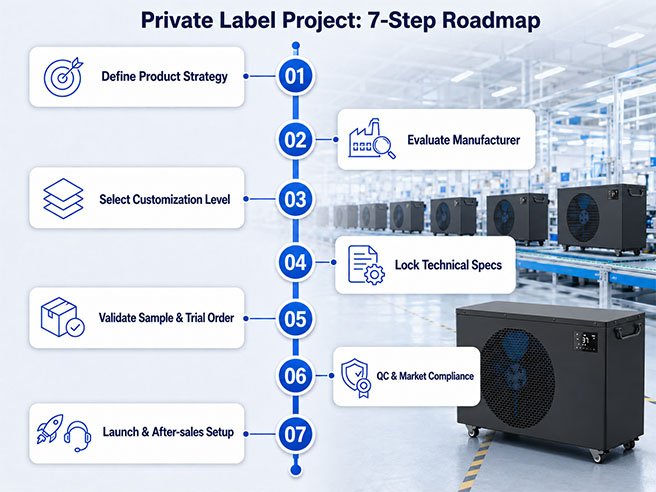
Step 1: Define the Product Strategy
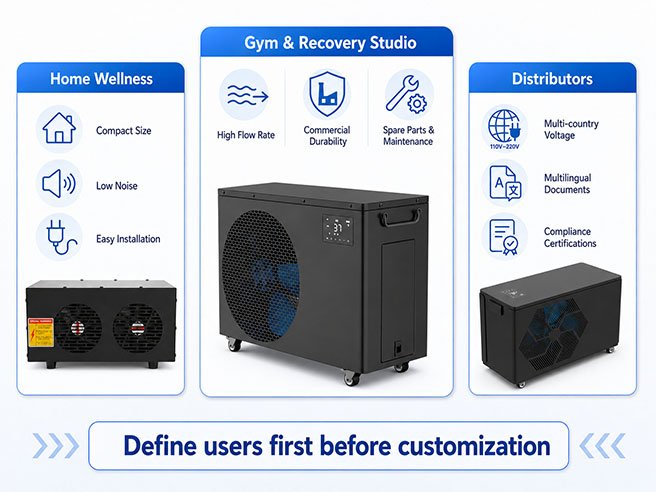
Before contacting a supplier, define who will use the product, where it will operate and how it will be sold. These decisions determine the appropriate cooling capacity, water-system design, controls, installation requirements and level of customization.
Home Wellness Customers
Residential buyers often prioritize:
- Compact dimensions
- Manageable operating noise
- Simple installation and controls
- Energy use appropriate for regular home operation
- Appearance that suits indoor or outdoor wellness spaces
- Clear maintenance instructions
Gyms, Recovery Studios and Sports Facilities
Commercial operators may need:
- Cooling capacity matched to larger water volume and frequent use
- Stable operation under higher heat load
- Accessible filters and service components
- Defined cleaning and water-care procedures
- Durable connections and practical installation layouts
- Responsive technical and spare-parts support
Distributors and Multi-Market Brands
Distributors also need to consider:
- Voltage, frequency and plug variants
- Documentation languages
- Packaging suitable for the chosen logistics channel
- Replacement parts and warranty procedures
- Product consistency across repeat orders
- Compliance expectations in each destination market
A useful product brief should specify the target user, tub volume, desired temperature, ambient conditions, expected usage frequency, installation environment, target market and price position. Without this information, even an experienced manufacturer can only make a general recommendation.
Step 2: Evaluate the Manufacturing Partner
An attractive sample is important, but it does not show whether a supplier can consistently support repeat production. Buyers should evaluate engineering, manufacturing, quality control and after-sales capabilities together.
Relevant Refrigeration and Water-System Experience
An ice bath chiller combines refrigeration, water circulation, temperature control and electrical components. Ask how the supplier validates:
- Cooling performance under stated water volume and ambient temperature
- Water flow, pump compatibility and pressure requirements
- Refrigerant-system integrity
- Leakage prevention
- Temperature sensing and control stability
- Protection functions and electrical configuration
OEM and Engineering Capability
The supplier should distinguish cosmetic changes from engineering changes. Logo application and packaging are not equivalent to modifying the enclosure, control system or refrigeration circuit.
Ask which requests can be completed on an existing platform and which require:
- Engineering evaluation
- Prototype development
- New tooling
- Additional testing
- A different MOQ or lead time
Production and Quality-Control Capacity
Review whether the supplier can move from a successful sample to consistent batches. Useful evidence can include:
- Production and assembly processes
- Incoming-component inspection
- In-process inspection points
- Finished-unit functional testing
- Batch traceability
- Handling of nonconforming products
- Packaging and pre-shipment checks
CHILLMEND’s dedicated manufacturing and quality-control page should carry the detailed factory evidence. This article is intended to help buyers understand what evidence to request rather than duplicate the core manufacturing page.
Step 3: Choose the Appropriate Customization Level
Successful customization begins with commercial priorities. Adding every possible option can increase cost, complexity and validation work without necessarily improving the customer experience.
Brand Identity
Common private-label elements include:
- Logo placement
- Product and rating labels
- Branded manuals and warranty cards
- Packaging artwork
- Accessory presentation
- Approved product photography or sales materials
Brand assets should be supplied in the manufacturer’s required format, and the buyer should approve placement, color and production proofs before mass production.
Appearance and Product Configuration
Depending on the product platform and order scope, possible changes may include:
- Housing color or surface treatment
- Panel or interface appearance
- Handle and wheel configuration
- Connection layout
- Accessory combinations
- Market-specific electrical configuration
Not every platform supports every change. Structural modifications can affect airflow, noise, waterproofing, service access or compliance, so they require engineering review rather than visual approval alone.
Feature Selection
Select functions according to the buyer’s actual use case. Examples can include temperature controls, filtration arrangements, connectivity or accessory packages, but availability must be confirmed for the selected model.
A premium product is not defined by the longest feature list. Reliability, ease of use, serviceability and consistent performance often create more value than functions that customers rarely use.
Step 4: Confirm Technical Specifications Before Sampling
The quotation and sample specification should define the operating conditions used to evaluate performance. A horsepower label alone cannot determine whether a chiller is suitable for a specific cold plunge.
Cooling Conditions
Confirm:
- Tub water volume
- Starting and target water temperatures
- Expected pull-down time
- Ambient temperature range
- Indoor or outdoor installation
- Frequency and duration of use
- Whether users enter the water repeatedly during operation
Cooling performance varies with heat load, insulation, plumbing, water volume and ambient conditions. Buyers should request test conditions alongside performance data rather than comparing isolated capacity claims.
Water Circulation and Connections
Check:
- Recommended flow range
- Pump and filter configuration
- Hose or pipe connection size
- Maximum practical plumbing distance
- Priming and drainage requirements
- Filter access and replacement procedure
A chiller can only perform reliably when the complete water circuit is correctly sized and installed.
Temperature Control
Review the adjustable range, control accuracy, sensor placement and operating logic. The lowest displayed setting should not be treated as proof that every tub can reach that temperature under all conditions.
Noise and Installation
Noise depends on the compressor, fan, housing, mounting surface and installation environment. If quiet operation is commercially important, agree on the test method and conditions used to report it.
Also confirm clearance, ventilation, drainage, weather exposure and service access. Incorrect placement can reduce cooling performance and shorten component life.
Electrical Configuration
Confirm the destination market, voltage, frequency, plug type, rated power and circuit requirements before production. A plug change alone does not make a product electrically suitable for a different market.
Step 5: Validate Samples, MOQ and Production Plans
Private-label projects usually progress through sample validation, a trial order and repeat production. Each stage answers a different commercial question.
Sample Validation
The sample should verify the agreed specification and the supplier’s communication process. Test it under conditions that reflect the intended market, including:
- Cooling time and temperature stability
- Water circulation and connections
- Noise in the intended environment
- Controls and user experience
- Installation and maintenance steps
- Packaging condition after transport
- Manuals, labels and accessories
Record the test conditions and requested corrections in writing. This creates a clearer approved reference for the next production stage.
Trial Order
A trial order can help the brand evaluate:
- Customer response
- Installation questions
- Shipping damage risk
- Support workload
- Return reasons
- Packaging and documentation quality
- Suitability of the sales price and channel
The trial stage is most useful when feedback is collected systematically rather than treated only as a small sales batch.
MOQ and Lead Time
MOQ depends on the product model, customization scope, dedicated materials, packaging, tooling and production setup. Buyers should request separate terms for:
- A standard evaluation sample
- A private-label trial order
- Repeat production using the approved configuration
- Any structural or ODM development work
For a detailed purchasing framework, see the guide to ice bath chiller MOQ, sample orders and mass production.
Step 6: Review Quality Control and Market Requirements
Quality planning should be agreed before production, not added after products are complete.
Incoming and In-Process Inspection
The quality plan may cover compressors, pumps, heat exchangers, control boards, electrical components and product-specific materials. During assembly, inspection points should address workmanship, connections, refrigerant-system integrity, water leakage and electrical assembly.
Finished-Unit Testing
The scope should be documented for the selected model and may include:
- Power-on and control checks
- Cooling and temperature-control testing
- Water-circuit and leakage testing
- Protection-function checks
- Appearance and labeling inspection
- Accessories and packaging verification
Buyers should ask whether every finished unit or a defined sample from each batch receives a particular test. General statements such as “100% tested” are meaningful only when the test items and acceptance criteria are clear.
Certifications and Destination-Market Compliance
Requirements vary by country, product configuration, voltage and sales channel. CE marking, North American certification routes, Australian requirements and other market obligations are not interchangeable.
Before placing an order, the buyer should confirm:
- The exact model and configuration covered by available documents
- Whether requested modifications affect existing test reports or certifications
- Which party is responsible for importer, labeling and registration obligations
- Whether additional laboratory evaluation is required
- Which claims and certification marks may legally appear on the product or packaging
Review CHILLMEND’s available certification information and request model-specific documentation for the intended destination. Final compliance should be confirmed for the buyer’s product configuration and market.
Step 7: Prepare the Brand for Launch and After-Sales Support
Manufacturing is only one part of a successful private-label program. Before launch, the brand should prepare the customer experience around the product.
Sales and Technical Content
Useful materials can include:
- Accurate specification sheets
- Installation and setup instructions
- Plumbing diagrams
- Maintenance schedules
- Filter and accessory information
- Troubleshooting guidance
- Product comparison charts
- Training content for distributors or installers
Marketing claims should match the validated configuration and test conditions. Avoid publishing universal cooling-time, noise or minimum-temperature claims if performance depends on water volume and climate.
Warranty and Service Workflow
Define how the brand will handle:
- Pre-installation questions
- Fault diagnosis
- Replacement parts
- Warranty evidence
- Returns and damaged shipments
- Escalation to the manufacturer
CHILLMEND provides a one-year warranty and after-sales support through its California warehouse and service point in the United States. Buyers should confirm the applicable service scope, parts arrangements and destination coverage for their individual project before making customer-facing promises.
Repeat Production and Product Improvement
Track customer feedback by model, batch and issue type. This helps the brand and manufacturer distinguish installation problems from packaging, component or design issues and prioritize future improvements.
Questions to Ask Before Starting a Private-Label Project
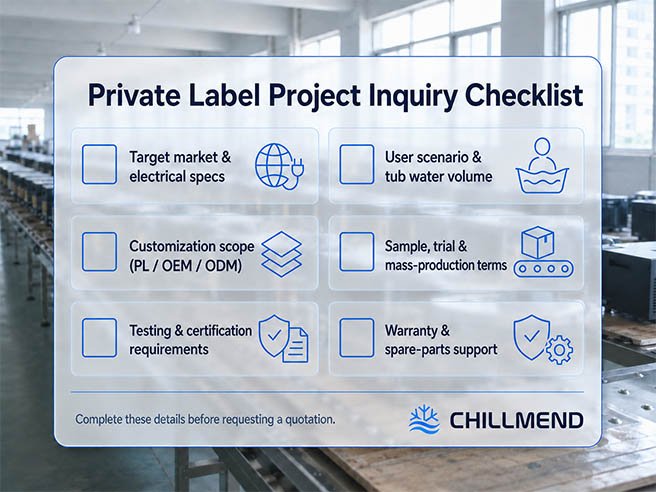
Send manufacturers a structured brief and request written answers to questions such as:
- Which existing model best matches our water volume, climate and usage frequency?
- What operating conditions were used for the cooling-performance data?
- Which branding and configuration changes are available on this platform?
- Which requests require new tooling or engineering validation?
- What are the sample, trial-order and repeat-production terms?
- What voltage, frequency and plug configurations are supported?
- Which documents apply to the exact model and target market?
- What testing is performed during assembly and before shipment?
- How are approved specifications and production changes controlled?
- What warranty, spare-parts and technical-support arrangements are available?
- What packaging tests or shipping protections are used?
- What information is required to prepare a model-specific quotation?
Clear answers make it easier to compare suppliers on engineering fit, manufacturing reliability and long-term support—not just unit price.
Working With CHILLMEND on a Private Label Ice Bath Chiller
CHILLMEND supports B2B buyers developing branded cold plunge cooling products. The company was established in 2022 and its HVAC experience dates to 2010. Its manufacturing operation includes a 5,000-square-meter facility, two production lines, a 10-person research and development team, and stated annual capacity of 10,000 units.
Project support can cover model selection, branding, market-specific electrical configurations, packaging, documentation, sample validation and production planning. The final customization scope, MOQ, timeline and compliance path are confirmed according to the selected product and destination market.
Buyers can review CHILLMEND’s OEM and private-label capabilities, manufacturing process, ice bath chiller models and certification information before requesting a proposal.
Frequently Asked Questions
What is a private label ice bath chiller?
It is an ice bath cooling product manufactured on an established platform and sold under the buyer’s brand. Customization may include logos, labels, manuals, packaging, colors, accessories or selected configurations.
Is private label the same as OEM or ODM?
Not always. Private label usually focuses on branding an existing platform. OEM can include additional configuration changes, while ODM or co-development may involve deeper structural, tooling or engineering work. The terminology should be defined in the quotation and specification agreement.
Can a wellness brand order a sample first?
Sample availability depends on the selected model and configuration. A sample is normally used to validate performance, installation, appearance, documentation and supplier communication before a trial or repeat order.
What is the MOQ for a private label ice bath chiller?
There is no universal MOQ. It depends on the model, branding method, packaging, electrical configuration, dedicated materials and required engineering work. Buyers should request separate terms for samples, trial orders and repeat production.
Can the housing and functions be customized?
Available options depend on the product platform. Cosmetic changes may be relatively straightforward, while structural or functional changes can require engineering evaluation, tooling and additional validation.
Which certification does my market require?
That depends on the destination, product configuration and sales channel. Buyers should verify that documents cover the exact model and should obtain professional compliance advice where required. A certification associated with one configuration should not automatically be assumed to cover a modified product.
How should a brand compare manufacturers?
Compare product fit, test conditions, engineering capability, quality-control evidence, compliance support, production consistency, documentation and after-sales arrangements. The lowest quotation does not necessarily represent the lowest total sourcing risk.
Discuss Your Private Label Project
Planning a branded cold plunge product line requires a clear product brief and model-specific evaluation. Share your target market, application, expected water volume, temperature requirements, electrical configuration, customization scope and estimated order stage with CHILLMEND.
Contact CHILLMEND to discuss a private label ice bath chiller sample, trial order or production proposal.
For Brands, Distributors & Commercial Buyers
If you are evaluating equipment for resale, private label or a commercial cold plunge project, compare more than cooling specifications. Review manufacturing capability, customization scope, compliance support, quality control, warranty and spare-parts availability.