
Article Summary
OEM ice bath chiller cost is determined by more than the factory unit price. The selected product platform, cooling configuration, branding scope, electrical version, tooling, testing, packaging, order quantity and destination-market requirements can all affect the final quotation. This guide explains how B2B buyers can compare OEM proposals, understand one-time and recurring costs, and plan samples, trial orders and repeat production without sacrificing product reliability.
Quick Outline
- What determines OEM ice bath chiller cost
- OEM, private label and ODM cost differences
- When tooling is required
- How MOQ affects unit pricing
- Why bulk prices change by order volume
- Costs commonly missed in a quotation
- How to compare suppliers using total landed cost
- How to reduce OEM investment risk
- Information required for an accurate quotation
- Frequently asked questions
What Determines OEM Ice Bath Chiller Cost?
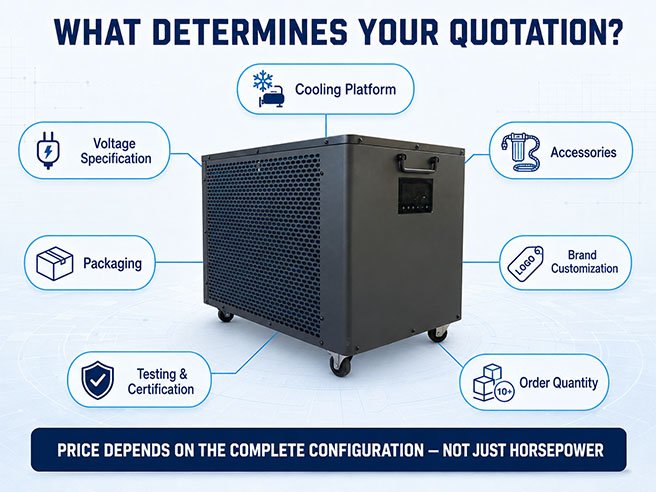
When a brand or distributor asks, “How much does an OEM ice bath chiller cost?”, a manufacturer cannot provide a meaningful answer from horsepower alone.
An accurate quotation depends on the complete commercial and technical configuration, including:
- Product model and refrigeration platform
- Target water volume and temperature
- Ambient and installation conditions
- Pump, filtration and accessory configuration
- Voltage, frequency and plug type
- Branding and appearance requirements
- Packaging and documentation
- Testing and destination-market requirements
- Sample, trial or repeat-production quantity
- Tooling or engineering development
- Delivery terms and shipping method
Two chillers described as having the same nominal horsepower may use different compressors, heat exchangers, pumps, controls, housings, tests and accessories. For this reason, a price comparison is useful only when suppliers are quoting against the same specification and commercial terms.
OEM, Private Label and ODM Follow Different Cost Paths
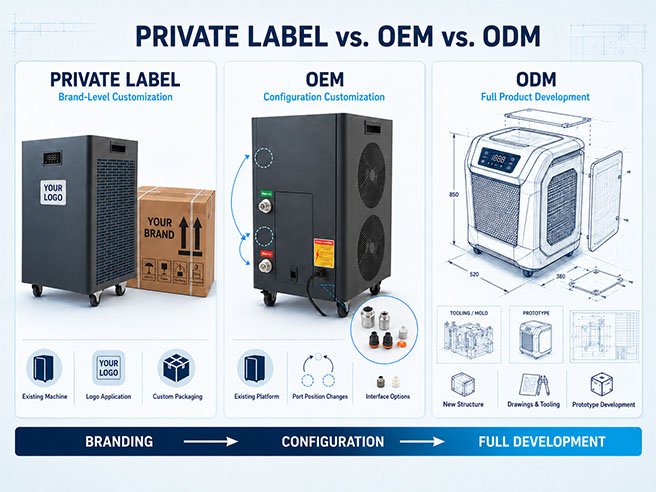
Buyers often use OEM, private label and ODM as interchangeable terms. In practice, the required customization level changes both the initial investment and the recurring unit cost.
Private Label on an Existing Platform
A private-label project normally uses an established product platform and adds selected brand elements, such as:
- Logo application
- Product labels
- Branded manuals
- Packaging artwork
- Approved colors or accessories
- Market-specific electrical configuration
This route generally requires less engineering work than a structurally new product. However, printing methods, packaging quantities and dedicated materials may still create setup charges or minimum purchase requirements.
OEM Configuration
An OEM project can extend beyond presentation changes. It may involve a defined combination of components, controls, connections, filtration, accessories or appearance options based on an existing platform.
The manufacturer should identify which requirements are already validated and which changes need additional testing. Even a seemingly small modification can affect airflow, electrical loading, water flow, service access or documentation.
ODM or Co-Development
ODM and co-development projects can include:
- New enclosure or structural design
- Custom control logic or interface
- New component arrangement
- Dedicated tooling
- Prototype iterations
- Additional performance or compliance evaluation
These projects normally involve non-recurring engineering and development costs before repeat production begins. Buyers should not compare an ODM quotation directly with a logo-only private-label quotation.
For a detailed overview of brand development steps, read the private label ice bath chiller guide.
Tooling Cost: When Is New Tooling Required?
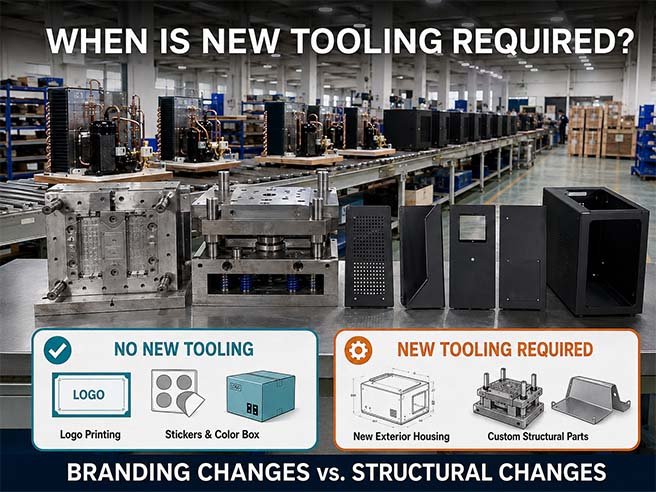
Tooling refers to molds, dies, fixtures or other dedicated production equipment used to manufacture a specific part or product configuration. Not every OEM ice bath chiller project requires new tooling.
Changes That May Not Require New Product Tooling
An existing platform may support the following without a completely new product mold:
- Logo plates, decals or printing
- Branded cartons and manuals
- Existing color options
- Approved accessory combinations
- Labels for a supported electrical version
These changes can still involve artwork preparation, printing plates, samples or supplier minimums. “No new mold” does not necessarily mean “no setup cost.”
Changes That May Require Tooling or Engineering Investment
Dedicated investment may be required for:
- A new plastic or metal housing
- Custom front panels or structural components
- New handles, wheels or mounting parts
- A different internal component layout
- Proprietary connection or accessory designs
- Dedicated assembly or testing fixtures
The manufacturer should explain whether a charge covers design work, prototypes, molds, fixtures or validation. These are different deliverables and should not be grouped under an undefined “tooling fee.”
Questions to Ask About Tooling Ownership
Before approving tooling, document:
- What exact parts and work are included?
- Who owns the finished tooling?
- Where will it be stored and maintained?
- Is its expected service life defined?
- Who pays for repair or replacement?
- Can it be used for another buyer’s product?
- Are prototype and design revisions included?
- What happens if the project is discontinued?
These terms affect exclusivity, long-term supply and the buyer’s ability to recover the development investment.
Should a New Brand Invest in Tooling Immediately?
The answer depends on market validation and the commercial value of differentiation. A new brand can often reduce initial exposure by validating an established platform before developing an exclusive enclosure or structure.
Tooling may become commercially sensible when the brand has reliable demand, a clear product specification and evidence that the new design will improve positioning, installation, serviceability or customer value.
How MOQ Affects OEM Ice Bath Chiller Pricing
MOQ affects pricing because production involves costs that do not increase proportionally with each unit. Material purchasing, production scheduling, assembly setup, artwork preparation, inspection planning and packaging setup must be completed even for a relatively small batch.
When these costs are spread across fewer units, the unit price is normally higher. As quantity increases, some costs can be distributed more efficiently, but the relationship is not unlimited or perfectly linear.
Sample Orders
A sample usually carries a higher unit cost because it may require individual preparation, configuration, testing and export packaging. Its purpose is product and supplier validation, not volume-price optimization.
The buyer should use the sample to verify:
- Cooling performance under defined conditions
- Water circulation and installation
- Noise in the intended environment
- Controls and user experience
- Electrical configuration
- Branding, labels and documentation
- Packaging condition after transport
Trial Orders
A trial order tests whether the approved product can be supplied consistently and whether it fits the buyer’s sales and service model. It can also reveal packaging, installation and customer-support issues that a single sample cannot show.
Repeat and Mass Production
Once the specification is stable and demand is clearer, repeat production can support better component planning, packaging purchasing and production scheduling. Pricing should still reflect the exact configuration, forecast, payment terms and delivery conditions.
There is no universal MOQ for all ice bath chillers. For a fuller sample-to-production framework, see Ice Bath Chiller MOQ: Sample Orders, Trial Orders and Mass Production.
How Bulk Ice Bath Chiller Pricing Works
A professional quotation may use quantity tiers, but buyers should understand what changes between tiers. A lower unit price can result from several types of efficiency.
Component Purchasing
Larger and better-planned orders can improve purchasing terms for compressors, pumps, heat exchangers, electronic controls, packaging and other materials. Savings depend on supplier thresholds and component availability; they should not be assumed to increase at the same rate for every volume tier.
Production Setup and Labor Efficiency
Repeated assembly of one approved configuration can reduce changeovers, material handling and setup time. Mixed models, colors or electrical versions may reduce that efficiency even when the total order quantity is large.
Packaging and Printed Materials
Branded cartons, foam inserts, labels and manuals can have their own supplier MOQs. A buyer may receive a lower packaging cost per unit at higher quantities but should ask whether unused materials must be purchased, stored or prepaid.
Forecasting and Repeat Orders
A reliable forecast can help a manufacturer plan long-lead components and production capacity. However, a forecast is not automatically a confirmed order. Both parties should distinguish estimated demand from committed quantity and define how material changes will be handled.
Price Reductions Must Not Change the Specification Silently
When reviewing a lower quotation, confirm that it does not result from an unapproved change in:
- Compressor or pump specification
- Heat-exchanger material or size
- Controls and sensors
- Electrical protections
- Filtration components
- Testing scope
- Packaging protection
- Warranty or spare-parts support
The approved bill of materials, specification and change-control process matter as much as the price tier.
OEM Costs Buyers Commonly Miss
The ex-factory unit price is only one part of the investment. The following items should be identified before calculating margin or retail pricing.
Engineering, Prototypes and Tooling
Clarify whether industrial design, engineering drawings, prototypes, revised samples, tooling and validation are quoted separately. Also ask whether any fee is refundable or credited against a future production order; never assume that it is.
Branding and Packaging
Possible costs include logo application, color matching, label artwork, printing setup, branded cartons, foam inserts, manuals, warranty cards and photography. Some are one-time charges, while others recur with every order.
Testing and Compliance
Requirements vary by product configuration, destination country and sales channel. Existing test reports or certificates may not cover a customized model. Buyers should confirm:
- The exact model and configuration covered
- Whether changes require further evaluation
- Laboratory, documentation and renewal costs
- Importer, labeling or registration responsibilities
- Which certification marks can be used
Review CHILLMEND’s certification information and request documentation for the selected model and market. Regulatory suitability should be confirmed before production.
Inspection and Quality Assurance
The base quotation may or may not include specific inspections, third-party inspection, additional test reports or buyer-defined acceptance procedures. Define the test scope and responsibility in writing.
Logistics and Import Costs
Depending on the agreed Incoterm and destination, total landed cost can include:
- Export packaging
- Freight and insurance
- Customs duties and taxes
- Brokerage and port charges
- Inland delivery
- Warehousing
- Damage allowance
A low ex-factory quotation can become less competitive after freight, packaging and import costs are included.
Spare Parts, Warranty and After-Sales Support
Plan for replacement filters, pumps, sensors, control parts, shipping for warranty cases, diagnosis time and local service. These costs affect customer satisfaction and the brand’s true gross margin.
CHILLMEND provides a one-year warranty and after-sales support through its California warehouse and service point in the United States. Project-specific coverage, parts allocation and service responsibilities should be agreed before the buyer communicates warranty terms to customers.
Compare Suppliers Using Total Landed Cost
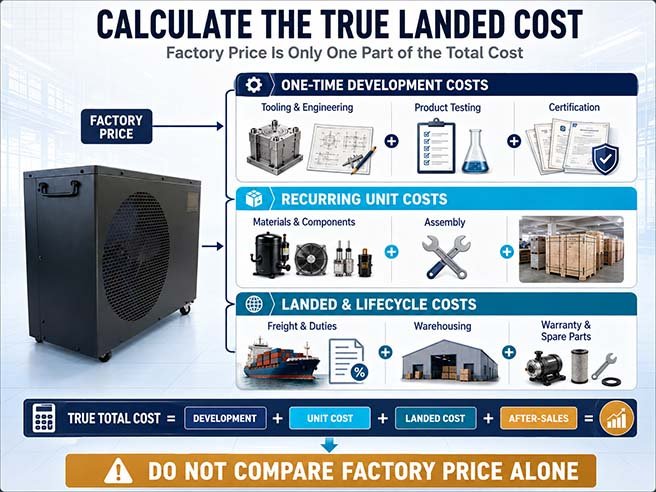
To compare quotations fairly, build one cost sheet using the same configuration and assumptions for every supplier.
| Cost category | Questions to confirm |
|---|---|
| Product | Is the model, cooling configuration and accessory scope identical? |
| Customization | Which branding, packaging and product changes are included? |
| One-time charges | Are design, prototypes, tooling and testing listed separately? |
| Quality control | What inspection and finished-unit tests are included? |
| Compliance | Which documents cover the exact configuration and market? |
| Logistics | Which Incoterm applies and which destination costs remain? |
| After-sales | What warranty, spare-parts and technical support are included? |
| Payment | What deposit, balance and currency terms apply? |
| Lead time | When does production time begin, and what approvals are required first? |
This approach separates three important figures:
- Non-recurring investment: design, tooling, prototypes and initial validation.
- Recurring unit cost: product, customization, packaging and standard testing.
- Landed and lifecycle cost: freight, import, storage, service, warranty and replacement parts.
The lowest unit quote is not necessarily the lowest-cost sourcing decision.
How to Reduce OEM Investment Risk
Start With an Appropriate Existing Platform
Use a product platform that already matches the target water volume, climate, electrical market and usage pattern as closely as possible. This reduces avoidable structural changes and validation work.
Freeze the Specification Before Comparing Prices
Create a written specification covering the model, components, functions, accessories, branding, packaging, tests and documentation. Otherwise, suppliers may quote different products under similar descriptions.
Validate Before Scaling
Move through sample evaluation and an appropriate trial stage before committing to a large inventory position. Record test conditions, corrections and approval samples so that repeat production has a clear reference.
Separate Essential Requirements From Optional Features
Rank customization requests as essential, commercially valuable or optional. This makes it easier to evaluate whether each feature justifies its engineering, tooling and MOQ impact.
Establish Change Control
Require written approval before changes to key components, materials, firmware, packaging or test methods. Cost reduction should not weaken the approved configuration without the buyer’s knowledge.
Plan After-Sales Costs Early
Decide which parts will be stocked, who will diagnose faults, how claims will be documented and which cases require manufacturer support. Service planning should influence the sourcing decision before the first order.
Information Needed for an Accurate OEM Quotation
Send the manufacturer a structured request containing:
- Buyer type and target sales market
- Intended application and user group
- Tub water volume and dimensions
- Target water temperature
- Typical and maximum ambient temperature
- Indoor or outdoor installation
- Expected usage frequency
- Preferred product model or cooling capacity
- Voltage, frequency and plug type
- Pump, filtration and accessory requirements
- Branding and packaging scope
- Requested structural or functional changes
- Destination-market documentation requirements
- Sample, trial or production stage
- Estimated quantity and delivery destination
- Preferred Incoterm and delivery timing
An accurate brief allows the manufacturer to identify technical risks and separate standard-product costs from customization and development costs.
Working With CHILLMEND on OEM Cost Planning
CHILLMEND supports brands, distributors and commercial recovery businesses with ice bath chiller model selection, OEM configuration, private labeling and production planning. The company was established in 2022, and its HVAC industry experience dates to 2010. Its manufacturing operation includes a 5,000-square-meter facility, two production lines, a 10-person research and development team, and stated annual production capacity of 10,000 units.
Rather than applying one price or MOQ to every project, the quotation is prepared according to the selected platform, market, customization scope, order stage and delivery requirements.
Buyers can review CHILLMEND’s OEM capabilities, manufacturing and quality-control process, ice bath chiller models and certification information before requesting a model-specific proposal.
Frequently Asked Questions
How much does an OEM ice bath chiller cost?
There is no reliable universal price. Cost depends on the model, cooling and water-system configuration, branding, electrical version, packaging, quantity, testing, destination requirements and delivery terms. A useful quotation requires a defined specification.
What is the MOQ for a custom ice bath chiller?
MOQ varies by model and customization scope. A standard sample, private-label trial order and structural ODM project can have different minimums because they require different materials, setup and engineering work.
Does private labeling require new tooling?
Not necessarily. Logo, label, manual and packaging changes on an existing platform may not require new product molds. A new housing, structural part or proprietary component may require tooling and validation.
Why is a sample more expensive per unit?
A sample can require individual preparation, configuration, testing, documentation and export packaging. Those costs are concentrated in one or a few units rather than distributed across a production batch.
Why do bulk orders receive different pricing?
Larger, consistent orders can improve component purchasing, packaging efficiency, production scheduling and setup allocation. The saving depends on the product mix and supplier thresholds, so it is not a fixed percentage.
What should be included in an OEM quotation?
The quotation should identify the model, specification, customization, accessories, packaging, quantity, one-time charges, unit price, testing scope, delivery term, payment terms, lead time and quotation validity.
How can buyers compare two OEM suppliers?
Compare the same specification and calculate total landed and lifecycle cost. Include tooling, packaging, compliance, freight, duties, inspection, warranty, spare parts and support—not only the factory unit price.
Request an OEM Ice Bath Chiller Cost Proposal
Share your target market, water volume, operating conditions, electrical configuration, customization scope, quantity stage and delivery destination with CHILLMEND. This allows the team to recommend a suitable platform and separate standard product, customization and development costs clearly.
Contact CHILLMEND to request a model-specific OEM ice bath chiller quotation, MOQ plan and bulk pricing proposal.
For Brands, Distributors & Commercial Buyers
If you are evaluating equipment for resale, private label or a commercial cold plunge project, compare more than cooling specifications. Review manufacturing capability, customization scope, compliance support, quality control, warranty and spare-parts availability.