
Article Summary
Ice bath chiller manufacturing combines refrigeration, water circulation, electrical controls, structural assembly and final product testing. A reliable production system must do more than build one functional sample: it must control components, document specifications, identify defects, verify the finished configuration and reproduce approved quality across later batches. This guide explains a typical manufacturing flow and the evidence B2B buyers should request when evaluating an ice bath chiller factory.
Quick Outline
- Why manufacturing control matters to B2B buyers
- Production preparation and specification control
- Incoming component inspection
- Structural, refrigeration and water-system assembly
- Electrical and control-system installation
- Refrigeration-circuit preparation
- Functional and performance testing
- Final inspection and packaging
- Traceability and nonconforming-product control
- Questions to ask during a factory audit
Why Ice Bath Chiller Manufacturing Matters to Buyers
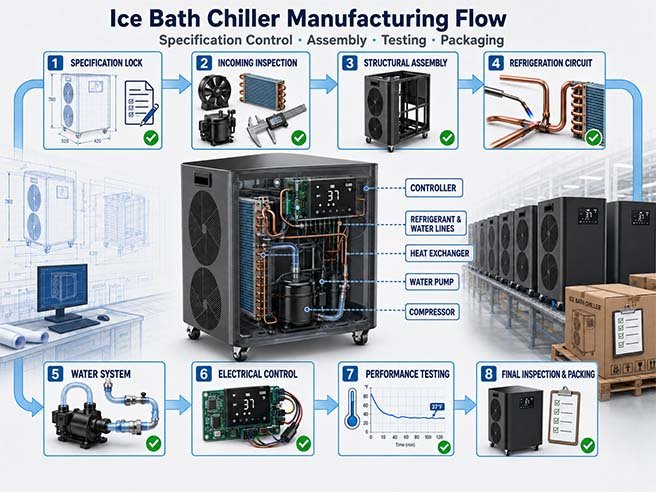
An ice bath chiller is a compact system in which refrigeration, airflow, water circulation, sensing and electrical controls must work together. A machine may look simple from outside, but its performance can be affected by:
- Compressor and heat-exchanger selection
- Refrigeration-pipe workmanship
- Condenser airflow
- Pump and water-flow configuration
- Sensor placement and control logic
- Electrical assembly and protection
- Structural mounting and vibration control
- Testing conditions and acceptance criteria
For distributors and private-label brands, the key question is not whether a factory can build one good sample. It is whether the factory can reproduce the approved specification across trial and repeat production.
Manufacturing quality therefore depends on both product engineering and process control.
Before Assembly: Freeze the Product Specification
Production should begin with an approved configuration rather than a general description such as “1 HP ice bath chiller.”
A controlled specification may define:
- Model and electrical version
- Refrigeration platform
- Compressor, heat exchanger, pump and fan requirements
- Refrigerant and designed charge
- Controller and sensor configuration
- Water connections and filtration arrangement
- Housing, surface finish and hardware
- Labels, manuals and accessories
- Packaging specification
- Buyer-approved OEM details
- Functional tests and acceptance criteria
For OEM projects, the specification should identify which characteristics are fixed and how proposed substitutions will be reviewed. A different pump, fan, controller or heat exchanger can change flow, noise, cooling behavior, serviceability or documentation even when the exterior remains unchanged.
The approved sample, drawings, artwork and written specifications should form one reference package for production.
Step 1: Incoming Component Inspection
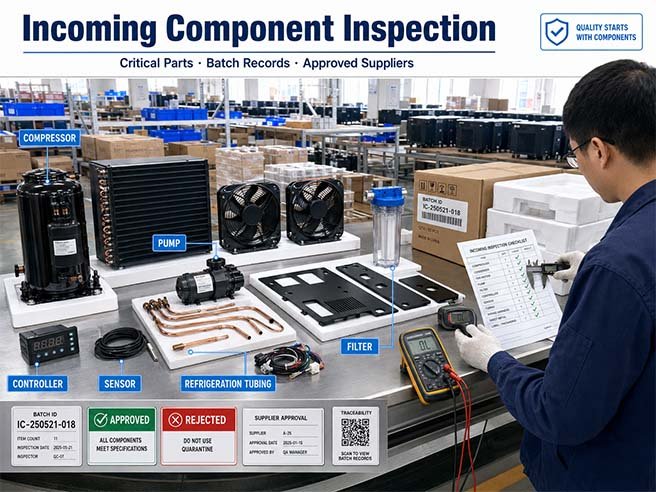
Manufacturing quality starts before components reach the assembly line. Incoming inspection verifies that supplied materials match purchasing and engineering requirements.
Components may include:
- Compressor
- Condenser and fan
- Heat exchanger
- Refrigeration tubing and related parts
- Pump, filter and water fittings
- Controller, PCB and sensors
- Wiring harnesses and electrical components
- Housing panels, brackets and fasteners
- Labels, manuals and packaging materials
The inspection method should reflect the component’s function and risk. A housing panel may be checked for dimensions, finish and fit, while an electrical component may be verified against its model, rating and approved specification.
Not every item necessarily receives the same inspection or sample size. Buyers should ask which components are considered critical, how inspection frequency is determined and what records are retained.
Why Supplier and Component Control Matter
A final assembly test cannot fully compensate for unstable materials. Some component differences may appear only after extended use or under different climates. Approved suppliers, component specifications and change control reduce this risk.
During a factory audit, ask:
- Which components are critical to performance and safety?
- How are supplier or model changes approved?
- Are incoming lots identifiable?
- What happens when a component fails inspection?
Step 2: Chassis and Structural Assembly
The chassis supports the refrigeration, airflow, water and electrical systems. Structural assembly can affect noise, vibration, service access and shipping durability.
Typical work can include:
- Installing brackets and mounting points
- Securing the compressor and heat exchanger
- Positioning the condenser and fans
- Preparing pump, filter and water connections
- Installing the electrical enclosure and controller
- Routing pipes, hoses and wiring
- Checking panel fit and service clearances
Component placement should support airflow and avoid unnecessary heat transfer, abrasion or vibration. Refrigeration tubing and wiring should not rub against sharp edges or resonate against housing panels.
Buyers can inspect whether fasteners, brackets, vibration isolators and service access appear consistent across units rather than evaluating only the painted exterior.
Step 3: Refrigeration-Circuit Assembly
The refrigeration circuit transfers heat from the plunge water to the surrounding air. Depending on the design, it can include the compressor, condenser, metering component, heat exchanger, tubing and control or protection components.
Assembly commonly involves:
- Cutting and forming tubing
- Positioning components and pipe runs
- Joining the circuit using the specified process
- Supporting pipes to control movement and vibration
- Protecting the circuit from contamination
- Preparing it for integrity checks, evacuation and charging
Workmanship matters because small refrigerant leaks, contamination, poor routing or inadequate support can affect cooling and reliability.
The production environment, technician procedures and tools should be appropriate for the refrigerant and product design. Requirements can differ, particularly where refrigerants have different safety characteristics.
What Buyers Should Verify
Ask the manufacturer:
- How refrigeration-circuit integrity is checked
- How joining workmanship is controlled
- How evacuation is verified
- How the designed refrigerant charge is measured
- How refrigerant type and charge are recorded
- What happens if a leak or abnormal pressure condition is found
Avoid assuming that one procedure is suitable for every model or refrigerant.
Step 4: Water-Circulation System Installation
The water circuit moves heat from the tub through the heat exchanger. It may include an internal or external pump, filter housing, flow-detection components, hoses, fittings, drainage points and optional treatment equipment.
Assembly should confirm:
- Correct inlet and outlet routing
- Compatible pump and flow requirements
- Secure and sealed connections
- Practical priming and drainage
- Accessible filtration and maintenance points
- Hose and fitting compatibility
- Separation from sensitive electrical areas
Water flow affects heat transfer. A chiller with a capable compressor can still perform poorly if circulation is restricted, air is trapped in the circuit or the pump is mismatched.
This is why horsepower alone is not a complete measure of cold plunge performance. Water volume, ambient temperature, insulation, flow, airflow, heat-exchanger design and control logic all contribute to the result.
Step 5: Electrical Wiring and Controls
Electrical assembly connects the compressor, fan, pump, sensors, controller and protection components according to the approved design.
Typical control points include:
- Correct wire and harness routing
- Secure terminals and connectors
- Grounding or protective connections where applicable
- Mechanical protection from sharp edges and vibration
- Separation from heat and possible water exposure
- Correct sensor and output connections
- Correct voltage and frequency configuration
- Controller parameters and firmware where relevant
Standardized harnesses and documented connection points can improve consistency and simplify diagnosis.
If the approved model includes Wi-Fi, Bluetooth, an app or a heating function, those elements require their own verification. They should not be presented as standard features across every chiller model.
For private-label projects, any interface or software customization should be included in the approved configuration and version records.
Step 6: Circuit Integrity, Evacuation and Refrigerant Charging
After refrigeration assembly, the sealed circuit is prepared for operation using procedures appropriate to the model and refrigerant.
The process may involve:
- An integrity or pressure check
- Leak detection
- Evacuation to remove unwanted air and moisture
- Verification of the evacuation process
- Charging the specified refrigerant by a controlled method
- Recording the charge and related production information
Both insufficient and excessive charge can affect system behavior. Refrigerant should therefore be controlled according to the engineered specification rather than by casual judgment.
If a unit fails an integrity check, the repair and reinspection procedure matters. Buyers should ask whether repaired circuits repeat the required preparation and testing steps before moving forward.
Step 7: Initial Startup and Functional Inspection
The first startup confirms whether the assembled systems operate together.
Technicians may review:
- Controller and display startup
- Sensor readings
- Pump and water flow
- Compressor and fan operation
- Inlet and outlet behavior
- Error codes and protection functions
- Water leakage
- Abnormal sound or vibration
The purpose is not simply to see whether the screen lights up or the compressor starts. Incorrect wiring, reversed connections, unstable sensing or abnormal vibration should be investigated before performance testing.
The test procedure and acceptance criteria should be defined for the product. A brochure statement such as “fully tested” does not explain which functions are tested or whether every unit receives the same checks.
Step 8: Cooling-Performance Testing
Cooling claims are meaningful only when the conditions are recorded.
A useful test record can include:
- Model and serial or batch identification
- Water volume
- Starting and target temperatures
- Ambient temperature
- Tub and insulation condition
- Pump, filter and hose configuration
- Test duration
- Temperature measurements over time
- Electrical readings where required
- Error or protection events
Testing can evaluate pull-down behavior, displayed temperature, cycling and temperature holding. The exact procedure may differ between routine production inspection, batch verification and engineering validation.
Why Cooling Curves Are More Useful Than One Number
A statement such as “reaches 3°C” does not show how much water was used, how warm the environment was or how long the process took. A cooling curve with defined conditions gives buyers more useful evidence for model selection.
The final customer’s installation may still produce different results. Manufacturers and distributors should avoid turning one controlled factory test into a universal cooling-time promise.
Step 9: Water-Flow and Leakage Testing
The operating water circuit should be inspected under realistic flow rather than only when the system is dry.
Inspection points may include:
- Inlet and outlet fittings
- Heat-exchanger connections
- Pump and filter housing
- Internal pipes and hoses
- Drainage points
- Flow stability
- Air-lock behavior
- Abnormal pump noise
Small leaks can damage electrical components, corrode the housing or cause costly customer claims. The acceptance method should define how leakage is checked and what happens when a connection is repaired.
For the buyer’s independent validation process, see the ice bath chiller sample order checklist.
Step 10: Electrical and Product-Safety Checks
Functional operation is not the same as product-safety compliance. The applicable construction requirements, tests and documentation depend on the exact design, voltage, refrigerant, intended use and destination market.
Production or conformity procedures may address areas such as:
- Protective connections
- Insulation and dielectric properties
- Leakage current
- Protection devices
- Ratings and markings
- Cord and plug configuration
- Access to hazardous parts
- Moisture-related construction
The actual test program must be established using the applicable standards and market requirements. A brief factory check does not make a product “globally certified,” and one document should not be assumed to cover every model or voltage.
Importers should request model-specific evidence and obtain qualified compliance advice. CHILLMEND’s certification information can be reviewed as a starting point for that discussion.
Step 11: Noise and Vibration Inspection
Compressors, fans and pumps create operating sound. Quality control focuses on identifying abnormal noise and preventing avoidable vibration.
Potential issues include:
- Loose panels or fasteners
- Pipe contact with the housing
- Inadequate compressor isolation
- Fan interference or imbalance
- Pump cavitation
- Hose or fitting vibration
- Structural resonance
The acceptable result depends on the application and agreed test method. A quiet home wellness room and a busy gym have different expectations.
If noise is specified numerically, the distance, operating mode, installation surface and room conditions should be recorded. Read the guide to ice bath chiller noise levels for more context.
Step 12: Extended-Operation or Aging Tests
Some faults appear only after components warm up, the machine cycles or connections remain under operating conditions.
Extended testing can help reveal:
- Intermittent sensor or controller faults
- Slow water or refrigerant leaks
- Protection trips
- Fan or pump abnormalities
- Loose connections
- Changing noise or vibration
- Unstable temperature control
There is no universal runtime that proves reliability for every design. Buyers should ask:
- What is the purpose of the test?
- Which units or production samples receive it?
- How long and under what conditions do they run?
- Which measurements are recorded?
- What are the acceptance criteria?
- How are failures corrected and retested?
These answers are more useful than a general claim that a product receives an “aging test.”
Step 13: Final Quality-Control Inspection
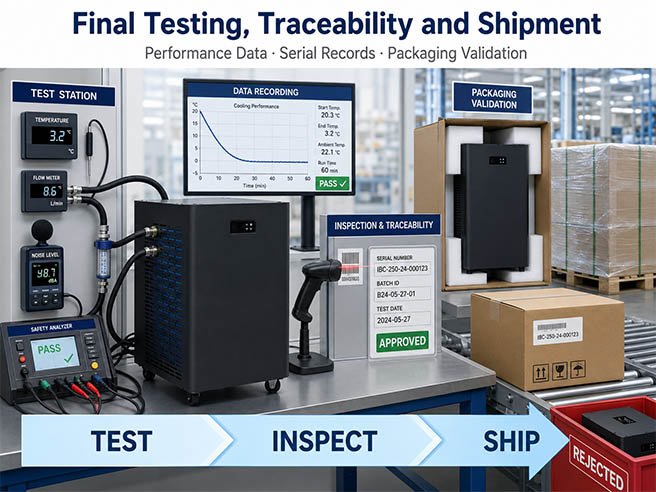
Final inspection confirms that the finished unit matches the order and is ready for packing.
It may cover:
- Correct model and electrical version
- Serial or batch identification
- Functional status
- Housing and surface finish
- Controls and display
- Water connections
- Power cable and plug
- Labels and rating information
- Branding and artwork
- Manuals and accessories
- Packaging configuration
OEM orders require careful version control. A technically functional machine can still be nonconforming if it carries the wrong voltage label, outdated manual, incorrect logo or missing accessory.
Buyers should ask whether the final inspection is performed on every unit or according to a sampling plan, and what records accompany the shipment.
Step 14: Draining, Cleaning and Packaging
After water testing, residual water should be handled according to the manufacturer’s procedure. The unit is then cleaned and protected for its intended transport method.
Packaging work can include:
- Protecting panels and controls
- Securing accessories
- Preventing hose and fitting damage
- Adding foam, corners or other internal protection
- Applying model, orientation and handling labels
- Verifying carton or pallet information
- Checking the packed weight and dimensions
Packaging is part of product quality. A conforming unit that arrives damaged is not commercially successful for the importer.
Sample shipments, palletized orders and container loads may require different validation. Distributors should monitor damage rates and feed that information back into the packaging specification.
Typical Ice Bath Chiller Manufacturing Flow
A typical flow can be summarized as:
Specification approval → Material purchasing → Incoming inspection → Structural assembly → Refrigeration-circuit assembly → Water-system installation → Electrical assembly → Circuit preparation and charging → Initial startup → Functional and performance testing → Final inspection → Draining and cleaning → Accessory check → Packaging → Shipment release
The sequence can vary by model and factory layout. The important issue is whether each critical stage has defined instructions, responsibility, acceptance criteria and records.
Traceability and Nonconforming-Product Control
Testing only creates value when failures lead to controlled action.
A factory quality system should answer:
- How is a failed unit identified and separated?
- Who determines whether it is repaired, reworked or rejected?
- Which tests must be repeated after repair?
- Are defects recorded by type and batch?
- Can recurring issues be traced to components or process stages?
- How are corrective actions verified?
Production Traceability
Serial or batch records can help connect a finished unit with its model, electrical version, production period and approved configuration. More detailed traceability may cover major components or test results depending on the product and quality plan.
For distributors, this information improves warranty diagnosis and helps determine whether an issue is isolated or batch-related.
Change Control
Supply-chain changes can occur, but critical substitutions should not happen silently. The manufacturer and buyer should define which component, firmware, material, label or packaging changes require review and approval.
This protects consistency between the approved sample and future production.
What Buyers Should Check During a Factory Audit
1. Controlled Specifications
Ask how the factory converts the buyer’s order into production documents and prevents different revisions from being used at the same time.
2. Component and Supplier Control
Review the approved-component process, incoming inspection and handling of substitutions.
3. Refrigeration Workmanship
Observe tubing preparation, joint quality, pipe support, cleanliness and leak-control procedures.
4. Water-System Testing
Ask whether the complete circuit is checked while circulating water and how repaired connections are retested.
5. Cooling-Test Conditions
Request water volume, starting temperature, ambient temperature, flow configuration, target and recorded test time.
6. Electrical and Safety Procedures
Ask which checks apply to the exact model and how equipment calibration and test records are controlled.
7. Failed-Unit Handling
Follow one nonconforming unit through identification, repair, reinspection and release.
8. Traceability
Ask what information can be retrieved from a serial or batch number after the product enters the market.
9. Packaging Validation
Inspect the packed product, not only empty cartons. Ask how shipment damage is recorded and used to improve packaging.
10. After-Sales Feedback
Review how warranty data, field failures and distributor feedback reach quality and engineering teams.
CHILLMEND’s dedicated manufacturing and quality-control page should remain the primary page for its factory evidence and capabilities. This article explains how buyers can interpret and verify manufacturing controls.
Why One Good Sample Does Not Prove Batch Quality
A sample validates one unit under a defined configuration. Repeat production introduces additional variables:
- Different component lots
- More assemblers and workstations
- Multiple models or electrical versions
- Packaging variation
- Schedule and supply-chain pressure
To reduce these risks, buyers should establish:
- An approved golden sample
- Controlled product and packaging specifications
- Written change approval
- Trial-order inspection
- Batch-level acceptance criteria
- Pre-shipment inspection where appropriate
- Warranty and defect feedback records
This turns product approval into a repeatable quality plan rather than reliance on a specially prepared sample.
How Manufacturing Quality Affects Total Cost
Unit price is only one part of a distributor’s cost. Manufacturing variation can later appear as:
- Shipping damage
- Installation problems
- Support tickets
- Replacement parts and freight
- Technician time
- Returns and refunds
- Negative reviews
- Lost repeat business
Buyers should therefore compare the approved configuration, test scope, quality records, spare-parts support and change-control process together with price.
For a complete commercial cost model, read OEM Ice Bath Chiller Cost: Tooling, MOQ and Bulk Pricing Explained.
CHILLMEND Ice Bath Chiller Manufacturing
CHILLMEND was established in 2022, and its HVAC industry experience dates to 2010. Its manufacturing operation includes a 5,000-square-meter facility, two production lines, a 10-person research and development team, stated annual production capacity of 10,000 units and 20 patents. CHILLMEND reports a defect rate below 0.1%.
The company supports B2B projects involving model selection, sample evaluation, OEM and private labeling, production planning, documentation coordination and after-sales support. It provides a one-year warranty and after-sales service through its California warehouse and service point in the United States.
The exact components, production flow, test scope, inspection records and acceptance criteria should be confirmed for the selected model and order. Buyers can review CHILLMEND’s OEM capabilities, ice bath chiller models and certification information before requesting a project-specific manufacturing proposal.
Frequently Asked Questions
How are ice bath chillers manufactured?
A typical process includes specification control, incoming inspection, structural assembly, refrigeration and water-system assembly, electrical wiring, circuit preparation, functional testing, final inspection and packaging. The exact sequence varies by model and manufacturer.
How are ice bath chillers tested before shipping?
Testing may cover controller operation, cooling, water circulation, leakage, electrical functions, noise, extended operation, labels and accessories. Buyers should ask which tests apply to every unit, which use sampling and what the acceptance criteria are.
How long should an aging test last?
There is no universal duration that proves reliability. The appropriate time depends on the product and test objective. Buyers should review the conditions, monitored parameters, unit coverage and failure-handling procedure.
What quality checks matter most to wholesale buyers?
Important areas include configuration consistency, refrigeration-circuit integrity, water leakage, cooling under defined conditions, electrical construction, abnormal noise, identification, documentation, accessories and packaging.
Does every ice bath chiller require the same certification?
No. Requirements depend on the design, voltage, refrigerant, functions, application and destination market. Documentation must be reviewed for the exact model and configuration.
How can a buyer verify manufacturing consistency?
Use an approved sample and specification, require change control, define batch inspection criteria, review traceability and confirm how failed units are corrected and retested.
What should a buyer ask an ice bath chiller factory?
Ask about critical components, incoming inspection, refrigeration assembly, leak testing, cooling-test conditions, electrical checks, aging tests, traceability, failed-unit handling, packaging and after-sales feedback.
Discuss an Ice Bath Chiller Manufacturing Project
Share your target application, water volume, climate, electrical market, required configuration, branding scope and purchasing stage with CHILLMEND.
Contact CHILLMEND to discuss sample evaluation, OEM configuration, production planning and quality-control requirements.