
Article Summary
An ice bath chiller warranty for distributors is more than a warranty period. A workable after-sales program should define coverage, exclusions, start dates, claim evidence, diagnosis, replacement authorization, freight and labor responsibility, spare-parts availability and support after warranty expiry. This guide helps distributors and private-label brands evaluate those terms, prepare local parts inventory and build a repeatable service process before placing a wholesale order.
Quick Outline
- Why distributor warranties need a complete service process
- Terms every warranty agreement should define
- Warranty parts, consumables and damage exclusions
- How to build a model-specific spare-parts plan
- A practical warranty claim and RMA workflow
- When to repair a part or replace the complete unit
- Freight, labor and local service responsibilities
- Warranty planning for private-label brands
- Using field data to improve product quality
- Questions to ask before placing an order
Why Warranty Planning Matters to Ice Bath Chiller Distributors

A consumer normally asks what happens if one machine fails. A distributor must decide what happens when an installed base across homes, gyms, recovery studios or commercial facilities needs support.
The direct cost of a service case may include:
- Customer communication and diagnosis
- Collection or site attendance
- Technician labor
- Replacement parts
- Domestic and international freight
- Temporary or complete replacement units
- Warehouse inspection
- Refunds or commercial compensation
The indirect cost can include downtime, poor reviews and lost repeat business.
For this reason, warranty length should not be evaluated on its own. A longer written period can still provide weak commercial protection if the supplier lacks diagnostic procedures, identifiable parts, technical documentation and clear freight responsibility.
A useful distributor warranty combines contractual terms with an operating process.
What an Ice Bath Chiller Warranty Agreement Should Define
There is no universal warranty structure for every manufacturer, model or country. Buyers should confirm the following in writing before production.
Covered Products and Parties
The agreement should identify:
- Legal seller and buyer
- Covered models and electrical versions
- Territory and sales channels
- Whether coverage applies to the distributor, end customer or both
- Whether the product is manufacturer-branded or private label
- Transferability when the product is resold
Warranty Period and Start Date
“One-year warranty” remains incomplete unless the starting event is defined. Possibilities include:
- Factory shipment date
- Distributor receipt date
- Sale to the end customer
- Installation or commissioning date
The parties should also define the evidence required to establish that date and whether any maximum period applies when inventory remains unsold.
Scope of Coverage
Coverage may apply to confirmed defects in materials, components or workmanship under specified installation, operation and maintenance conditions. The written terms should state:
- Covered assemblies or components
- Available remedy: repair, part replacement, unit replacement or credit
- Who chooses the remedy
- Whether parts are new, equivalent or refurbished
- Whether the replacement part receives a new or remaining warranty period
- Whether labor and travel are included
- Whether diagnostic or inspection charges apply
Do not assume that “parts warranty” includes technician labor or international shipping.
Dead on Arrival and Shipping Damage
DOA, concealed freight damage and later product failure are different cases. Establish:
- Time limit for reporting visible and concealed damage
- Required carton and product photographs
- Carrier claim responsibility
- Criteria for DOA classification
- Whether the distributor should repair, replace or quarantine the unit
- Who pays urgent replacement freight
Packaging evidence should be preserved until the claim is resolved.
Exclusions and Customer Responsibilities
Depending on the agreed policy, exclusions may include damage caused by:
- Incorrect voltage or electrical installation
- Insufficient or interrupted water flow
- Blocked filtration or missed maintenance
- Restricted ventilation
- Incorrect plumbing
- Unsuitable chemicals or water conditions
- Freezing during prohibited storage conditions
- Physical impact or unauthorized modification
- Repair by unapproved personnel
- Operation outside stated environmental limits
- Normal wear of consumables
Exclusions should be clear in the distributor agreement, manual, warranty card and customer-facing policy. They should not be introduced only after a claim.
Local laws may provide mandatory customer rights that cannot be reduced by a commercial warranty. Distributors and private-label brands should obtain legal advice for each sales market before publishing final customer terms.
Warranty Parts, Consumables and Commercial Accessories
Separating these categories helps prevent claim disputes and improves inventory planning.
Warranty Replacement Parts
These are components supplied after a confirmed covered failure. Depending on the model and diagnosis, they may include certain sensors, pumps, controls, fans, fittings or other factory-installed parts.
This is not a universal parts list. Electrical version, model revision and installation method can affect compatibility.
Consumable and Maintenance Parts
These are expected to require cleaning or replacement during normal use, such as applicable filter elements, seals or other model-specific maintenance items. Normal replacement does not automatically indicate a manufacturing defect.
The manual should state applicable maintenance intervals or condition-based checks. Commercial use can require different maintenance frequency from residential use.
Accessories and Customer-Damaged Parts
Hoses, connectors or other accessories may be covered only for a confirmed manufacturing defect, not for loss, incorrect installation or physical damage. Pricing and replacement availability should be identified separately.
Refrigeration and Safety-Critical Parts
Sealed refrigeration and internal electrical work may require qualified technicians, special tools and regulated handling. Distributors should not stock or install every internal part simply because it can be shipped.
Diagnosis, repair qualification and safety requirements should determine the service approach.
How to Build a Spare-Parts Plan
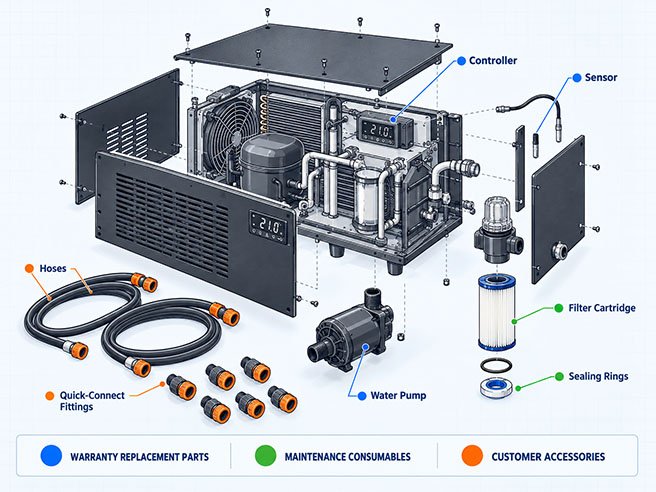
A distributor does not need to stock every component. The objective is to reduce customer downtime without tying up unnecessary capital or encouraging unsafe repairs.
Step 1: List Parts by Model and Revision
The manufacturer’s parts list should include:
- Part name and number
- Photograph or diagram
- Compatible model and serial range
- Voltage or regional version
- Consumable, service or warranty classification
- Installation skill level
- Storage requirements
- Unit price and lead time
A generic description such as “control board” is insufficient when multiple electrical versions exist.
Step 2: Classify Service Level
Divide parts into practical service groups:
- Customer-maintainable: items explicitly covered by the user manual.
- Distributor-serviceable: modular parts that trained distributor personnel may replace under documented procedures.
- Qualified-technician only: electrical, refrigeration or other work requiring professional competence.
- Factory or depot service: cases unsuitable for field repair.
This classification protects safety and helps the support team route each case correctly.
Step 3: Prioritize by Risk and Downtime
Consider:
- Installed quantity by model
- Historical demand or failure information
- Part lead time
- Customer downtime if unavailable
- International courier cost
- Local repair capability
- Part value and storage life
- Commonality across models
- Seasonal or commercial-use demand
There is no reliable universal spare-parts percentage. Initial quantities should be agreed for the order and refined using actual field data.
Step 4: Separate Service Stock From Retail Stock
Warranty inventory should remain available for urgent covered cases. Retail filters and accessories can be managed separately so normal sales do not consume emergency service stock.
Step 5: Set Reorder Points
Record monthly use, supplier lead time and minimum stock. Review slow-moving and obsolete inventory when models or components change.
A Practical Warranty Claim Workflow
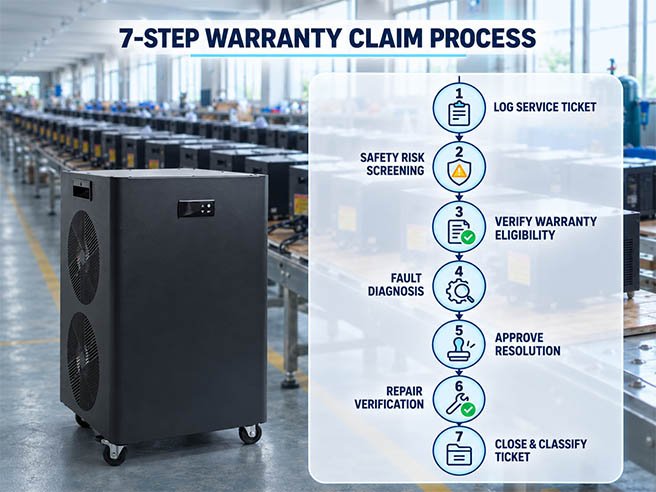
A repeatable workflow avoids immediate full-unit replacement and prevents excessive document requests for simple cases.
Stage 1: Register the Claim
Collect:
- Distributor and customer reference
- Model and serial number
- Purchase, delivery and installation dates
- Installation type and application
- Clear description of the symptom
- Error codes
- Photos or video
- Tub volume and operating conditions where relevant
- Plumbing, filter and electrical information
- Troubleshooting already completed
Assign a claim or ticket number so later communication and parts shipments remain connected.
Stage 2: Screen for Safety
If the report involves smoke, burning odor, sparking, severe water leakage, damaged power components, repeated electrical trips or strong mechanical failure, instruct the user to stop operation and follow the applicable safety procedure.
Do not ask an unqualified customer to open electrical or sealed-refrigeration components.
Stage 3: Confirm Eligibility
Check:
- Warranty dates
- Model and serial identification
- Installation and maintenance conditions
- Signs of shipping damage or misuse
- Whether the reported item is a consumable
- Whether previous unauthorized repair affects coverage
Eligibility and technical diagnosis are related but not identical. A real fault can exist outside warranty, while a covered claim still needs diagnosis.
Stage 4: Diagnose the Cause
The distributor and manufacturer can use operating data, images, video, error codes and guided tests to narrow the cause.
Common symptom groups include:
- No cooling or slow cooling
- Low or interrupted water flow
- Leakage
- Abnormal noise or vibration
- Incorrect temperature reading
- Controller or connectivity issue
- Electrical startup or protection event
Use the appropriate troubleshooting content, such as the guides for an ice bath chiller not cooling or an ice bath chiller that is unusually loud, but follow the model manual and technical instructions for the final diagnosis.
Stage 5: Authorize the Remedy
Document whether the approved action is:
- Guidance or configuration correction
- Maintenance or consumable replacement
- Warranty part replacement
- Qualified local repair
- Depot inspection
- Complete-unit replacement
- Commercial credit or another agreed resolution
Record who authorizes the action and whether the failed part must be returned.
Stage 6: Verify the Repair
After service, record the replacement part, technician, date, test result and returned or disposed part. Confirm that the original symptom is resolved under appropriate operating conditions.
Stage 7: Close and Classify the Case
Assign a defect or cause category. Useful categories distinguish manufacturing, component, shipping, installation, maintenance and customer-damage issues.
This data supports spare-parts forecasting and corrective action.
Repair a Component or Replace the Complete Chiller?
The decision should follow diagnosis, safety, cost and downtime—not a fixed rule.
Component Repair May Be Appropriate When
- The failed part is clearly identified
- Replacement is permitted and documented
- Qualified local capability is available
- Safety and compliance are not compromised
- Repair time and cost are reasonable
- Post-repair testing can confirm operation
Complete-Unit Replacement May Be Appropriate When
- A major defect makes safe field repair impractical
- Multiple assemblies are affected
- Required technicians or tools are unavailable
- Repair logistics approach the replacement cost
- The manufacturer’s technical team recommends replacement
- A customer-critical application requires a faster approved remedy
The warranty agreement should explain who has authority to choose the remedy and whether the distributor may issue an urgent customer replacement before supplier approval.
Freight and Labor Responsibility
“Free replacement part” does not necessarily mean a free warranty case. Define responsibility for:
- International and domestic freight
- Customs or import charges on replacements
- Return shipping for failed parts
- Local technician labor
- Travel and site attendance
- Removal and installation
- Express shipping for urgent cases
- Complete-unit collection and redelivery
Possible commercial arrangements include shipping parts with the next order, maintaining a prepaid service allowance or handling confirmed cases individually. No single arrangement fits every distributor.
The agreed policy should also cover what happens when diagnosis finds that a claim is outside warranty after parts or technician time have already been used.
Response Times and Escalation
A distributor needs an operating expectation, not only a contact email. Agree on targets for:
- Initial acknowledgment
- Request for missing evidence
- Technical diagnosis
- Parts or remedy authorization
- Shipment of stocked parts
- Escalation of unresolved cases
These should be described as agreed service targets rather than assumed promises. Response may depend on time zones, holidays, parts availability and the complexity of the case.
Identify primary commercial, technical and urgent-safety contacts and decide how cases will be handed over when a staff member is unavailable.
Local Service Capability
As the installed base grows, distributors can develop a three-level support structure:
Customer support → Manufacturer-assisted diagnosis → Qualified local technician or service depot
The local network may include plumbing, electrical, refrigeration or appliance-service professionals depending on the repair.
Before authorizing work, confirm:
- Required qualifications
- Service manuals and diagrams
- Parts compatibility
- Safe isolation and test procedure
- Warranty authorization
- Labor reimbursement, if any
- Repair and verification records
The aim is not to turn every customer into a technician. It is to route work to the appropriate level efficiently.
Private-Label Warranty Responsibilities
When a product carries the distributor’s brand, the buyer may take on responsibilities beyond the factory’s commercial warranty. The customer normally contacts the brand first, and local law may treat the brand as a manufacturer or responsible seller in some circumstances.
The OEM agreement should define:
- Factory warranty and remedy
- Buyer’s customer-facing warranty
- Difference between those two policies
- Product and serial-number records
- Customer communication responsibilities
- Claims approval and cost allocation
- Technical documentation
- Recall and corrective-action cooperation
- Spare-parts support after model changes
- Use of subcontracted local service
A brand may voluntarily provide a longer or broader customer warranty than its supplier provides. That can be a commercial advantage, but the additional risk and cost belong in pricing and reserves.
Review the Private Label Ice Bath Chiller Guide before finalizing a branded product program.
Warranty Support After Product Changes or Discontinuation
Buyers should ask how long service parts are expected to remain available. Avoid treating an estimated availability period as a guarantee unless it is written into the agreement.
Define:
- Notice before a model or major component is discontinued
- Last-time purchase opportunity
- Replacement or superseding part numbers
- Compatibility with older serial ranges
- Firmware or controller support
- Technical documentation retention
- Handling when an original part is no longer available
This matters most for commercial customers that expect equipment to remain repairable beyond the initial warranty.
Use Warranty Data to Improve Production
Warranty claims should feed back into manufacturing and product design.
Track at least:
- Cases per model and production batch
- Failure or symptom category
- Confirmed root cause
- Installation and maintenance contribution
- Parts used
- Repair time and freight cost
- Repeat failure after repair
- Customer downtime
When a pattern appears, the manufacturer and distributor should investigate whether it relates to a component lot, production process, packaging, documentation, installation or operating environment.
Corrective action can include specification changes, improved testing, packaging reinforcement, clearer instructions, staff training or a revised spare-parts plan.
The guide to how ice bath chillers are manufactured explains how production control and traceability support this feedback loop.
Questions to Ask a Manufacturer Before Ordering
- What is the warranty period, and when does it begin?
- Which models, territories and buyers are covered?
- Which components and remedies are included?
- How are DOA cases and freight damage handled?
- What installation, maintenance and operating exclusions apply?
- Who pays parts, labor, domestic freight and international freight?
- What evidence is required to open a claim?
- Who performs diagnosis and authorizes replacement?
- Which repairs require qualified technicians?
- Must failed parts be returned?
- What response and escalation targets can be agreed?
- Which spare parts should accompany the initial order?
- How are parts identified by model, voltage and serial range?
- What support is available after warranty expiry?
- How are product changes and discontinued parts communicated?
- How are recurring field problems reported to quality and engineering?
- Are service manuals and training available to approved personnel?
- How will private-label warranty responsibilities be divided?
Written answers are more valuable than a general promise that quality is good.
Distributor Warranty Readiness Checklist
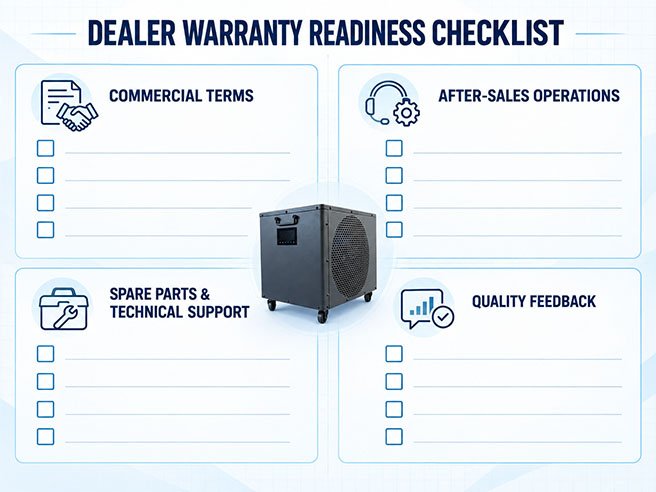
Commercial Terms
- Covered parties, products and territory defined
- Warranty start point documented
- Remedies and exclusions approved
- Freight and labor responsibility agreed
- Customer-facing terms reviewed for local law
Service Operation
- Claim form and ticket numbering established
- Safety escalation process defined
- Diagnostic contacts identified
- RMA and failed-part return process documented
- Repair-verification and closure records prepared
Parts and Technical Support
- Model-specific parts list received
- Voltage and serial compatibility recorded
- Service levels assigned by repair difficulty
- Initial stock and reorder points agreed
- Qualified local technicians identified where needed
Quality Feedback
- Model and serial records maintained
- Defect categories defined
- Batch trends reviewed
- Recurring issues escalated to manufacturing
- Corrective actions tracked to closure
CHILLMEND Warranty and Distributor Support
CHILLMEND provides a one-year product warranty, subject to the selected model, agreed commercial terms, correct installation and applicable warranty conditions. It also has an overseas warehouse and an after-sales service point in California, United States.
For distributor and private-label projects, model-specific discussions can cover spare-parts planning, documentation, troubleshooting coordination, replacement-component support and production feedback. The exact part availability, diagnostic method, freight responsibility, response targets and permitted repair scope must be confirmed in the project agreement.
Buyers can review CHILLMEND’s ice bath chiller models, OEM capabilities, manufacturing and quality-control process and sample-order checklist before planning the first wholesale order.
Frequently Asked Questions
How long is an ice bath chiller warranty?
It depends on the manufacturer and agreement. CHILLMEND provides a one-year product warranty subject to the applicable terms. Buyers should also confirm the start date, covered remedy, exclusions, freight, labor and claim process.
Which spare parts should a distributor stock?
Use a model-specific list based on installed quantity, service risk, lead time, voltage, local repair capability and field data. Separate consumables, distributor-serviceable parts and qualified-technician repairs.
Can a chiller be repaired without returning it to the factory?
Some confirmed faults can be resolved with maintenance, a modular replacement part or qualified local repair. Others require depot or complete-unit service. The decision should follow diagnosis and safety requirements.
Who pays freight for warranty parts?
There is no universal rule. The distributor agreement should define responsibility for international freight, local delivery, return freight, duties and urgent courier shipments.
Are filters covered by warranty?
Routine filter replacement is normally maintenance rather than a defect, but a manufacturing fault in a supplied component may be treated differently. The product-specific warranty should define this clearly.
Can spare parts be purchased after the warranty expires?
That depends on availability and the supply agreement. Ask about expected support periods, price lists, discontinued components and compatible replacements before ordering.
Is the factory warranty the same as the distributor’s customer warranty?
Not necessarily. The distributor may have separate contractual or mandatory obligations in its sales market. Private-label brands should align the two policies and obtain local legal advice.
Discuss Warranty and Spare-Parts Planning
Share your target market, selected models, expected quantity, electrical versions, sales channels and local service capability with CHILLMEND.
Contact CHILLMEND to discuss project-specific warranty terms, spare-parts planning and distributor technical support.