
Article Summary
Buying wholesale ice bath chillers requires more than comparing factory prices. Distributors and wellness brands need a product range suited to their market, clear MOQ and pricing terms, consistent production, accurate technical documentation, spare-parts planning, warranty procedures and dependable after-sales support. This guide explains how to evaluate a wholesale program, calculate commercial viability and build a more sustainable supplier relationship.
Quick Outline
- What wholesale ice bath chillers are
- Who should buy through a wholesale program
- How wholesale pricing is structured
- How MOQ and order planning affect a distributor
- How to evaluate product and market fit
- What distributor support should include
- How to plan margin and total landed cost
- How to evaluate a wholesale supplier
- Questions to ask before ordering
- Frequently asked questions
What Are Wholesale Ice Bath Chillers?
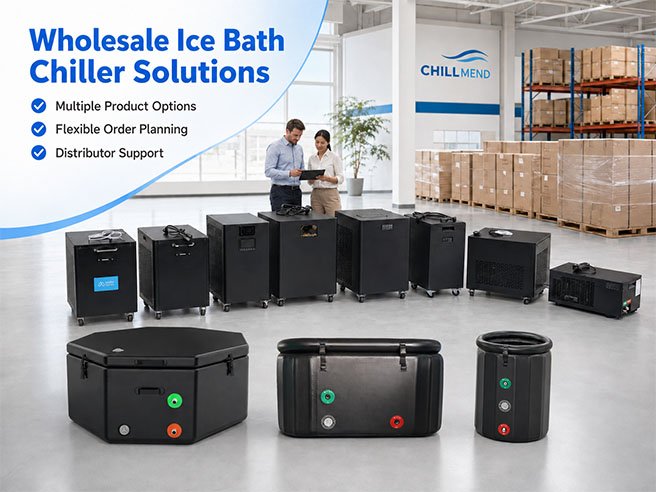
Wholesale ice bath chillers are cooling systems purchased by a business for resale, inclusion in a branded cold plunge package or installation across multiple commercial locations. Unlike a consumer buying one unit for personal use, a wholesale buyer must consider the complete commercial system around the product.
That system includes:
- Repeatable product specifications
- Quantity-based purchasing terms
- Market-compatible electrical configurations
- Inventory and replenishment planning
- Installation and technical documentation
- Spare parts and warranty procedures
- Packaging suitable for the chosen logistics channel
- Support for sales teams, dealers or commercial operators
The lowest factory price does not necessarily produce the best distributor margin. Product failures, shipping damage, unclear documentation, unavailable parts or inconsistent repeat orders can turn a low-cost purchase into an expensive channel problem.
Who Buys Ice Bath Chillers Wholesale?
Wholesale programs can serve several types of B2B buyers, but their requirements are not identical.
Fitness and Wellness Equipment Distributors
Distributors normally need a defined range of products, predictable replenishment and materials their sales and service teams can use. They may sell through dealers, showrooms, ecommerce channels or commercial projects.
Cold Plunge and Recovery Brands
Brands may purchase chillers separately or combine them with tubs, hoses, filters and accessories as a complete system. Compatibility, packaging, installation instructions and brand presentation are especially important.
Gym, Studio and Hospitality Suppliers
Project suppliers may need products for gyms, recovery studios, hotels, sports facilities or wellness centers. They should evaluate actual usage frequency, water volume, ambient conditions, installation layout and service access instead of selecting by horsepower alone.
Multi-Location Commercial Operators
An operator buying for several locations may not resell the equipment, but it faces similar requirements: standardized installations, staff training, maintenance procedures, spare parts and consistent replacement units.
Online Retailers
Online sellers need packaging that can withstand their delivery method, accurate product content, manageable returns and a clear technical-support workflow. A product that is difficult to install or diagnose can create support costs that are invisible in the initial quotation.
How Wholesale Ice Bath Chiller Pricing Works
Wholesale pricing depends on the technical configuration and commercial scope of the order. A meaningful quotation should define both.
Product Configuration
Cost can be affected by:
- Refrigeration platform and cooling capacity
- Compressor, heat exchanger and control components
- Pump, filtration and sanitation configuration
- Housing and connection layout
- Voltage, frequency and plug type
- Accessories included with each unit
- Packaging and documentation
- Required testing or destination-market preparation
Nominal horsepower is not enough to compare two products. Suppliers may use different test conditions, components and included accessories even when their model descriptions appear similar.
Order Quantity and Product Mix
Quantity can influence component purchasing, packaging, production scheduling and setup allocation. However, one large mixed order is not always equivalent to a large run of one configuration.
Ask whether a pricing tier applies:
- Per individual model
- Per color or electrical version
- Across a mixed container or shipment
- Per purchase order
- Across a defined annual commitment
This prevents a buyer from planning margin around a price tier that its actual model mix does not qualify for.
Branding and Channel Requirements
A standard wholesale product and a private-label product may have different costs. Logo application, branded manuals, labels, cartons, accessory kits and market-specific content can create setup fees, supplier minimums or recurring costs.
For a full breakdown of tooling, customization and pricing components, see OEM Ice Bath Chiller Cost: Tooling, MOQ and Bulk Pricing Explained.
Delivery Terms
The quoted price must state the Incoterm, shipping point, currency, payment terms and quotation validity. An ex-factory price cannot be compared directly with a quotation that includes export handling, freight or delivery.
MOQ and Order Planning for Distributors
MOQ is the smallest quantity a supplier will produce or supply for a defined configuration. It is not necessarily the quantity a distributor should purchase.
A commercially sensible order also depends on:
- Expected monthly sales
- Replenishment lead time
- Warehouse capacity
- Cash-flow requirements
- Number of models and electrical versions
- Seasonal demand
- Minimum stock required for warranty replacements
- Risk of product or packaging updates
Sample Evaluation
Before selecting a product line, test the proposed model under conditions that represent the target customer. Verify cooling performance, water circulation, installation, controls, noise, documentation, packaging and service access.
One sample cannot prove batch consistency, but it can reveal whether the product and supplier are suitable for further evaluation.
Initial Wholesale or Trial Order
The first commercial batch should help the distributor validate more than sales demand. Track:
- Delivery condition and shipping damage
- Installation questions
- Customer objections
- Support time per unit
- Return and warranty reasons
- Spare-parts demand
- Performance in the target climate
- Differences between customer segments
This information improves the next forecast and can identify documentation or product changes before inventory increases.
Repeat Ordering
For repeat supply, agree on the approved specification, change-control process, forecast schedule, order lead time and material planning. If several voltage or plug versions are required, maintain separate forecasts so the manufacturer can plan the correct components.
For a deeper explanation of samples, trial orders and mass production, read the ice bath chiller MOQ guide.
Evaluate Product Fit Before Building Inventory
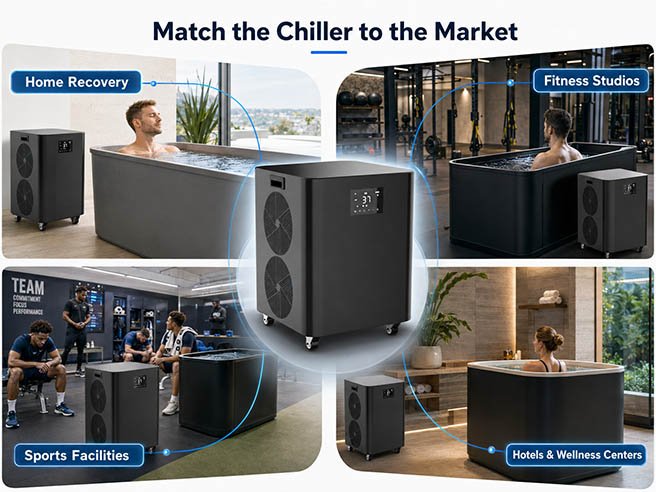
A wholesale range should reflect real applications in the distributor’s territory. More models do not automatically create more sales; they can fragment inventory and make sales training, spare-parts stocking and support more difficult.
Define the Target Application
Clarify whether the product is intended for:
- Personal home recovery
- Premium residential cold plunge systems
- Gyms and recovery studios
- Sports teams and training facilities
- Hotels, spas and wellness centers
- High-frequency multi-user installations
Each application creates different expectations for water volume, cooling pull-down time, operating hours, noise, maintenance and installation.
Match Capacity to Operating Conditions
Request performance data with the test conditions, including water volume, starting and target temperatures, ambient temperature, insulation and operating setup. A stated minimum temperature does not mean every tub can reach it in every climate.
Confirm System Compatibility
If the distributor combines a chiller with its own tub, confirm:
- Recommended water-flow range
- Pump and filter arrangement
- Connection sizes
- Hose or pipe requirements
- Ventilation clearance
- Drainage and priming procedure
- Indoor or outdoor installation limitations
- Electrical circuit requirements
The distributor should validate the complete system rather than assume that individually suitable components will automatically work well together.
Limit Unnecessary Product Variants
Begin with enough choice to serve distinct customer needs, but avoid variants that differ only slightly. A clear good-better-best or residential-commercial structure can make sales, inventory and after-sales management easier.
What Distributor Support Should Include
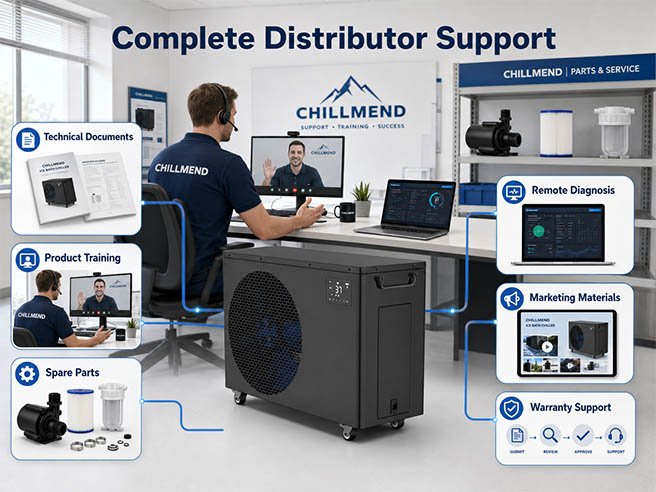
Distributor support should be defined as specific deliverables and processes. General promises such as “full support” are difficult to evaluate.
Product and Sales Documentation
The distributor may need:
- Accurate specification sheets
- Product dimensions and connection diagrams
- Installation and setup guides
- Operating and maintenance manuals
- Troubleshooting information
- Approved product images and videos
- Model comparison information
- Packaging dimensions and shipping weights
All materials should match the exact model and configuration being sold. Marketing claims should be based on documented conditions.
Technical Training
Training can cover product selection, installation, operation, routine maintenance, fault-code interpretation and basic diagnosis. The parties should agree on the format, language, responsible contacts and update process.
Spare Parts Planning
Before launch, identify:
- Recommended spare parts by model
- Parts that a distributor can replace locally
- Parts that require qualified technical service
- Suggested initial stock quantity
- Replenishment lead time
- Part numbering and compatibility
- Handling of obsolete or revised components
Filters and consumable accessories should be planned separately from warranty parts.
Warranty and Claims Procedure
A workable warranty process should state:
- Warranty period and starting point
- Covered and excluded conditions
- Evidence required for a claim
- Remote diagnosis procedure
- Responsibility for parts, labor and freight
- Handling of installation-related issues
- Escalation and response contacts
CHILLMEND provides a one-year warranty and after-sales support through its California warehouse and service point in the United States. Each distributor should confirm the applicable territory, service scope and commercial responsibilities before publishing customer-facing warranty terms.
Product Updates and Change Control
Distributors need notice of changes that could affect specifications, installation, content, spare-parts compatibility or compliance documents. Agree on how changes are approved and how older inventory will be supported.
Marketing Support
Manufacturer-provided images and technical information can accelerate a launch, but the distributor remains responsible for local positioning, claims and channel strategy. Confirm the permitted use of product images, trademarks, certification marks and performance statements.
Calculate Distributor Margin Using Total Landed Cost
Gross margin should not be calculated from the factory unit price alone.
A distributor cost model may include:
- Product and included accessories
- Branding and packaging
- Freight and insurance
- Duties, taxes and customs clearance
- Port, brokerage and inland-delivery charges
- Warehousing and inventory finance
- Inspection and quality assurance
- Marketing and channel commissions
- Installation or technical-support time
- Warranty parts, labor and shipping
- Return, damage and replacement allowance
After identifying these costs, compare them with the expected net selling price—not simply the advertised retail price.
Protect Margin Through Product Reliability
A lower purchase price can reduce margin if it produces more returns, service calls or negative reviews. Evaluate total contribution after support and warranty costs.
Protect Margin Through Better Product Selection
Stock models with distinct applications and enough demand to turn inventory. Excessive variations can trap working capital and increase the chance of obsolete packaging, parts or electrical versions.
Protect Margin Through Replenishment Planning
Balance inventory holding cost against production and transport lead time. Share realistic forecasts, define reorder points and identify components that may require longer planning.
Protect Margin Through Clear Commercial Terms
Document payment terms, quotation validity, delivery term, lead-time starting point, inspection arrangements and responsibility for changes. Unclear terms often become unplanned costs later.
How to Evaluate a Wholesale Ice Bath Chiller Supplier
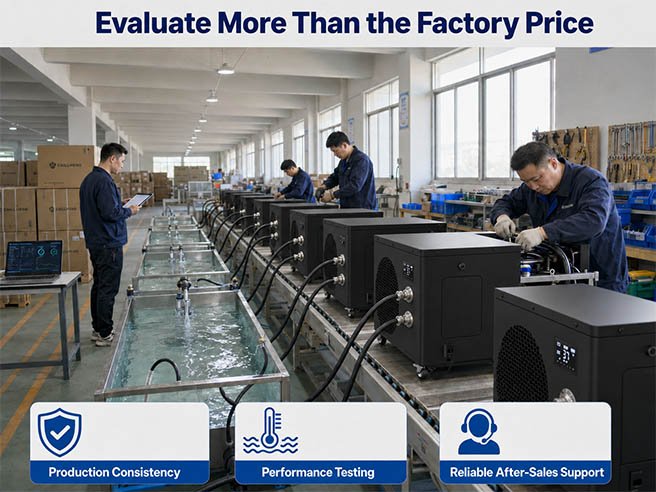
Manufacturing and Engineering Evidence
Ask for evidence relevant to the product rather than relying only on general factory claims. Review refrigeration experience, water-system knowledge, production processes, test methods and engineering support.
CHILLMEND’s manufacturing and quality-control page provides the detailed factory information that supports its wholesale and OEM programs.
Repeat-Production Consistency
Ask how the approved bill of materials and specification are controlled, how component substitutions are handled and how batches can be traced. A good first sample has limited value if later production changes without approval.
Market-Specific Configuration and Documentation
Confirm voltage, frequency, plug, rating labels and documentation for the destination market. Available certificates or test reports must correspond to the exact model and configuration.
Review the manufacturer’s certification information and request the documents relevant to the intended market. The buyer should independently confirm its importer and local compliance obligations.
Production and Supply Planning
Discuss normal lead time, peak-season capacity, long-lead components, mixed-model orders and forecasting. Capacity claims should be considered together with the supplier’s planning and communication processes.
After-Sales Capability
Evaluate who responds to technical questions, how faults are diagnosed, how parts are identified and shipped, and how feedback reaches engineering and quality teams.
Commercial Alignment
Territory protection, channel restrictions, exclusivity and annual commitments should never be assumed. If required, they need explicit written terms covering targets, duration, exceptions, review periods and termination.
Wholesale, Private Label or OEM: Which Route Fits?
Choose the cooperation model based on the current business stage.
| Route | Best suited to | Main consideration |
|---|---|---|
| Standard wholesale | Distributors validating a product range | Speed, model fit and repeat availability |
| Private label | Brands needing their own presentation | Branding scope, packaging and MOQ |
| OEM configuration | Buyers requiring defined product variations | Engineering validation and configuration control |
| ODM development | Established businesses seeking deeper differentiation | Tooling, development time and commercial commitment |
Starting with standard wholesale does not prevent deeper customization later. A staged approach can generate market evidence before the buyer invests in dedicated tooling or a proprietary design.
Buyers considering branded products can review the private label ice bath chiller guide and CHILLMEND’s OEM capabilities.
Questions to Ask a Wholesale Supplier
Before placing an order, ask:
- Which models fit our target applications, water volumes and climate?
- Under what conditions was cooling performance tested?
- Can models, colors or electrical versions be combined for pricing or MOQ?
- What is included in each quantity tier?
- Which accessories and spare parts are included or optional?
- What inspections and finished-unit tests are performed?
- Which documents apply to the exact model and destination market?
- What are the packaging dimensions, weights and transport protections?
- What is the normal production lead time, and when does it begin?
- How are component or specification changes communicated and approved?
- What technical training and documentation are provided?
- How are warranty claims diagnosed and resolved?
- What spare parts should the distributor stock locally?
- Which Incoterm, currency and payment terms apply?
- Are any territory, channel or exclusivity terms available, and under what conditions?
Written answers make supplier comparisons more accurate and reduce misunderstandings after the first order.
CHILLMEND Wholesale Support for B2B Partners
CHILLMEND supports brands, distributors and commercial recovery businesses with ice bath chiller selection, wholesale supply, private labeling and OEM production planning. The company was established in 2022, and its HVAC industry experience dates to 2010. Its manufacturing operation includes a 5,000-square-meter facility, two production lines, a 10-person research and development team, and stated annual production capacity of 10,000 units.
Support can include model selection, market-specific electrical configurations, technical documentation, branding, packaging, sample validation, production planning and after-sales coordination. The exact product scope, MOQ, pricing, documents and support responsibilities are confirmed for each distributor project.
Review the available ice bath chiller models, manufacturing process, OEM services and certification information before requesting a wholesale proposal.
Frequently Asked Questions
What is the MOQ for wholesale ice bath chillers?
MOQ depends on the model, configuration, packaging, branding and product mix. Ask whether the minimum applies per model, per electrical version or across a mixed order.
How much does a wholesale ice bath chiller cost?
Price depends on the technical configuration, quantity, included accessories, packaging, testing and delivery terms. Compare suppliers using the same specification and calculate landed and after-sales costs.
Can a distributor start with samples?
Sample availability depends on the selected model. A sample can help validate performance, installation, documentation and supplier communication before an initial wholesale order.
Can wholesale chillers carry the distributor’s brand?
Private-label options may include logos, labels, manuals and packaging. Availability, setup charges and MOQ depend on the selected platform and branding method.
What support should an ice bath chiller distributor receive?
Relevant support can include specifications, installation and maintenance documents, training, spare-parts planning, warranty procedures, approved marketing assets and production-change communication. The exact deliverables should be agreed in writing.
Can one chiller model serve home and commercial customers?
Not necessarily. Water volume, ambient temperature, usage frequency, installation and maintenance requirements can differ significantly. Select models according to defined operating conditions rather than using one description for every application.
Does a wholesale agreement include territorial exclusivity?
Exclusivity is not automatic. If offered, the agreement should define territory, channels, sales targets, duration, exceptions, review periods and termination conditions.
Request a Wholesale Ice Bath Chiller Proposal
Share your target market, customer applications, expected water volumes, climate, electrical requirements, preferred models, quantity stage, branding needs and delivery destination with CHILLMEND.
Contact CHILLMEND to request model recommendations, wholesale pricing, MOQ terms and a distributor-support proposal.
For Brands, Distributors & Commercial Buyers
If you are evaluating equipment for resale, private label or a commercial cold plunge project, compare more than cooling specifications. Review manufacturing capability, customization scope, compliance support, quality control, warranty and spare-parts availability.