
Article Summary
Importing ice bath chillers from China requires more than comparing factory prices. B2B buyers need to define the product configuration, calculate total landed and lifecycle cost, choose an appropriate Incoterm, verify customs classification, review destination-market compliance, inspect documentation and plan spare parts and after-sales support. This guide provides a practical framework for brands, distributors and commercial cold plunge businesses. It is not legal, customs or regulatory advice; requirements must be confirmed for the exact product and destination before shipment.
Quick Outline
- Define the product and destination market
- Calculate landed and lifecycle cost
- Compare EXW, FCA, FOB, CIF and DDP correctly
- Verify customs classification, valuation and origin
- Review product compliance by destination market
- Check refrigerant and wireless-module requirements
- Evaluate the manufacturer and approve a sample
- Prepare shipping and customs documents
- Inspect production and plan spare parts
- Complete a pre-shipment import checklist
Why the Factory Price Is Only the Starting Point
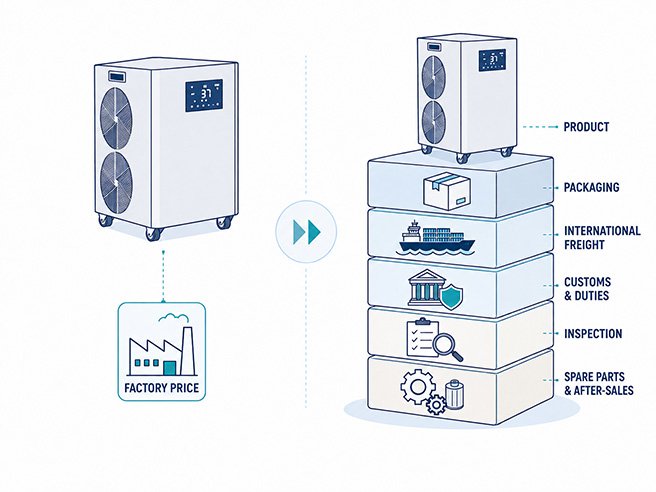
An ice bath chiller quotation may show the product price, but an importer pays for the complete journey from factory to saleable inventory.
The final economics can be affected by:
- Product configuration and included accessories
- Branding and export packaging
- China-side handling and transport
- International freight and cargo insurance
- Customs duty, taxes and clearance fees
- Destination terminal and inland-delivery charges
- Product testing and compliance work
- Inspection, warehousing and inventory finance
- Spare parts, warranty and technical support
Two suppliers can quote what appears to be the same 1 HP chiller while including different pumps, filters, hoses, electrical versions, packaging and testing. Buyers should therefore compare one approved specification and one landed-cost model—not two headline unit prices.
Step 1: Define the Product Before Requesting Freight or Compliance Advice
Customs brokers, laboratories and freight forwarders need an accurate product description. Before requesting quotations, define:
- Manufacturer and model number
- Product function and intended use
- Cooling and water-system configuration
- Refrigerant type and charge
- Voltage, frequency, plug and rated current
- Heating function, if present
- Pump, filter and sanitation equipment
- Wireless functions such as Wi-Fi or Bluetooth
- Tub or accessories included in the shipment
- Country of manufacture
- Destination country and sales channel
The exact configuration matters. Adding a radio module, changing the voltage or selling the product under the importer’s brand can alter documentation or regulatory responsibilities.
Step 2: Calculate Landed Cost and Lifecycle Cost
Landed cost is the total cost required to bring the goods to the agreed destination in a condition ready for storage, distribution or sale.
A practical estimate is:
Landed Cost = Product + Customization + Export Packaging + Origin Charges + Freight + Insurance + Duty and Taxes + Clearance + Destination Charges + Inland Delivery + Inspection and Compliance Costs
For a distributor, the calculation should go further:
Lifecycle Cost = Landed Cost + Warehousing + Financing + Warranty + Spare Parts + Returns + Technical Support + Product Disposal or Recovery Obligations
Product and Accessory Cost
Confirm whether each quoted unit includes:
- Chiller
- Pump and filter housing
- Filter cartridge
- Hoses, connectors and adapters
- Power cord
- Drainage or installation accessories
- User manual and labels
- Export or retail packaging
- Recommended spare parts
If two quotations include different systems, their prices are not directly comparable.
OEM and Private-Label Cost
Request separate prices for the standard product and for logo application, labels, manuals, branded cartons, color changes, electrical versions, sample development and any dedicated materials.
For deeper cost analysis, see OEM Ice Bath Chiller Cost: Tooling, MOQ and Bulk Pricing Explained and the Private Label Ice Bath Chiller Guide.
Packaging and Freight-Damage Allowance
Refrigeration equipment contains components and tubing that must withstand repeated handling. Review the internal protection, carton or crate specification, orientation markings, pallet plan and container-loading method.
Packaging cost should be compared with the expected cost of damage, replacement freight, customer delays and claims.
Destination and After-Sales Cost
Include customs brokerage, terminal handling, storage, demurrage risk, inland trucking, warehouse receiving, local installation support and warranty inventory. A lower factory price can disappear quickly if the product generates more damage or technical cases.
Step 3: Select and Name the Incoterm Correctly
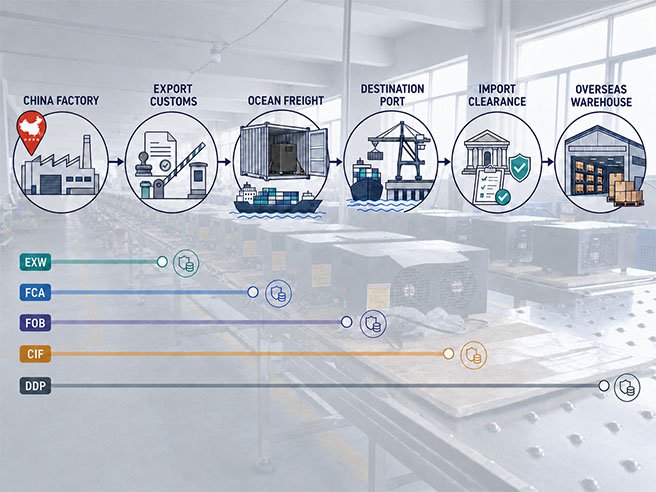
Use the rule, named place or port, and edition—for example, FCA [named place], Incoterms® 2020. The trade term allocates delivery, transport, clearance, cost and risk responsibilities; it does not determine product compliance, ownership transfer or every contract term.
The International Chamber of Commerce’s Incoterms® 2020 guidance should be used when selecting a rule.
EXW
Under EXW, the seller makes the goods available at the named place, while the buyer takes on extensive transport and clearance responsibilities. ICC guidance notes that EXW is primarily suited to domestic trade. Cross-border buyers should consider whether they can practically complete export formalities in the seller’s country.
FCA
FCA can be suitable for containerized or multimodal shipments. The seller completes export clearance and delivers the goods to the buyer’s nominated carrier at the named place. For container shipments, FCA may be more appropriate than automatically using FOB.
FOB
FOB is for sea or inland-waterway transport, with delivery and risk transfer when the goods are on board the vessel at the named port. It is not the default rule for every shipment described casually as “ocean freight.”
CIF
CIF is also a sea or inland-waterway rule. The seller arranges freight and minimum insurance cover to the named destination port, but risk transfers at shipment rather than when the goods reach the destination. Port arrival is not warehouse delivery; import clearance and destination costs normally remain with the buyer.
DDP
Under DDP, the seller carries extensive obligations, including import clearance and duties to the named destination, except unloading unless otherwise agreed. Commercial buyers should verify whether the seller can lawfully and correctly act in the destination country, who appears as importer of record, and who holds the customs and compliance documentation.
No Incoterm removes the buyer’s need to understand local product obligations.
Step 4: Build a Complete Logistics Estimate
Request these details before comparing freight:
- Product and carton dimensions
- Net and gross weight
- Units per pallet
- Pallet dimensions and weight
- Units per container
- Stackability and orientation restrictions
- Dangerous-goods or refrigerant declarations, if required
- Loading address and nearest port
A full logistics estimate may include:
- Factory pickup
- Export declaration and origin handling
- Freight and cargo insurance
- Destination terminal charges
- Customs brokerage
- Examination, inspection or storage charges
- Port or airport handling
- Demurrage or detention
- Inland delivery and unloading
- Warehouse receiving
Sample shipments by express courier, air cargo, less-than-container load and full-container shipments have different cost and risk structures. Calculate logistics per saleable unit, including an allowance for damage or non-saleable stock.
Step 5: Verify Customs Classification, Valuation and Origin
Do not treat a supplier’s HS code as a guaranteed classification for every country. The importer or its broker should classify the exact product under the destination’s tariff system.
Provide the broker with:
- Functional description
- Product specification and manual
- Component and material information
- Refrigeration and water-system details
- Photographs and diagrams
- Whether accessories are packed together
- Proposed classification and prior rulings, if any
For the United States, CBP’s Importing into the United States guide explains the importer’s reasonable-care responsibilities for classification and valuation. EU importers can review the Common Customs Tariff and use official classification resources.
Duty Is Not the Only Border Charge
Depending on the destination and current trade measures, the importer may also face import VAT or sales taxes, processing fees, trade-remedy duties or other charges. Rates can change and can depend on origin as well as classification.
Customs Value Must Be Supported
Commercial invoices and declared value should reflect the applicable customs valuation rules. Tooling, assists, royalties, packing, freight and insurance may be treated differently depending on the jurisdiction and transaction. Confirm the treatment with a licensed customs broker rather than lowering or rearranging invoice values informally.
Country-of-Origin Marking
Check the destination’s origin-marking rules and make sure the product and packaging information is consistent with the invoice and customs declaration.
Step 6: Treat Compliance as a Product-Specific Project
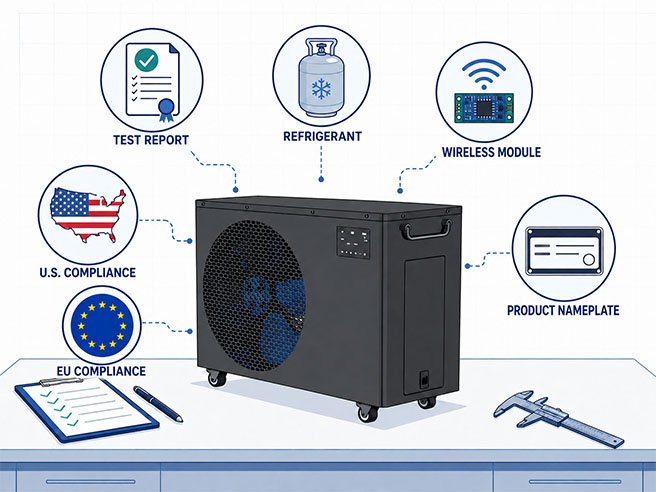
A logo on a brochure does not prove that the exact model is compliant. Before mass production, confirm:
- Which model and variants were assessed?
- Which voltage and frequency were covered?
- Which standards and legal requirements were considered?
- Who issued each report or certificate?
- Does the production bill of materials match the tested product?
- Do labels, instructions and traceability information meet local rules?
- Who is the manufacturer, importer or other responsible economic operator?
- Will branding or product modification change that legal role?
CHILLMEND’s certification information can be used as a starting point, but buyers should request model-specific documents and obtain qualified advice for their target market.
Importing Ice Bath Chillers into the United States
CE marking does not replace U.S. requirements. Depending on the configuration and use, U.S. buyers may need to examine:
- Customs classification, valuation and origin marking
- Electrical product-safety expectations of regulators, retailers, insurers or local authorities
- Power supply, cord, plug and installation requirements
- Refrigerant restrictions and servicing rules
- FCC equipment authorization for intentional radiators such as Wi-Fi or Bluetooth
- Product labels, instructions and traceability
- State-level requirements and commercial-installation codes
CBP expects importers to exercise reasonable care even when they use a broker. If the product contains a wireless transmitter, the FCC’s equipment-authorization rules should be reviewed for the exact device and module.
U.S. refrigerant rules are also evolving. EPA’s Technology Transitions program restricts specified HFC uses by sector and compliance date. Confirm how the exact equipment category, refrigerant and date are treated instead of assuming every chiller follows one general rule.
Importing Ice Bath Chillers into the European Union
An electrical chiller may fall within multiple EU rules depending on its design and functions. Possible areas include electrical safety, electromagnetic compatibility, radio equipment, hazardous substances, ecodesign or other product-specific legislation. Refrigerant and waste-related obligations may also apply.
CE marking is not a general quality certificate or an approval issued by a central EU authority. It is the manufacturer’s declaration that the product satisfies all applicable EU requirements after the proper conformity-assessment process.
The manufacturer may need to prepare technical documentation and an EU Declaration of Conformity. The EU importer must verify relevant conformity, documentation, markings, traceability and instructions before placing the product on the market. The official European Commission CE-marking guidance and EU product-compliance guidance describe these responsibilities.
Check at least:
- Exact model and electrical variants on the Declaration of Conformity
- Applicable legislation and standards
- Technical file availability
- Manufacturer and EU importer details
- Type, batch or serial identification
- Required instructions and safety information in appropriate languages
- CE mark placement and other labels
- Changes between the assessed and production configurations
If an importer sells the chiller under its own name or trademark, its obligations may be different from those of a distributor selling an unchanged manufacturer-branded product. Obtain market-specific advice.
Importing Ice Bath Chillers into Great Britain
Great Britain and Northern Ireland do not have identical product-market frameworks. For England, Scotland and Wales, check current UK product rules, the applicable conformity route, importer details, technical documentation, declaration and labeling obligations.
Current government guidance recognizes CE or UKCA routes for a range of regulated product sectors, subject to sector-specific rules. Because these arrangements can change, use the current GOV.UK guidance for placing CE- or UKCA-marked products on the GB market rather than relying on an old transition deadline.
For Northern Ireland, consult the separate applicable guidance before production.
Refrigerant Compliance Requires Separate Verification
Refrigerant type and charge can affect import, sale, servicing, labeling, transport and future product availability.
Ask the manufacturer for:
- Refrigerant designation
- Charge quantity
- Safety classification
- Global warming potential information
- Refrigeration-circuit labeling
- Service and recovery instructions
- Transport documentation where applicable
The EU’s current F-gas framework is Regulation (EU) 2024/573. Restrictions differ by equipment category, refrigerant, charge, use and date, so the importer should obtain a product-specific assessment.
In the United States, EPA rules include sector-based HFC restrictions and refrigerant-management requirements. Product import rules and technician servicing obligations are not the same question; both may need review.
Wireless Controls Can Trigger Additional Requirements
If a chiller includes Wi-Fi, Bluetooth or another radio function, request:
- Radio module manufacturer and model
- Module authorization or test documentation
- Antenna specification
- Integration instructions
- Firmware or app information
- Labels and user-manual statements
- Destination-country radio compliance evidence
Authorization of a module does not automatically prove that every final-product integration is compliant. Confirm the finished configuration with a qualified laboratory or compliance professional.
Step 7: Evaluate the Manufacturer and Approve a Sample
Review Manufacturing and Engineering Capability
Assess the supplier’s refrigeration experience, water-system knowledge, production controls, component traceability and ability to support repeat batches. Review CHILLMEND’s manufacturing and quality-control process for its factory information.
Test the Complete System
Use the intended tub, pump, filter, hoses and installation method. Test:
- Pull-down time under recorded conditions
- Temperature stability
- Water flow and leakage
- Noise in the intended environment
- Electrical configuration
- Controls and wireless functions, if included
- Filter cleaning and drainage
- Documentation and setup experience
- Packaging after transport
Do not assume a display’s minimum setting proves that every tub can achieve that temperature in every climate.
Freeze the Approved Configuration
After testing, document the model, bill of materials or controlled specification, accessories, labels, packaging, firmware and requested corrections. Require written approval for later component or document changes.
For the purchasing sequence, see Ice Bath Chiller MOQ: Sample Orders, Trial Orders and Mass Production.
Step 8: Prepare and Cross-Check Import Documents
The required package depends on the transaction and destination, but may include:
- Commercial invoice
- Packing list
- Bill of lading or air waybill
- Purchase order and sales contract
- Product and electrical specifications
- Refrigerant declaration or information
- Product labels and serial-number records
- User and installation manuals
- Test reports and certificates
- Declaration of Conformity where applicable
- Origin documentation where required
- Insurance document
- Inspection report
- Spare-parts list and warranty terms
Cross-check the model number, manufacturer name, consignee, quantities, weights, values, Incoterm, origin and product description across all documents. Resolve inconsistencies before loading or paying the balance.
Step 9: Inspect Production Before Shipment
Agree on the inspection scope before production. It may include:
- Quantity and model verification
- Appearance and workmanship
- Product and carton labels
- Electrical configuration
- Accessories and manuals
- Water-circuit leakage checks
- Functional and cooling tests
- Packaging and palletization
- Document review
Ask whether a test applies to every unit or to a sample from the batch, and define acceptance criteria. “100% tested” is not useful without knowing the test items and records.
Step 10: Plan Spare Parts and After-Sales Responsibility
A first commercial shipment should include a model-specific spare-parts plan based on the product structure and service strategy. Possible categories include filters, seals, connectors, sensors, pumps or control components, but only qualified personnel should handle parts that involve electrical or sealed-refrigeration work.
Define:
- Warranty period and start date
- Claim evidence and diagnosis process
- Responsibility for parts, labor and freight
- Parts that can be replaced locally
- Technician qualification requirements
- Replenishment lead times
- Handling of damaged shipments
- Product recall and corrective-action contacts
CHILLMEND provides a one-year warranty and after-sales support through its California warehouse and service point in the United States. Confirm the territory, covered work and responsibilities for the specific project before making promises to customers.
Ice Bath Chiller Import Checklist
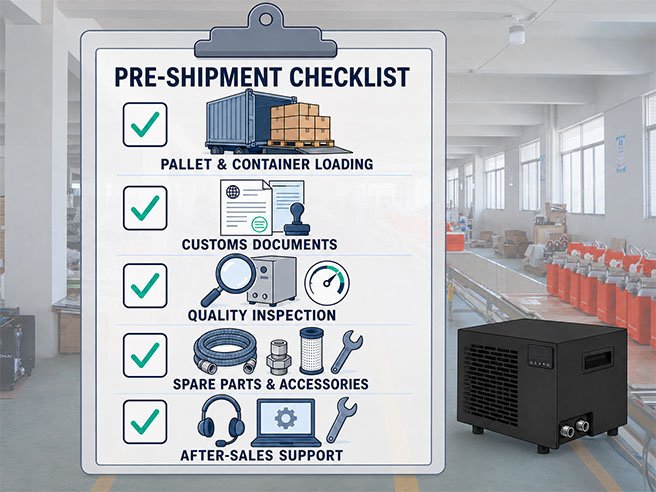
Product
- Confirm model and controlled specification
- Record water volume, target temperature and ambient conditions
- Confirm pump, filtration, connections and accessories
- Confirm dimensions, weight, refrigerant and installation limits
Electrical and Wireless
- Confirm voltage, frequency, plug and rated current
- Confirm circuit and installation requirements
- Identify every radio module and applicable authorization route
Compliance
- Identify destination-market legislation
- Verify exact model and electrical versions in documents
- Check manufacturer, importer and traceability information
- Confirm instructions, labels and language requirements
- Verify refrigerant and environmental obligations
Commercial and Customs
- Confirm quantity, price, payment and Incoterm
- Obtain a broker-reviewed classification and landed-cost estimate
- Confirm customs value, origin and required records
- Separate one-time development costs from recurring unit cost
Logistics
- Confirm carton, pallet and container-loading data
- Obtain a full origin-to-warehouse freight estimate
- Arrange cargo insurance and inspection
- Plan clearance timing, storage and inland delivery
After-Sales
- Approve warranty and claim procedures
- Order suitable spare parts
- Prepare technical training and support contacts
- Maintain model, batch and serial-number records
Working With CHILLMEND on an Import Project
CHILLMEND supports brands, distributors and commercial recovery businesses with model selection, wholesale supply, OEM configuration, documentation coordination, production planning and after-sales support. The company was established in 2022, and its HVAC industry experience dates to 2010. Its manufacturing operation includes a 5,000-square-meter facility, two production lines, a 10-person research and development team, and stated annual production capacity of 10,000 units.
Buyers can review CHILLMEND’s ice bath chiller models, OEM capabilities, manufacturing process and certification information before requesting a project-specific proposal.
The importer remains responsible for obtaining professional customs, tax, transport and compliance advice for its product and destination. CHILLMEND can supply relevant product and shipment information to support that review.
Frequently Asked Questions
How much does it cost to import an ice bath chiller from China?
The total depends on the product, quantity, packaging, freight mode, Incoterm, classification, duty, taxes, clearance, local delivery, compliance and after-sales costs. Calculate landed and lifecycle cost per saleable unit rather than comparing factory prices alone.
Which HS code should be used for an ice bath chiller?
There is no safe universal answer without examining the exact product and destination tariff. Give a customs broker the specifications, function, components and photographs and obtain a written classification recommendation or binding ruling where appropriate.
Is FOB or DDP better?
Neither is automatically better. The correct term depends on transport mode, importer capability, control of freight and customs arrangements. Use the full named place and Incoterms® 2020 edition, and verify that the responsible party can legally complete its obligations.
What certifications are required?
Requirements depend on the destination, configuration and sales channel. Electrical safety, EMC, radio, refrigerant, environmental, labeling and traceability rules may apply. Verify the exact model with qualified professionals before production.
Can CE-marked chillers be imported into the United States?
CE marking does not demonstrate compliance with U.S. requirements. The U.S. importer should separately review customs, electrical, refrigerant, wireless, marking and other applicable obligations.
Should importers order a sample first?
Yes, when available and commercially practical. A sample helps validate the product, packaging, documentation and supplier communication, but a later production batch still requires specification control and inspection.
Who is responsible when a customs broker is used?
A broker can prepare and submit entries, but using one does not eliminate the importer’s legal responsibilities. The scope differs by jurisdiction, so the importer should understand and document its obligations.
Request an Ice Bath Chiller Import Proposal
Share your destination country, business model, expected water volume, climate, electrical requirements, preferred configuration, quantity stage, branding needs and delivery location with CHILLMEND.
Contact CHILLMEND to request a model recommendation, product documentation package, commercial quotation and shipment information for your import review.
For Brands, Distributors & Commercial Buyers
If you are evaluating equipment for resale, private label or a commercial cold plunge project, compare more than cooling specifications. Review manufacturing capability, customization scope, compliance support, quality control, warranty and spare-parts availability.